
General Blog Posts
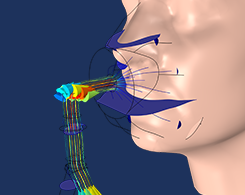
Optimizing an NIV Mask Design with Multiphysics Simulation
NIV masks offer a form of noninvasive monitoring and ventilation for COVID-19 patients, which lessens the need for ventilators and other mechanical respirators.
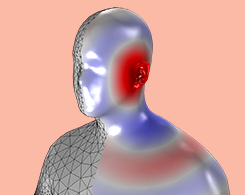
Computing the HRTF of a Scanned Geometry of a Human Head
Designing cochlear implants, hearing aids, headphones, and other audio devices requires precise measurements of the head-related transfer function (HRTF). Simulation and geometry import can help.
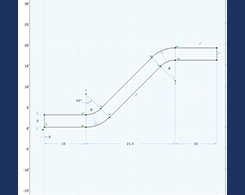
How to Use the Sketch Tools in COMSOL® to Draw 2D Geometry
Did you know that you can interactively draw and edit geometry right within the Graphics window in COMSOL Multiphysics®? Learn how to use Sketch mode with step-by-step video demonstrations.
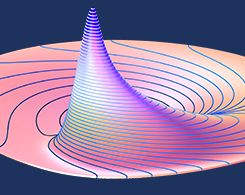
Exploiting Hardware Parallelism with COMSOL® Batch Sweeps
What is a batch sweep? How do I set up a batch sweep for my model? How much batch parallelism can COMSOL Multiphysics® exploit? We answer these questions and more…
Gaining Understanding of Complex Phenomena with Virtual Laboratories
Virtual laboratories make complex scientific phenomena accessible for students. See examples from the University of Hartford, Virginia Commonwealth University, and the University of Dayton.
How to Use State Variables in COMSOL Multiphysics®
As of COMSOL Multiphysics® version 5.5, you can use state variables to track the state of your model; affect other fields, such as material properties; and even implement hysteresis.
How to Create an App with CAD Import and Selections
What if you want to create an app with CAD import functionality and interactive selections, but you don’t know any programming? The Form Editor in the Application Builder lets you do just that.
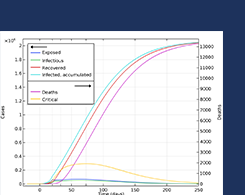
Modeling the Spread of COVID-19 with COMSOL Multiphysics®
From susceptible to exposed and infected to recovered: See how numerical modeling can help us understand the dynamics of the COVID-19 pandemic and how it spreads.
7 Reasons Why COMSOL Customers Are Using Simulation Apps
Collaboration. Quick answers. Freed up resources. See what else these seven COMSOL® users like about simulation apps.
Strategies to Counter Small Automatic Time Steps
When solving a model, you may encounter a varying time step and discretization order, or NLfail or Tfail could be greater than 0. Use these strategies to improve the efficiency of the simulation.
Material Characterization by Means of Simulation
Carbon-based materials, such as synthetic specialty graphites, are found in many industries, including solar, semiconductor, car manufacturing, ceramics, and metallurgy.

Using the Material Libraries in COMSOL Multiphysics®
The built-in material libraries are databases with materials and their associated properties, while the add-on Material Library contains material properties for more than 3800 materials.
Building Roller Chain Geometries in the Multibody Dynamics Module
You can easily set up a geometry model of a roller chain, sprocket, or roller chain sprocket assembly using the built-in parametric geometry parts in the COMSOL Multiphysics Part Library.
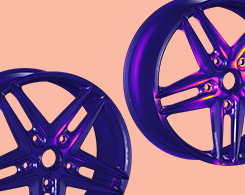
Optimizing Composite Wheel Rim Designs with COMSOL Multiphysics®
Composite wheel rims are stronger and lighter than their conventional steel and aluminum counterparts. Plus, they offer better acceleration, braking, and cornering on the road.
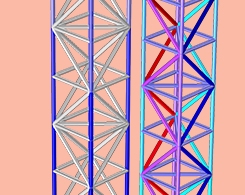
How to Perform a Sensitivity Analysis in COMSOL Multiphysics®
How do the parameters of your design affect its performance? Understanding this relationship is a valuable part of the design process. By performing a sensitivity analysis, you can do just that.
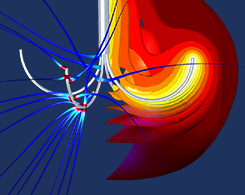
Predictive Analytics Capabilities of SmartUQ® for COMSOL®
How does COMSOL Multiphysics® fit into the predictive analytics and uncertainty quantification (UQ) workflow of SmartUQ®? Guest blogger Gavin Jones demonstrates with a microwave ablation example.
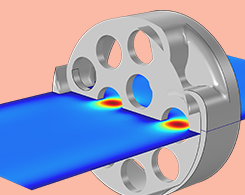
Using Transfer-Matrix Computation to Analyze Wax Guard Acoustics
The wax guard is an important part of a hearing aid, as it can improve the functionality and overall lifespan. We feature an acoustics model of a wax guard based on an actual industry example.

How to Use Topology Optimization Results as Model Geometries
Oftentimes, topology optimization is not the last step in your design process. In fact, you can use the results from a topology optimization study as model geometries for your next analysis.
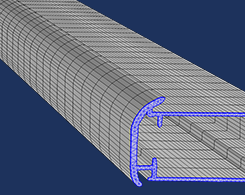
How to Use an Add-In to Convert Images to Geometry Models
Did you know that you can draw an image, import it into COMSOL Multiphysics®, and the Image to Curve add-in will create an interpolation curve from a contour plot of the image?
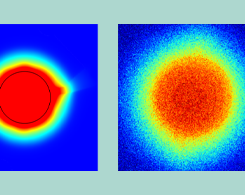
Developing a Silicon MEMS Chip for On-Demand DNA Synthesis
The development of genome editing tools like CRISPR-Cas9 has increased the demand for DNA synthesis technology. Researchers are creating a DNA synthesis platform to broaden horizons in the field.
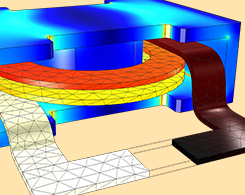
Which Study Type Should I Use for My Electrothermal Analysis?
What’s the best interface to use when implementing electrothermal analyses in COMSOL Multiphysics? We go over the interfaces, study types, and multiphysics couplings for high and low frequencies.
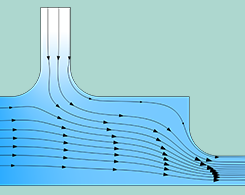
How to Simulate Control Systems Using the PID Controller Add-In
A PID controller can be used in a variety of industries. This blog post demonstrates how a PID controller add-in can be easily incorporated in two simulation examples.
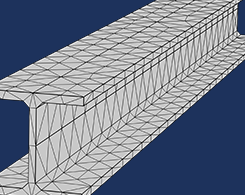
How to Customize Your Model Builder Workflow Using Add-Ins
By creating and using add-ins, as well as building your own add-in libraries or using the built-in library in COMSOL Multiphysics®, you can customize and streamline your Model Builder workflow.
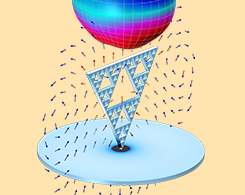
What Is the Curl Element (and Why Is It Used)?
When solving some electromagnetics problems, the curl element (also called the edge element or vector element) can be used in the finite element method.


