

MEMS microphones can be found in a wide variety of consumer products, including cellphones, laptops, and smartwatches. While these bite-sized acoustic sensors are able to process sound sources that vary greatly in tone, timbre, and application, distortion caused by wind noise has proven to be a design challenge since the beginning of this technology’s development.
Tackling the Wind-Noise Spectrum
MEMS technology boasts a high signal-to-noise ratio that makes it possible for some environmental noise to be filtered, such as the subtle hum of an HVAC system or the background chatter of an office space, but wind noise will often introduce a level of distortion that can make otherwise clear recordings unintelligible. This distortion becomes an even larger issue for electronic devices that rely on voice assistants, such as smartphones and speaker systems, as wind disruptions can cause operational problems.
In an effort to reduce this obstacle, the audio engineering team at Sonos, Inc. developed a simulation workflow for MEMS microphones to predict how cross-flow velocity shapes the wind-noise spectrum and to evaluate the efficacy of different port geometries.
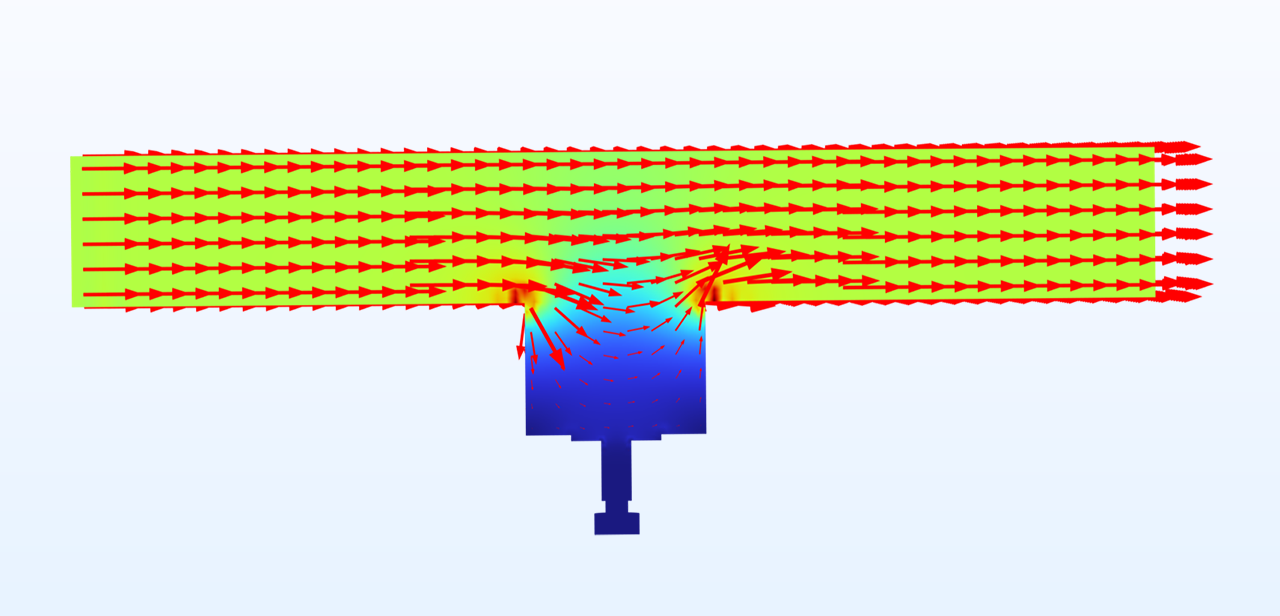 A microphone port model used to analyze the effects of wind noise.
Sonos’ Simulation Approach
A microphone converts acoustic energy into electrical signals, but in order to properly do so, the microphone diaphragm must be open enough for acoustic sound waves to reach it. The geometry of the port dictates how the microphone interacts with potential moving air around it. To observe how airflow behaves spectrally when flowing across a microphone system, the Sonos team built a microphone model in the COMSOL Multiphysics® software.
The model is composed of elements that directly affect the microphone’s acoustic performance — with the microphone itself, adhesives, and circuit board thickness remaining consistent across testing. The software’s Aeroacoustic Flow Source multiphysics coupling was used to combine fluid dynamics (using large eddy simulation, or LES) and acoustics (using pressure acoustics) analysis to compute the flow-induced noise. The model predicts the total sound pressure level and pressure spectra at the microphone diaphragm, depending on the air velocity across the microphone inlet and changes in the inlet port geometry.
The simulation consisted of wind flowing from an inlet, traveling across the microphone, and exiting through an outlet. In each test, the team changed the diameter of different cylindrical and conical microphone ports. The results suggested that the shape of the microphone port does, in fact, impact the wind noise present in the microphone cavity, although port shape does not have as large of a role in affecting wind noise performance as other factors, such as acoustic mesh. The results also proved that in an optimized design, there would be minimal pressure at the microphone and thus less wind noise captured.
Additionally, the team evaluated how the noise spectra changed with the following wind speeds:
- 2.4 m/s
- 3.0 m/s
- 4.0 m/s
- 5.0 m/s
The 2.4-m/s simulation resulted in the lowest levels, while 5.0 m/s produced the highest, as expected. The result were in good agreement with the team’s analytical scaling-law-based predictions, as the simulation successfully captured the velocity-driven shift in the corner frequencies.
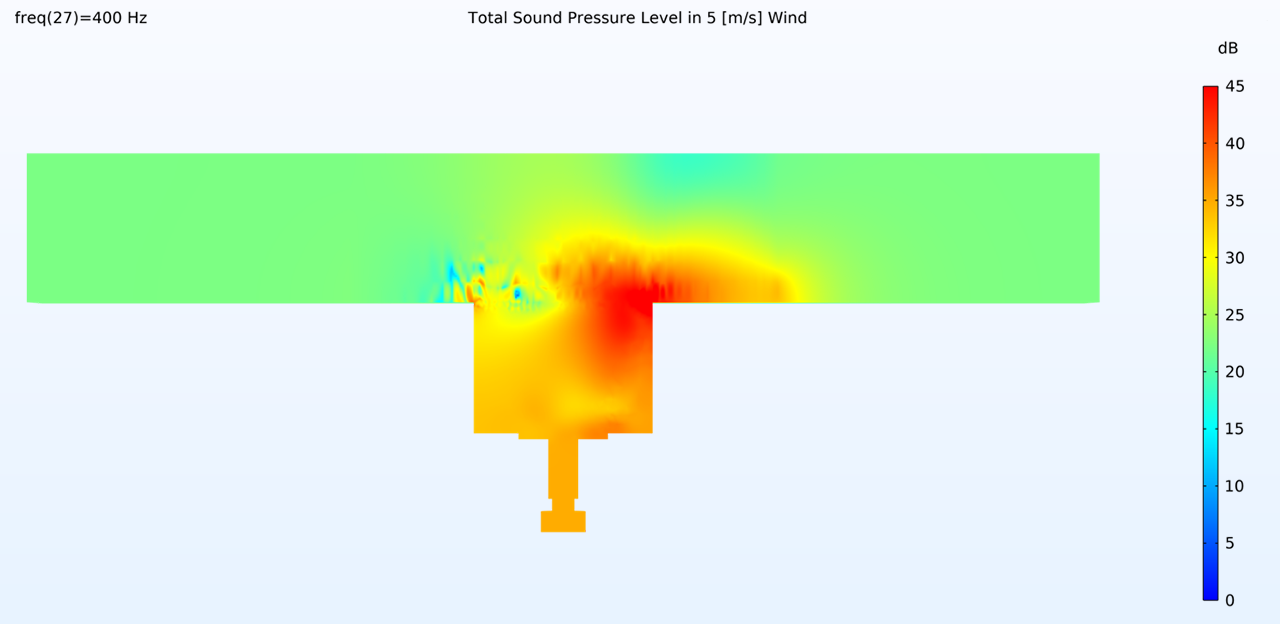 The sound pressure level of a microphone cavity when exposed to 5.0-m/s wind.
Lab Experiment Verification
Validating predicted results against real-world prototypes is a crucial step in the development process. For Sonos’ purposes, a series of physical lab experiments was conducted to confirm the modeling results.
The team produced laminar flow across the prototype ports in an effort to establish a consistent and repeatable wind flow evaluation. The microphone stackup was mounted to allow the exterior surface to be flush with a surrounding hard plane, while a singular angle of wind flow traveled perpendicular to the microphone. Multiple port geometries were tested in this setup.
Comparing the Results
The combined results from the simulations and lab experiments provided valuable insights — with both approaches confirming that wind velocity largely influences the wind-noise spectra scale. More specifically, it was confirmed that high velocities shift the shedding frequency. The agreement between the results also validates the COMSOL® model’s ability to capture the dominant physical mechanisms at play within wind-induced noise.
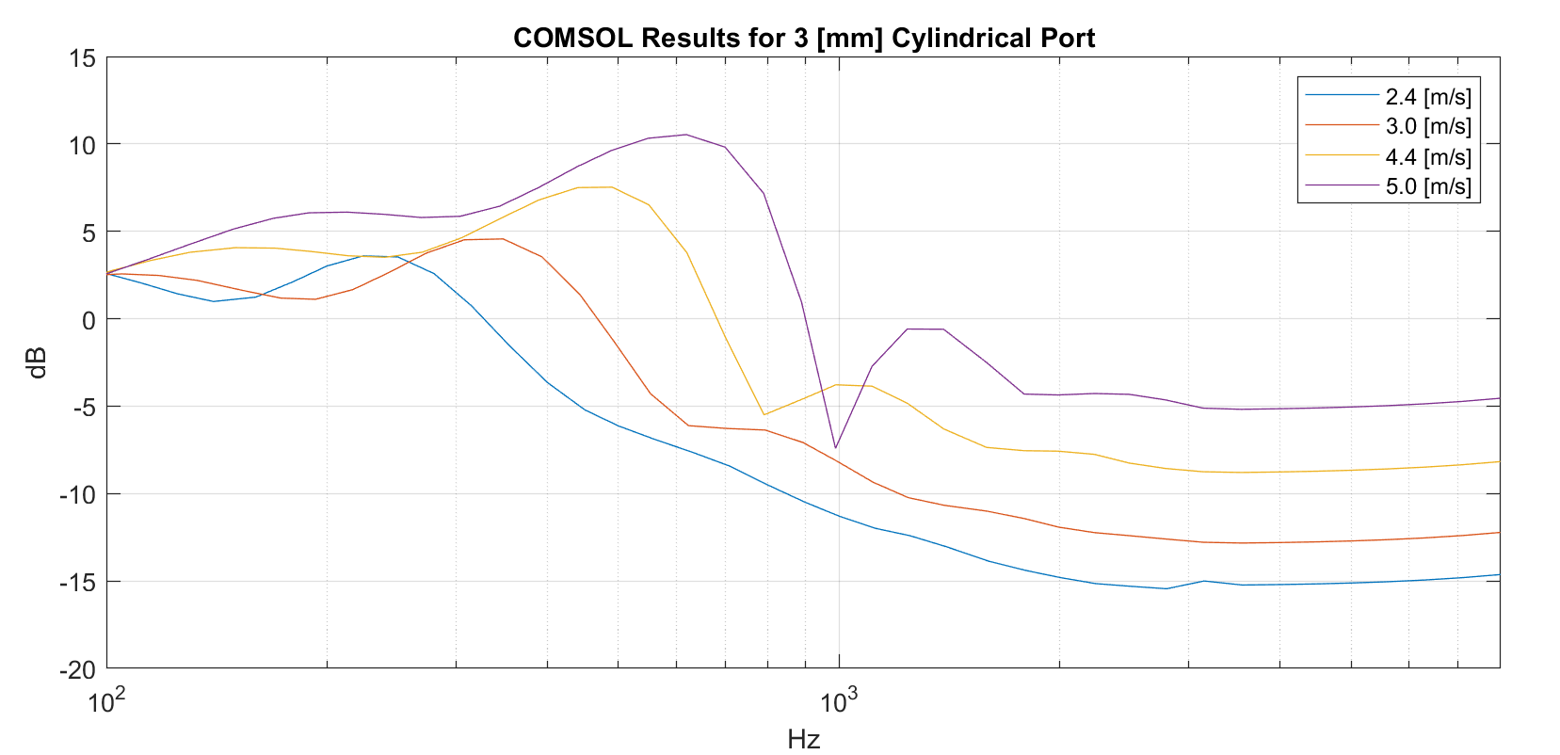
The normalized sound pressure level of four wind speeds for a cylindrical port.
However, when analyzing the effects of different port geometries, the team realized that in contrast to the simulation results, the laboratory measurements produced negligible differences across geometries under similar but not identical conditions (for example, the simulation included a slip-wall condition to simplify the modeling, whereas the lab experiment involved a no-slip condition). This disagreement shows that although the model offered a reliable representation of velocity-driven spectral trends, how the geometry influenced the aeroacoustic couplings was not fully captured. A factor that may elucidate the divergence between the model and lab results is the exclusion of an acoustic mesh over the microphone port in the COMSOL® model. Incorporating an acoustic mesh was found to substantially reduce wind-induced fluctuations in real-world systems, suggesting that modeling acoustic mesh could be an essential addition in future studies to improve predictive accuracy between model and experiment.
Ultimately, the audio engineers at Sonos concluded that the modeling framework is beneficial for early guidance in the design of MEMS microphones, can help with identifying worst-case scenarios, and can reduce the need for costly prototyping. Along with the study providing insight into the relationship between flow velocity and wind-noise spectra, it also offered a salient example of the importance of validating modeling results and modeling assumptions.
Further Learning
For more information on this work, read the Sonos team’s full paper, which won a Best Paper award at the COMSOL Conference 2025 Boston! The paper outlines the team’s modeling approach and results.
To get hands-on experience with modeling cavity flow noise in COMSOL Multiphysics®, check out the Cavity Flow Noise tutorial model in the Application Gallery. Want to share your work at the next COMSOL Conference? Learn more on our COMSOL Conference 2026 landing page.




Comments (0)