
The Application Gallery features COMSOL Multiphysics® tutorial and demo app files pertinent to the electrical, structural, acoustics, fluid, heat, and chemical disciplines. You can use these examples as a starting point for your own simulation work by downloading the tutorial model or demo app file and its accompanying instructions.
Search for tutorials and apps relevant to your area of expertise via the Quick Search feature. Note that many of the examples featured here can also be accessed via the Application Libraries that are built into the COMSOL Multiphysics® software and available from the File menu.
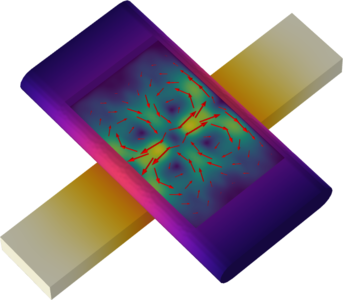
A 3D model of an acoustic trap in a glass capillary actuated by a piezoelectric transducer. The system is actuated by an oscillating electric potential across the piezoelectric transducer inducing mechanical vibrations in the solid and an acoustic pressure field in the fluid. The heat ... Read More
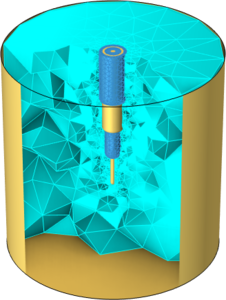
This model compares the results of five different formulations and approaches to solving an RF heating problem consisting of a coaxial cable inserted into a sample of lossy dielectric material. Results show that the different formulations agree over a wide frequency band. To learn more ... Read More

Not all analysis projects start with a CAD model. Sometimes the only data you have available is a set of points, also known as a point cloud. The examples files available here illustrate how point cloud data can be converted to geometry models that can be used for simulation in the ... Read More
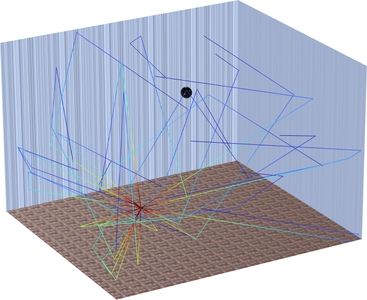
This model shows one approach for obtaining a broadband impulse response by combining ray-tracing and finite element methods. The combination is done all within COMSOL® and uses idealized filters. In this example, the simulation results are further compared to an analytical solution ... Read More
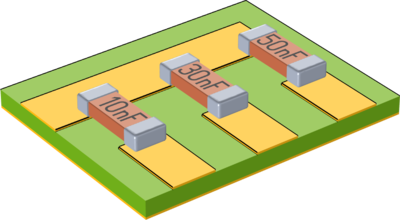
These models demonstrate the usage of the user defined lumped port and lumped elements to introduce excitations and lumped circuit elements between volumetric conductors. Additional models show how to use impedance and transition boundary conditions to model the conductors, instead of ... Read More
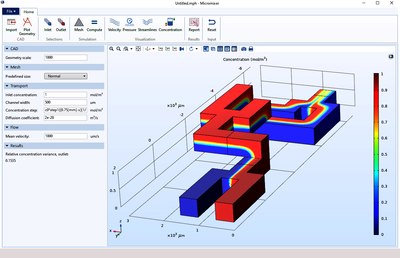
This app simulates a micromixer based on an imported CAD geometry. The app shows how you can use the Application Builder to build an app that can handle CAD import and let the user interactively select boundary conditions. The app shows how this can be done without any programming using ... Read More
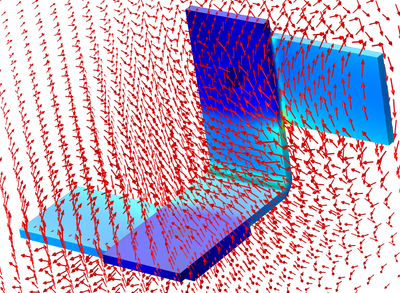
This is a busbar configuration with an AC analysis. The configuration is similar to the introductory tutorial in the book Introduction to COMSOL Multiphysics. However, two conductors are added to represent a more realistic case of magnetic fields surrounding the busbar. The results ... Read More
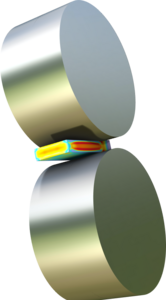
Roll forming processes are widely used in metal processing, battery electrode production and manufacturing processes. The model demonstrates the process of roll forming, where a workpiece is pressed after passing through a pair of rollers. The workpiece is carried between rollers by ... Read More

In COMSOL Multiphysics®, you can easily define moving loads and constraints. These three models demonstrate three different approaches for modeling moving loads in the COMSOL® software, including: A user-defined expression A text file of positions over time An imported ... Read More
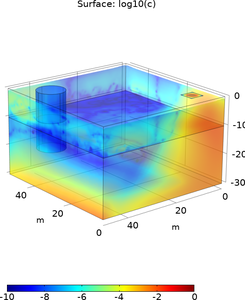
A simple model for groundwater contamination portrays a well that is bored into an aquifer. The aquifer consists of a partially saturated layer and a fully saturated layer. The model investigates how much of the contaminant ends up in the well after a contaminant is introduced in the ... Read More


