
The Application Gallery features COMSOL Multiphysics® tutorial and demo app files pertinent to the electrical, structural, acoustics, fluid, heat, and chemical disciplines. You can use these examples as a starting point for your own simulation work by downloading the tutorial model or demo app file and its accompanying instructions.
Search for tutorials and apps relevant to your area of expertise via the Quick Search feature. Note that many of the examples featured here can also be accessed via the Application Libraries that are built into the COMSOL Multiphysics® software and available from the File menu.

In this model the high speed turbulent gas flow in a converging and diverging nozzle is modeled using the High Mach Number Flow interface. The diffuser is transonic in the sense that the flow at the inlet is subsonic, but due to the contraction and the low outlet pressure, the flow ... Read More
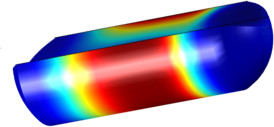
This example describes the operation of a drug delivery system that supplies a variable concentration of a water soluble drug. A droplet with a fixed volume of water travels down a capillary tube at a constant velocity. Part of the capillary wall consists of a permeable membrane ... Read More
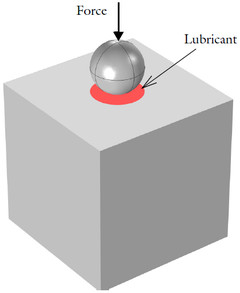
This benchmark model computes the transient pressure distribution and film height in a squeeze film bearing for lubrication in a nonconformal conjunction of a solid sphere and an elastic wall separated by a lubricant film. This model solves the benchmark case of hydrodynamic interaction ... Read More
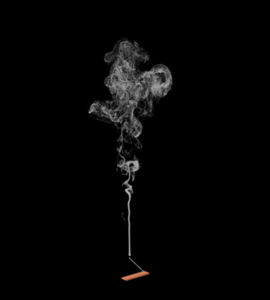
This example considers the natural convection of air above a smoldering incense stick. This kind of flow often shows a transition from laminar to turbulent which is nicely visualized by the smoke produced by the slow burning of the incense. The model uses the Nonisothermal Flow, LES RBVM ... Read More

Chemical mechanical polishing (CMP) is a crucial technique for surface planarization, widely used in semiconductor fabrication and optical device manufacturing. This model approximates the flow field of the slurry using a turbulent single-phase flow model. The Frozen Rotor approach is ... Read More
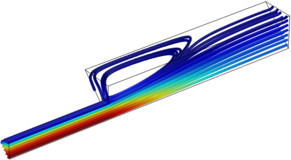
This tutorial model solves the incompressible Navier-Stokes equations in a backstep geometry using the Laminar Flow interface. A characteristic feature of fluid flow in geometries of this kind is the recirculation region that forms where the flow exits the narrow inlet region. The model ... Read More
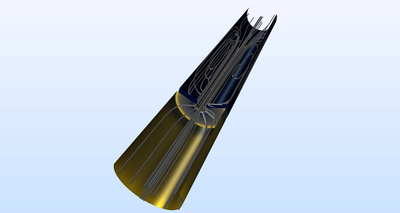
This example considers the turbulent flow of an oil-water suspension through an orifice. The oil droplets are broken up into smaller droplets by the turbulent stresses as the suspension passes through the orifice. The aim of this model is to track the distribution of droplet sizes. The ... Read More
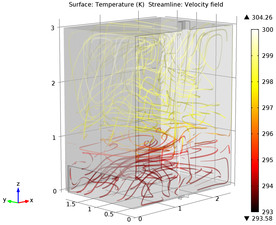
In general, there are two classes of ventilation: mixing ventilation and displacement ventilation. In displacement ventilation, air enters a room at the floor level and displaces warmer air to achieve the desired temperature. Heating sources in the room can include running electronic ... Read More


