
The Application Gallery features COMSOL Multiphysics® tutorial and demo app files pertinent to the electrical, structural, acoustics, fluid, heat, and chemical disciplines. You can use these examples as a starting point for your own simulation work by downloading the tutorial model or demo app file and its accompanying instructions.
Search for tutorials and apps relevant to your area of expertise via the Quick Search feature. Note that many of the examples featured here can also be accessed via the Application Libraries that are built into the COMSOL Multiphysics® software and available from the File menu.
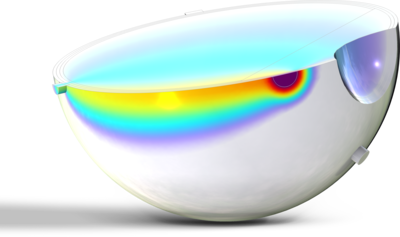
When evaluating the efficacy of treatments for ocular diseases, modeling and simulation can be used for pharmacokinetic analysis by visualizing drug concentration and how it spreads through the eye over time. In this simplified pharmacokinetic model of a human eye, a small patch is ... Read More
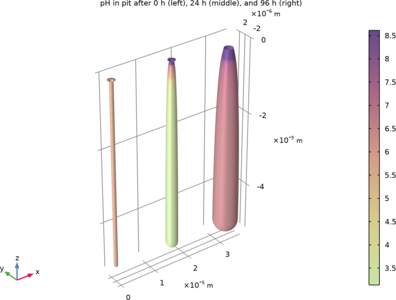
Pitting corrosion is localized corrosion by which local cavities, pits, are formed on a seemingly initially smooth metal surface. A pit may be initiated due to small surface defects, such as inhomogeneities in composition or shape, or from mechanical abuse. How and if the pit grows ... Read More
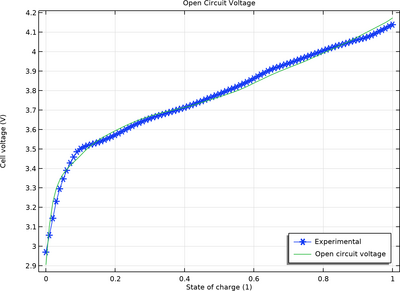
This application performs parameter estimation (fitting) of the active lithiation windows of the negative and positive electrode materials of a lithium-ion battery, based on a experimental open-circuit voltage (OCV) curve measured as a function of the cell state of charge (SOC). Once a ... Read More
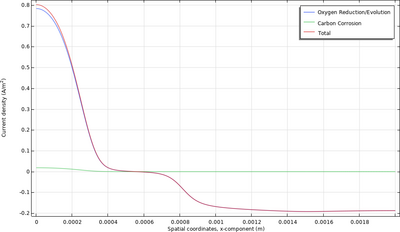
Carbon corrosion is one of the important degradation mechanisms in a Polymer Electrolyte Membrane (PEM) fuel cells which predominantly occurs during start-up or shut down of the fuel cells. During carbon corrosion, carbon support to catalysts is compromised affecting the cell ... Read More

This application uses the shrinking core model to study the reduction of iron ore pellets. A 1D model of a packed bed containing iron ore pellets is modeled. The bed filling pellets initially consists of solid phase FeO. The pellets are reduced by CO, and the solid core shrinks leaving a ... Read More
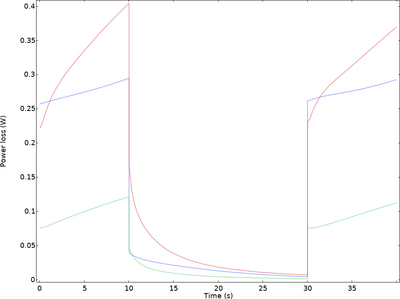
This example computes the power losses in a lithium-ion battery when exposed to high current pulses in a hybrid pulse power characterization (HPPC) test. Power loss contributions stemming from different phenomena are analyzed, as well as the total power losses pertaining to the ... Read More
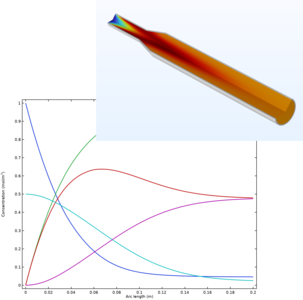
Tutorial model investigating a set of two competing reactions. The model demonstrates the natural modeling strategy for reaction engineering in COMSOL Multiphysics®. That is, how to go from chemical equations to space-dependent models of reacting flow with a minimum of work. Read More

The electrodes of a lithium-ion battery are porous, consisting of an active solid material, a binder, and pores filled with liquid electrolyte. If a force is applied on the porous layers of a battery, this will affect the volume fraction of the electrolyte-filled pores in the electrodes, ... Read More

This tutorial uses an equivalent circuit approach for modeling the performance of a lithium-ion battery, requiring no knowledge about the internal chemistry or structure of the battery. A 0D equivalent circuit battery model is defined based on a resistor connected in series with a ... Read More
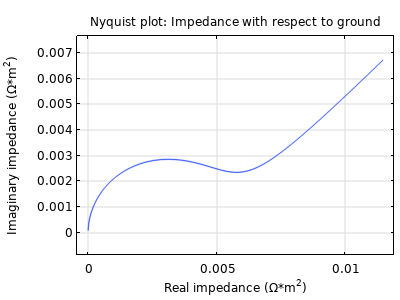
The purpose of this app is to understand EIS, Nyquist, and Bode plots. The app lets you vary the bulk concentration, diffusion coefficient, exchange current density, double layer capacitance, and the maximum and minimum frequency. Electrochemical impedance spectroscopy (EIS) is a common ... Read More


