
The Application Gallery features COMSOL Multiphysics® tutorial and demo app files pertinent to the electrical, structural, acoustics, fluid, heat, and chemical disciplines. You can use these examples as a starting point for your own simulation work by downloading the tutorial model or demo app file and its accompanying instructions.
Search for tutorials and apps relevant to your area of expertise via the Quick Search feature. Note that many of the examples featured here can also be accessed via the Application Libraries that are built into the COMSOL Multiphysics® software and available from the File menu.
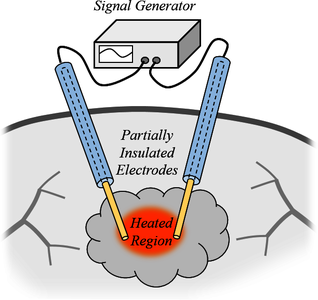
This example shows how to model tissue ablation through applying RF radiation. A more detailed description of the phenomenon and the modeling process can be seen in the blog post "Study Radiofrequency Tissue Ablation Using Simulation". Read More
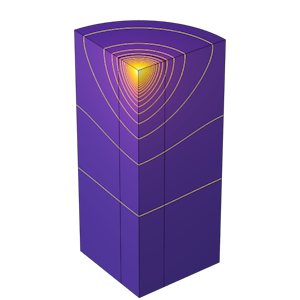
This tutorial shows how to use the Radiative Beam in Absorbing Media interface (Heat Transfer Module) to model the attenuation of a laser light going through a sample of silica glass, and the heat source generated by the absorption. Read More

This model presents the flow noise generated by flow past the so-called tandem cylinder configuration. The test is part of the “First Workshop on Benchmark problems for Airframe Noise Computations”. The tutorial model shows the steps involved in a flow-induced noise simulation in COMSOL ... Read More
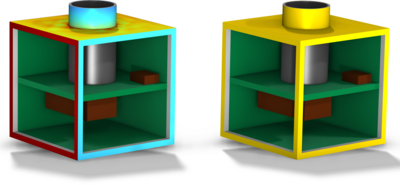
This model aims to demonstrate how a multilayer insulation can affect the temperature distribution of a satellite orbiting around the Earth. It is based on the Spacecraft Thermal Analysis model available in the Application Library. Read More

This model presents a way to compute projected area using the Surface-to-Surface Radiation interface of the Heat Transfer Module. By computing illuminated area from a set of directions on a discretized sphere, it is possible to interpolate the projected area onto any angle of incidence. ... Read More
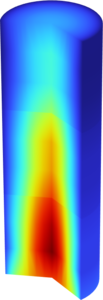
This model simulates a cylindrical furnace with isotropic scattering. It validates the use of the Discrete Ordinates Method for 2D axisymmetric cases, comparing the results with the highly accurate Monte Carlo method. The setup and reference Monte Carlo values are given in: R .P. Gupta, ... Read More
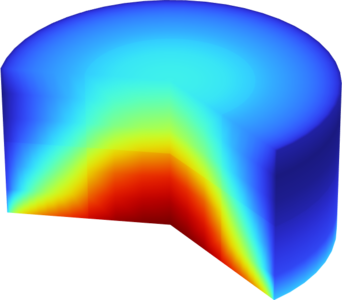
This model simulates a cylindrical furnace with isotropic scattering. It validates the use of the Discrete Ordinates Method for 2D axisymmetric cases, comparing the results with the highly accurate Monte Carlo method. The setup and reference Monte Carlo values are given in: R .P. Gupta, ... Read More
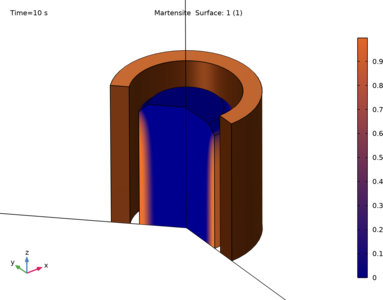
This example shows how to model induction hardening of a small steel pin. The ferritic-pearlitic pin is induction heated using a coil with a high frequency alternating current. The surface of the pin is thereby austenitized, and the pin is then water cooled to produce a hard, martensitic ... Read More
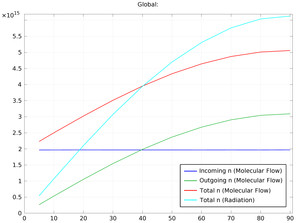
This model computes the particle flux, number density and pressure on the surface of a plate that rotates in a highly directional molecular flow. The results obtained are compared with those from other, approximate, techniques for computing molecular flows. Read More
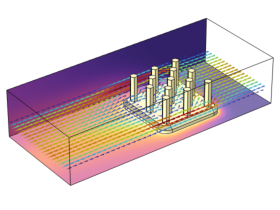
This model is intended as a first introduction to simulations of fluid flow and conjugate heat transfer. It shows you how to: Draw an air box around a device in order to model convective cooling in this box, set a total heat flux on a boundary using automatic area computation, and ... Read More


