
The Application Gallery features COMSOL Multiphysics® tutorial and demo app files pertinent to the electrical, structural, acoustics, fluid, heat, and chemical disciplines. You can use these examples as a starting point for your own simulation work by downloading the tutorial model or demo app file and its accompanying instructions.
Search for tutorials and apps relevant to your area of expertise via the Quick Search feature. Note that many of the examples featured here can also be accessed via the Application Libraries that are built into the COMSOL Multiphysics® software and available from the File menu.
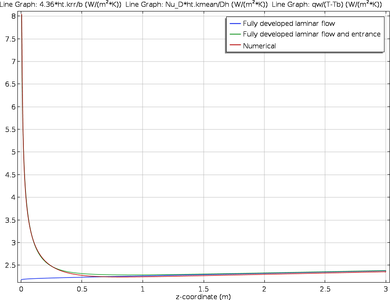
This verification model of nonisothermal laminar flow through a circular tube compares the heat transfer coefficient obtained from simulation with theoretical values based on Nusselt number correlation functions that can be found in the literature. Read More
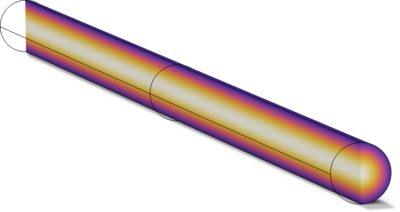
This tutorial model illustrates the use of the nucleate boiling heat flux features to compute the transient cooling of a cylindrical rod plated with nickel, and immersed in a pool of boiling water. The temperature and heat flux results obtained with a 3D time-dependent computation, with ... Read More

Basin-type insulators are essential components in Gas-Insulated Metal-Enclosed Switchgear (GIS). During manufacturing, the epoxy resin curing process can generate residual stresses that may lead to crack formation. Over time, such cracks can trigger partial discharges, degrading the ... Read More

This tutorial illustrates the use of the connecting features in the Heat Transfer in Solids and Heat Transfer in Shells interfaces, to couple them to a Lumped Thermal System interface. The results obtained with the solid and shell models are compared. Read More
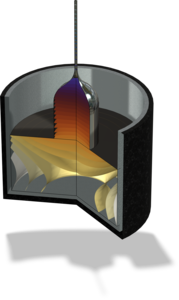
The Czochralski (CZ) method is one of the most important methods for the preparation of monocrystalline silicon. The shape of the crystal, especially the diameter, is controlled by carefully adjusting the heating power, the pulling rate, and the rotation rate of the crystal. This model ... Read More
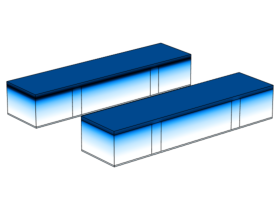
This tutorial model compares the results between a domain approach and the Thin Moisture Barrier feature to simulate the moisture transport in a wall with a vapor barrier. The Thin Moisture Barrier feature neglects diffusion, two studies are proposed, a first one where diffusion is ... Read More
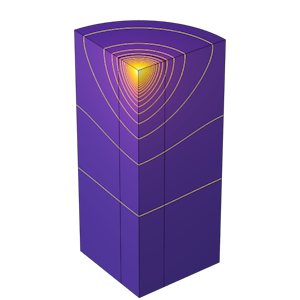
This tutorial shows how to use the Radiative Beam in Absorbing Media interface (Heat Transfer Module) to model the attenuation of a laser light going through a sample of silica glass, and the heat source generated by the absorption. Read More
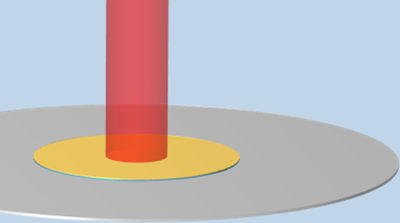
The following model demonstrates the usage of the Radiative Beam in Absorbing Media interface for computing the heating of semitransparent materials. Specifically, the model analyzes how a Gaussian profile laser beam heats two different semitransparent materials deposited onto a silicon ... Read More

This model evaluates the temperature distribution in 3 buried cables in a situation where the soil surface temperature is known. The temperature profile obtained with a thermal circuit approach for the cables is compared with a FEM approach. The thermal circuit properties are established ... Read More
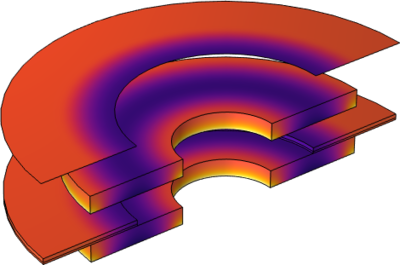
This tutorial model demonstrates the use of the multiphysics coupling feature Thermal Connection, Layered Shell, Surfaces. In this model, one layered shell is connected to heat domains by a facing boundary. The results obtained with the Heat Transfer in Shells interface are compared with ... Read More


