
The Application Gallery features COMSOL Multiphysics® tutorial and demo app files pertinent to the electrical, structural, acoustics, fluid, heat, and chemical disciplines. You can use these examples as a starting point for your own simulation work by downloading the tutorial model or demo app file and its accompanying instructions.
Search for tutorials and apps relevant to your area of expertise via the Quick Search feature. Note that many of the examples featured here can also be accessed via the Application Libraries that are built into the COMSOL Multiphysics® software and available from the File menu.

This example demonstrates how modeling can be used to investigate the performance of different hydrodynamic journal bearings. The model uses the Hydrodynamic Bearing interface, which solves the Reynolds equation to compute the pressure developed in a thin fluid film for four bearing ... Read More
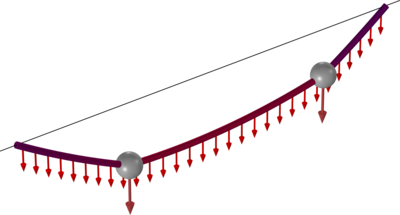
A cable is a structural member which has stiffness only in its tangential direction, but virtually no bending stiffness. When supported only at its two ends it deflects under gravitational load forming a curve known as catenary. This example shows how to model components such as cables, ... Read More
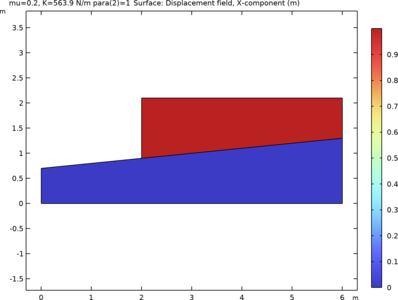
A contactor wedge is subject to a gravity load and is forced to slide due to a boundary load over a rigid target wedge surface, both infinitely wide. Horizontal linear springs are also connected between the left vertical boundary and the ground. This is a large sliding problem including ... Read More
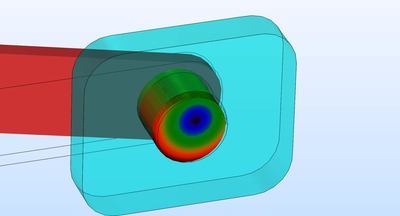
Clearance between connected components is often introduced to facilitate assembly and allow relative motion. However, clearance in joints can generate impact forces that adversely affect system performance and lead to noise and vibration. This model compares the dynamic behavior of a ... Read More
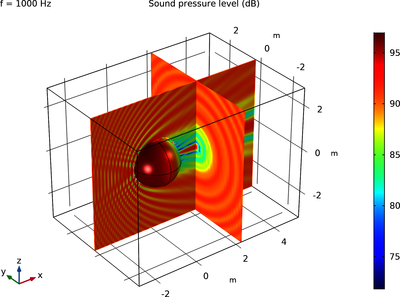
In this classical benchmark model, a spherical scatterer is placed in a plane wave background field. When the sphere is modeled as sound hard, the problem has an analytical solution. The model compares the results using the Pressure Acoustics, Boundary Elements interface with the ... Read More

This tutorial model shows how to model car cabin acoustics using a hybrid FEM-ray approach. The particular example is that of a tweeter located in the dashboard of the car near the windscreen. A FEM based sub-model of the speaker and its immediate surroundings is used to compute a ... Read More
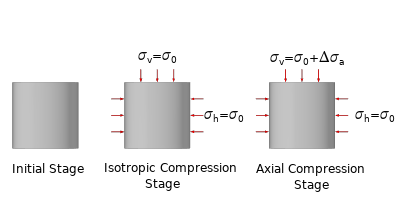
In this example, monotonic and cyclic triaxial tests are simulated using the Hardening Soil Small Strain material model. The model captures the effects of small strain stiffness and hysteresis under cyclic loading. The stress-strain relationship matches the hyperbolic curve reported in ... Read More
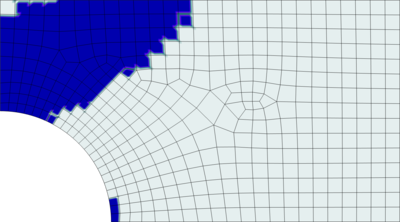
This example shows the analysis of a perforated plate loaded into the plastic regime. The purpose of the analysis is to demonstrate how plastic strains can be mapped between dissimilar meshes. Read More


