
The Application Gallery features COMSOL Multiphysics® tutorial and demo app files pertinent to the electrical, structural, acoustics, fluid, heat, and chemical disciplines. You can use these examples as a starting point for your own simulation work by downloading the tutorial model or demo app file and its accompanying instructions.
Search for tutorials and apps relevant to your area of expertise via the Quick Search feature. Note that many of the examples featured here can also be accessed via the Application Libraries that are built into the COMSOL Multiphysics® software and available from the File menu.
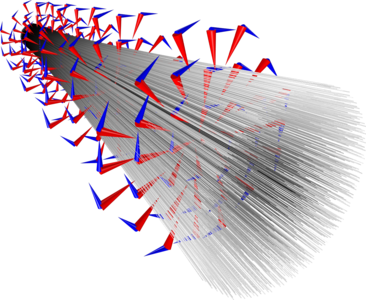
When modeling the propagation of charged particle beams at high currents and relativistic speeds, the space charge and beam current create significant electric and magnetic forces that tend to expand and focus the beam, respectively. The Charged Particle Tracing interface uses an ... Read More
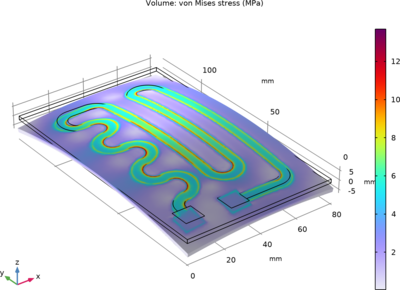
Small heating circuits find use in many applications. For example, in manufacturing processes, they heat up reactive fluids. The device in this tutorial example consists of an electrically resistive layer deposited on a glass plate. The layer results in Joule heating when a voltage is ... Read More
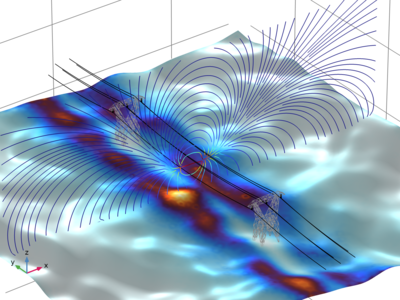
Power lines are commonly used as a means of transmitting electrical power across large distances. In this tutorial, towers transmitting high voltage three-phase AC power are modeled, and the resulting electric field is computed. The towers have two shielding lines. The model also ... Read More
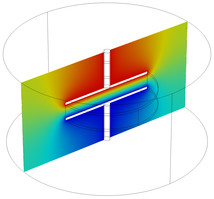
A capacitor with an applied sinusoidally time-varying voltage difference is modeled. A wide frequency range is considered and the impedance of the device is computed. Solver accuracy is addressed. The relationship between the frequency domain impedance and the steady-state capacitance ... Read More
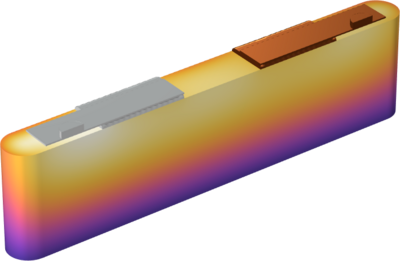
This model exemplifies how to compute the internal temperature distribution in a prismatic battery during a high-rate charge. The electrochemistry is described by a a lumped two-electrode model, which is coupled to the heat transfer model. The heat transfer model includes the effects of ... Read More
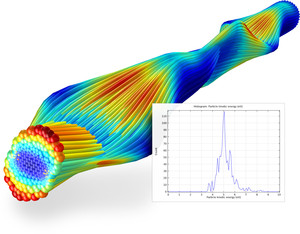
The principle component of a quadrupole mass spectrometer is the mass filter which is used to filter ions with different charge to mass ratios. The quadrupole mass filter has been well studied over the years, Ref. 1 and the physics and optimal design are well understood. In a real ... Read More
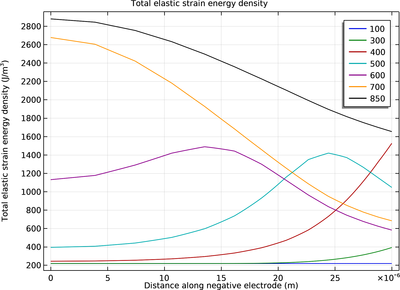
Diffusion-induced stress in lithium-ion battery electrode materials can occur as a result of compositional inhomogeneities during lithium intercalation in the host material particles. These stresses are important since the electrode host material can undergo significant volume changes ... Read More
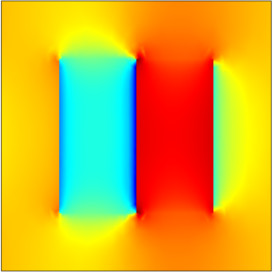
Magnetotellurics is a method for estimating the resistivity profile of the Earth's subsurface using the natural electromagnetic source provided by the ionosphere. This model was defined by Zhdanov et al. in a study published in 1997. In this article, various scientific groups compared ... Read More
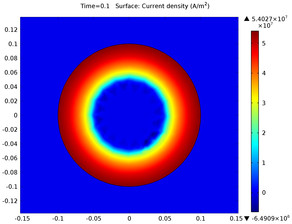
Superconducting materials have zero resistivity up to a certain critical current density, above which the resistivity increases rapidly. To model such a material, this example uses the Magnetic Field Formulation physics interface. The model was based on a suggestion by Dr. Roberto ... Read More
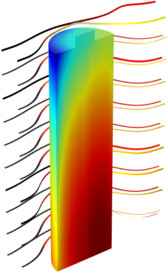
This example simulates the heat profile in an air-cooled cylindrical battery in 3d. The battery is placed in a matrix in a battery pack. The thermal model is coupled to a 1d-battery model that is used to generate a heat source in the active battery material. The model requires the ... Read More


