
The Application Gallery features COMSOL Multiphysics® tutorial and demo app files pertinent to the electrical, structural, acoustics, fluid, heat, and chemical disciplines. You can use these examples as a starting point for your own simulation work by downloading the tutorial model or demo app file and its accompanying instructions.
Search for tutorials and apps relevant to your area of expertise via the Quick Search feature. Note that many of the examples featured here can also be accessed via the Application Libraries that are built into the COMSOL Multiphysics® software and available from the File menu.

This model shows how to use the scattered field formulation to compute the transmission coefficient for impinging P and S plane elastic waves onto a finite size phononic crystal. The transmission tends to zero in the frequency range corresponding to P- and S-wave band gaps, as ... Read More

This example builds surrogate models with deep neural network (DNN) training to quickly estimate the performance of a microstrip patch antenna based on four design parameters: patch length, tuning stub length, dielectric constant of a substrate, and frequency. The model also simulates a ... Read More
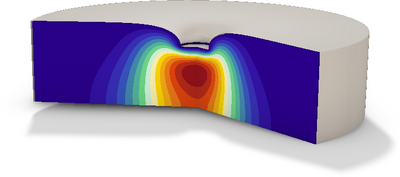
This example demonstrates how to use the Poroelasticity multiphysics coupling between the Solid Mechanics and Darcy's Law interfaces to model linear biphasic poroviscoelastic behavior of soft biological tissues. The implementation is verified using two numerical benchmarks from the ... Read More
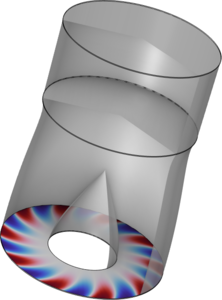
The acoustic field in a model of an axially symmetric lined aero-engine duct, based on modal sound transmission, is analyzed. The source is generated by a single mode excitation at a boundary. Sources and nonreflecting conditions are applied using port boundary conditions. The model ... Read More
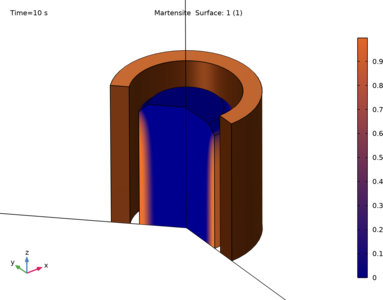
This example shows how to model induction hardening of a small steel pin. The ferritic-pearlitic pin is induction heated using a coil with a high frequency alternating current. The surface of the pin is thereby austenitized, and the pin is then water cooled to produce a hard, martensitic ... Read More
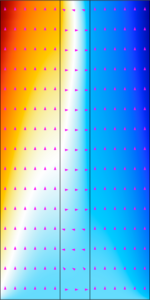
This tutorial demonstrates how to modify a concentration-independent (also known as a secondary current distribution) liquid alkaline water electrolyzer with concentrated electrolyte theory to explicitly resolve local electrolyte and solvent concentrations (thereby creating a tertiary ... Read More

The Turbulent flow, Elliptic Blending R-ε interface is used to analyze fully developed turbulent flow in a spanwise rotating channel. Due to the influence of the Coriolis force on turbulence, profiles of the flow variables are skewed at moderate rotation rates. An asymmetry between the ... Read More

This example illustrates a linear buckling analysis conducted for a corrugated conical shell, utilizing a single sector of the geometry along with cyclic symmetry periodicity edge conditions. The results are compared to those using the full shell geometry. Read More
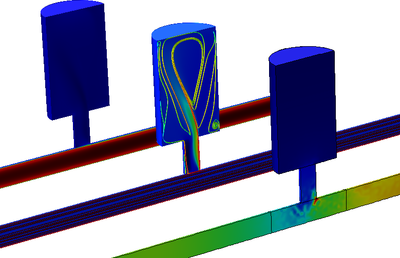
Helmholtz resonators are used in exhaust systems, as they can attenuate a specific narrow frequency band. The presence of a flow in the system alters the acoustic properties of the resonator and the transmission loss of the subsystem. In this tutorial model, a Helmholtz resonator is ... Read More
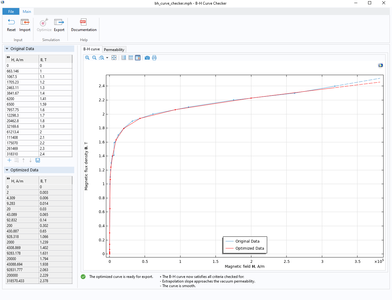
This app demonstrates the following: Importing measured data from a text file Handling measured data using methods Exporting the results to a text file. The app can be used to verify and optimize B–H curves using experimental data. It also generates curve data in the over-fluxed ... Read More


