
The Application Gallery features COMSOL Multiphysics® tutorial and demo app files pertinent to the electrical, structural, acoustics, fluid, heat, and chemical disciplines. You can use these examples as a starting point for your own simulation work by downloading the tutorial model or demo app file and its accompanying instructions.
Search for tutorials and apps relevant to your area of expertise via the Quick Search feature. Note that many of the examples featured here can also be accessed via the Application Libraries that are built into the COMSOL Multiphysics® software and available from the File menu.
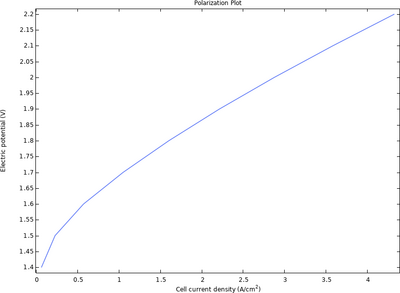
In a polymer electrolyte membrane water electrolyzer cell, hydrogen and oxygen gas is produced by electrolysis. The hydrogen and oxygen compartments are separated by a polymer membrane, that also acts as electrolyte. This introductory tutorial computes the ohmic and activation losses in ... Read More
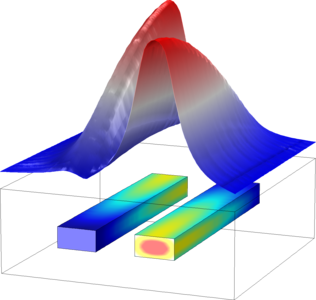
Two embedded optical waveguides in close proximity form a directional coupler. The cladding material is GaAs and the core material is ion-implanted GaAs. The waveguide is excited by the two first supermodes of the waveguide structure - the symmetric and antisymmetric modes. Two numeric ... Read More
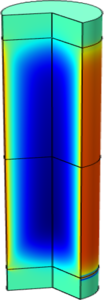
A gate-all-around MOSFET consists of a nanowire with a gate electrode wrapped around the circumference. Since the entire nanowire forms the channel, this configuration provides the best possible electrostatic control of the channel and offers a good candidate for the miniaturization of ... Read More
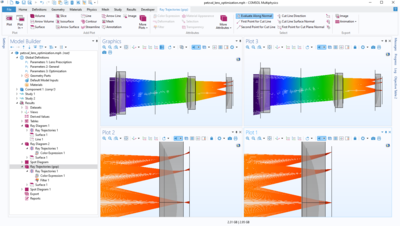
This example shows how to perform parameter optimization on a lens system. The optimization is motivated by the replacement of one of the glasses in a prior optical prescription with a new glass having slightly different optical dispersion coefficients. The control parameters are the ... Read More
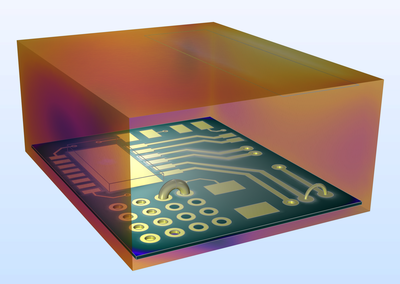
This example provides a walkthrough on how to simulate the basic radiated emission of a printed circuit board and its immunity response from outside noise. First, when one of the microstrip lines is excited, the crosstalk to an adjacent printed line and the radiated field, through an ... Read More
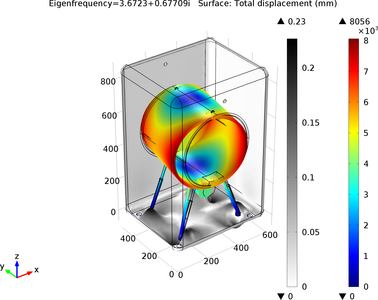
Vibration and noise in washing machines, due to the non-uniform distribution of clothes in the barrel, is a common problem worth studying and optimizing for. This model simulates a multibody dynamics model of a horizontal-axis portable washing machine. An eigenfrequency analysis is ... Read More
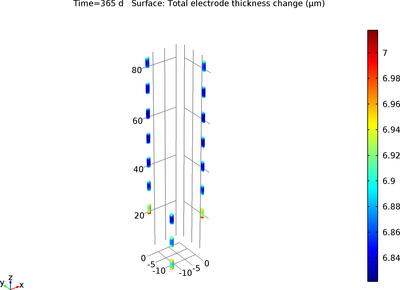
This model exemplifies how the rate of steel corrosion in an oil platform increases over time due to build-up of a resistive film on the sacrificial anodes, formed by reaction products. The model also includes secondary current distribution electrode kinetics on the protected steel ... Read More
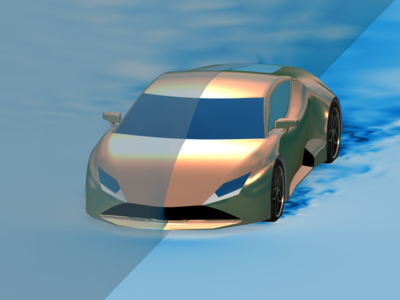
This example simulates turbulent flow around a sports car traveling at a speed of 180 km/h using Large Eddy Simulations (LES). Read More
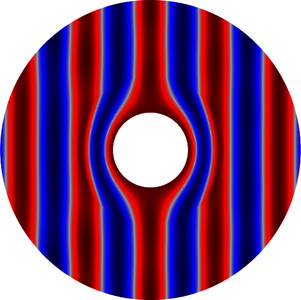
This example demonstrates how to use a background field in a sound scattering problem. The application is an acoustic invisibility cloak made of a metamaterial. Two different types of metamaterials are used, one using an anisotropic acoustic material with varying properties and one using ... Read More
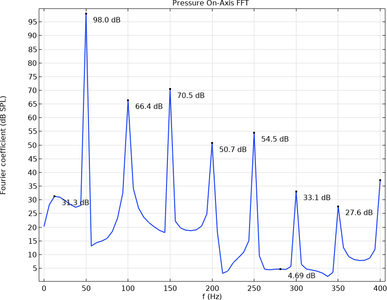
This model shows how to include the nonlinear (large signal) behavior of certain lumped components in a simplified loudspeaker analysis. The mechanical and electrical system is modeled using an equivalent electrical circuit. The large signal compliance CMS(x) and force factor BL(x) are ... Read More


