
The Application Gallery features COMSOL Multiphysics® tutorial and demo app files pertinent to the electrical, structural, acoustics, fluid, heat, and chemical disciplines. You can use these examples as a starting point for your own simulation work by downloading the tutorial model or demo app file and its accompanying instructions.
Search for tutorials and apps relevant to your area of expertise via the Quick Search feature. Note that many of the examples featured here can also be accessed via the Application Libraries that are built into the COMSOL Multiphysics® software and available from the File menu.
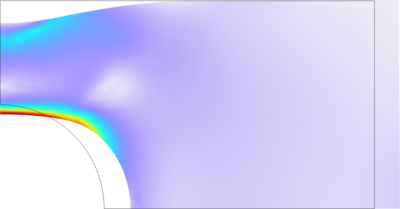
This example shows the analysis of a perforated plate loaded into the plastic regime. Part of the example is a benchmark, which you can find in section 7.10 of The Finite Element Method by O.C. Zienkiewicz. The unloading of the plate and residual stresses are also studied. In a second ... Read More
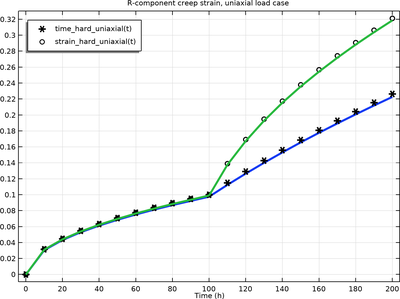
In this model example, you will study the creep behavior of material under non-constant loading. You will model the primary creep using a Norton–Bailey law and study the difference between the time hardening and the strain hardening methods available in COMSOL Multiphysics. The model is ... Read More
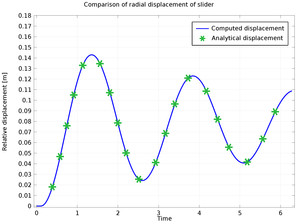
This model illustrates the modeling of slider motion caused by a base rotation. The motion of the slider is analyzed under various forces such as inertia force, centrifugal force, spring force and damping force. The prismatic joint, which is used to connect the two components, is spring ... Read More
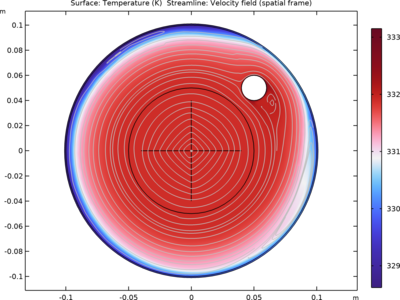
This model illustrates the modeling of temperature distribution in a simplified mixer. Read More

Lamb wave resonators are useful components for many radio-frequency applications. This tutorial shows how you model an aluminum nitride Lamb wave resonator and perform eigenfrequency and frequency-response analyses to characterize the device. Read More
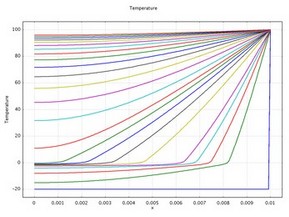
This example demonstrates how to model a phase change and predict its impact on a heat transfer analysis. When a material changes phase, for instance from solid to liquid, energy is added to the solid. Instead of creating a temperature rise, the energy alters the material’s molecular ... Read More
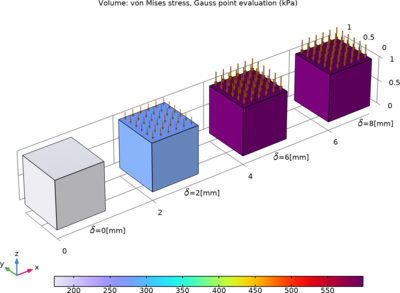
This model shows how to set up a uniaxial compression test on a prestressed soil sample. Due to uniaxial compression and simple initial stress values, it is possible to determine the vertical yield stress analytically. The soil sample is modeled with soil plasticity and the Mohr–Coulomb ... Read More

A thin-walled frame with a central cutout is subjected to a random load. Although the stresses are far below the yield level of the material, damage accumulates over the load history. The Rainflow counting algorithm is used to define the load scenario and Palmgren-Miner linear damage ... Read More
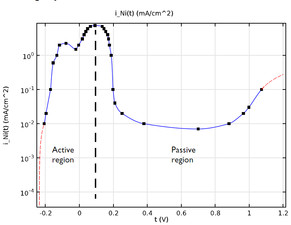
This model exemplifies the basic principles of crevice corrosion and how a time-dependent study can be used to simulate the electrode deformation. The model is in 2D and the polarization data for the corrosion reaction is taken from a paper by Absulsalam and others. The model and the ... Read More
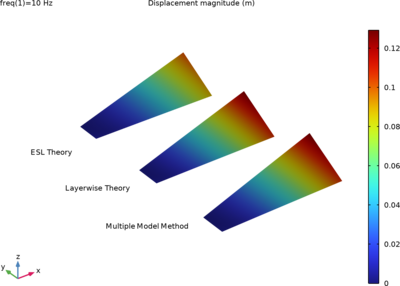
This example demonstrates the modeling of a sandwiched composite blade made up of carbon–epoxy, glass–vinylester, and PVC foam materials. Three different methods are used to model the sandwich composite structure: Layerwise theory, Equivalent Single Layer (ESL) theory, and a multiple ... Read More


