
The Application Gallery features COMSOL Multiphysics® tutorial and demo app files pertinent to the electrical, structural, acoustics, fluid, heat, and chemical disciplines. You can use these examples as a starting point for your own simulation work by downloading the tutorial model or demo app file and its accompanying instructions.
Search for tutorials and apps relevant to your area of expertise via the Quick Search feature. Note that many of the examples featured here can also be accessed via the Application Libraries that are built into the COMSOL Multiphysics® software and available from the File menu.
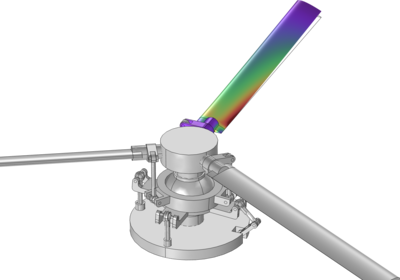
This model illustrates the operation of a swashplate mechanism used in helicopters to translate the input of helicopter flight control into the motion of the rotor blades, and hence controls the orientation of the rotor blades. In this model, the rotor blades are modeled as either rigid ... Read More
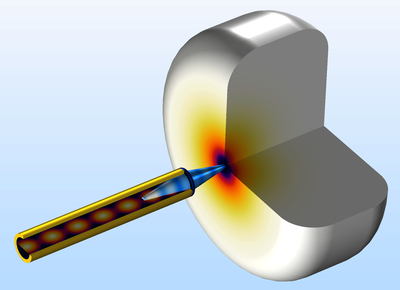
The response of a millimeter wave with frequencies of 35 GHz and 95 GHz is known to be very sensitive to water content. This model utilizes a low-power 35 GHz Ka-band millimeter wave and its reflectivity to moisture for noninvasive cancer diagnosis. Since skin tumors contain more ... Read More
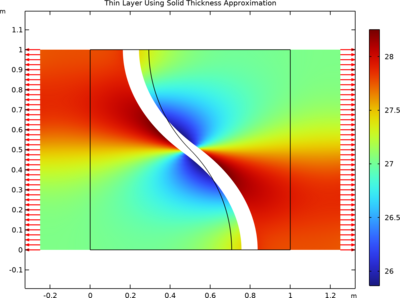
This model demonstrates alternative implementations used for describing a thin layer and the impact of the choice on the continuity of the displacement and stress fields. It is shown how a perfect interface can be obtained by asymptotically changing the material parameters. Read More
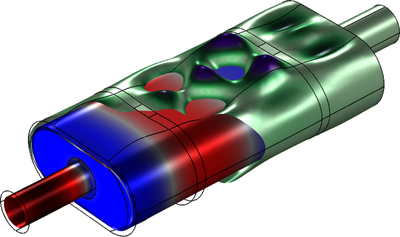
This model describes the pressure wave propagation in a muffler for an internal combustion engine. The purpose of the model is to show how to analyze both inductive and resistive damping in pressure acoustics as well as coupling the fluid to the surrounding elastic shell structure of the ... Read More
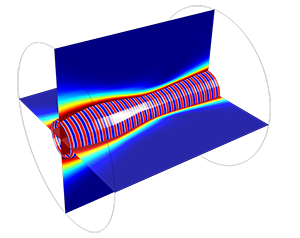
A Gaussian beam is launched into BK-7 optical glass. The material has an intensity-dependent refractive index. At the center of the beam, the refractive index is the largest. The induced refractive index profile counteracts diffraction and actually focuses the beam. Self-focusing is ... Read More

Frequency selective surfaces (FSS) are periodic structures with a bandpass or a bandstop frequency response. This model shows that only signals around the center frequency can pass through the periodic complementary split ring resonator layer. Read More
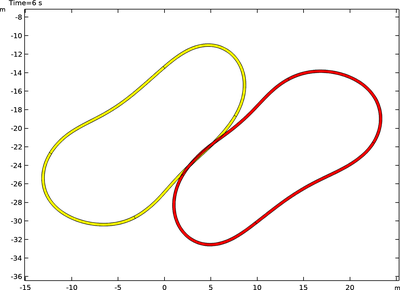
In this conceptual example, the soft impact between two elastic rings is modeled using the Solid Mechanics interface. One of the rings is given an initial velocity to initiate the impact event. Both rings are unconstrained and not subjected to any external forces. Contact is modeled ... Read More
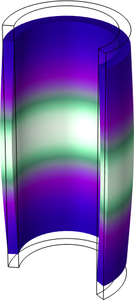
This model calculates the eigenfrequencies and mode shapes of an unconstrained cylinder in axisymmetry. The model is taken from NAFEMS Free Vibration Benchmarks. The eigenfrequencies are compared with the values given in the benchmark report. Three different physics interfaces are ... Read More
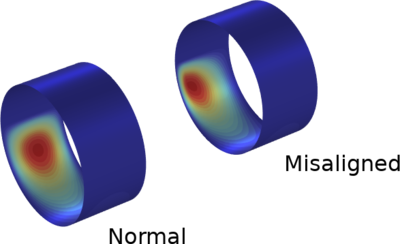
In this example, a rotor supported on two hydrodynamic bearings is analyzed. An eccentric disk located between the two bearings causes the rotor to whirl. One of the bearings is misaligned with the axis of the rotor. The Beam Rotor with Hydrodynamic Bearing interface in the ... Read More
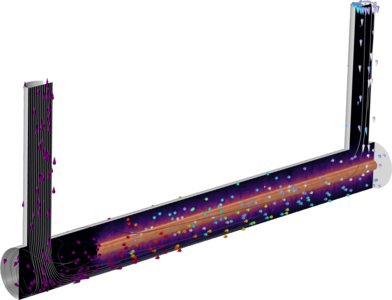
In this example, a simple ultraviolet (UV) water purification reactor is modeled using a combination of ray tracing, computational fluid dynamics, and Lagrangian particle tracking. First, the volumetric fluence rate is accumulated along rays released from the surface of the UV lamp using ... Read More


