
The Application Gallery features COMSOL Multiphysics® tutorial and demo app files pertinent to the electrical, structural, acoustics, fluid, heat, and chemical disciplines. You can use these examples as a starting point for your own simulation work by downloading the tutorial model or demo app file and its accompanying instructions.
Search for tutorials and apps relevant to your area of expertise via the Quick Search feature. Note that many of the examples featured here can also be accessed via the Application Libraries that are built into the COMSOL Multiphysics® software and available from the File menu.
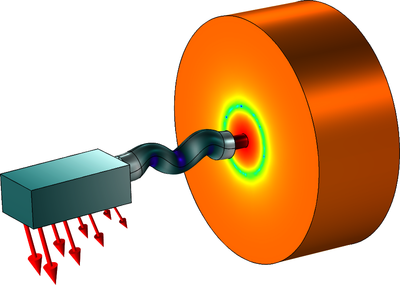
When simulations are involved in the development of mobile devices, consumer electronics, hearing aids, or headsets, it is necessary to consider how the transducers interact with the rest of the system. Here, we show an analysis of the interaction between a vibration isolation mounting ... Read More
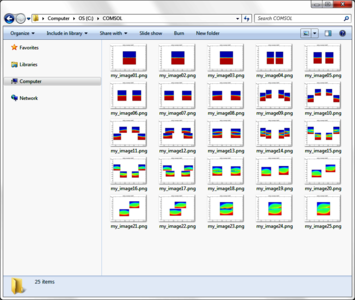
This example demonstrates how to use a parameterized slice plot and animation functionality to export a sequence of images. In addition, the example shows how to use a job sequence to perform a programmatic sequence of operations where the model is first solved and then the image ... Read More
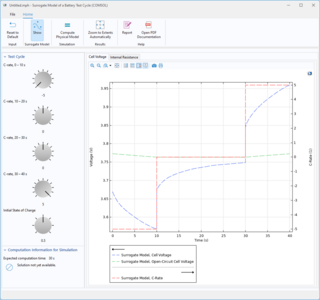
This app demonstrates the usage of a surrogate model function for predicting the cell voltage, cell open circuit voltage and internal resistance of an NMC111/graphite battery cell undergoing a battery test cycle. The surrogate function, a Deep Neural Network, has been fitted to a ... Read More
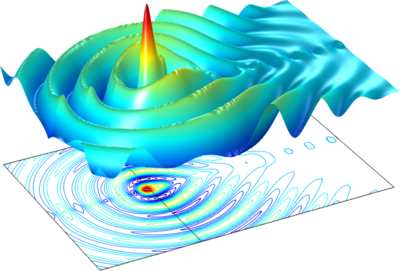
This is a benchmark model for the linearized Euler interface of the Acoustics Module. The model is from the NASA "Fourth Computational Aeroacoustics (CAA) Workshop on Benchmark Problems (2004)". The model results are compared to an analytical solution by Agarwal et al. (AIAA Vol. 42, No. ... Read More
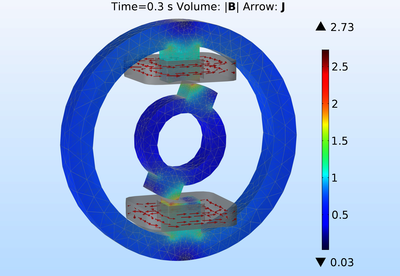
Switched reluctance motors work on the principle of reluctance torque. The stator and rotor will interact to minimize the reluctance for the flux path. This application simulates the behavior of the motor when the stator winding is excited with a step voltage and when the rotor is at a ... Read More
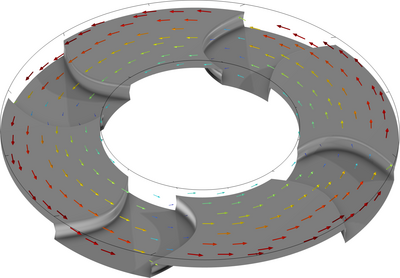
In this tutorial model, a step thrust bearing is shape optimized to maximize the bearing capacity. A step thrust bearing consists of a stepped bearing surface on which the end of the shaft rotates. The entire assembly is submerged in a lubricant. The shaft collar is assumed to be ... Read More
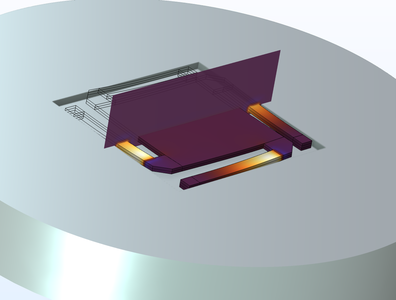
This model analyzes the operation of a micromirror in air and the effects of thermoviscous damping on the vibration response. The model includes thermal losses in the structure as well as thermoviscous acoustic phenomena. The model couples the Thermoelasticity multiphysics interface to ... Read More
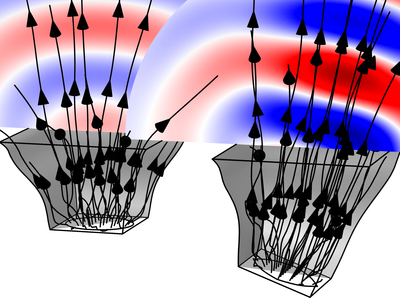
This model demonstrates how to use the Control Function feature to perform shape optimization on a rectangular horn for an improved on axis response. The results of the initial design are exported to a new component via a Filter dataset. Further, the off-axis spatial response is improved ... Read More
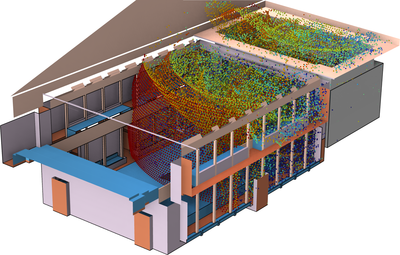
In this model, the acoustics of the Small Hall in the Konzerthaus Berlin is simulated with ray tracing. A full study of the room is performed in 1/3-octave bands with 10 pairs of source-receiver positions. The room acoustic parameters are derived from the calculated impulse responses, ... Read More
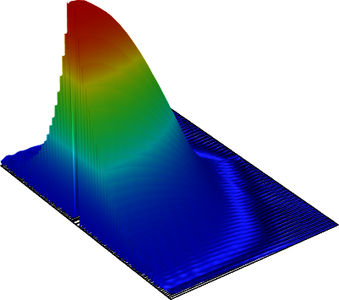
An eigenfrequency study is used to find the resonance frequency and threshold gain for an oxide-confined, GaAs-based, vertical-cavity surface-emitting laser (VCSEL). The simulations are performed in two steps. A regular eigenfrequency analysis is first performed, to find good initial ... Read More


