
The Application Gallery features COMSOL Multiphysics® tutorial and demo app files pertinent to the electrical, structural, acoustics, fluid, heat, and chemical disciplines. You can use these examples as a starting point for your own simulation work by downloading the tutorial model or demo app file and its accompanying instructions.
Search for tutorials and apps relevant to your area of expertise via the Quick Search feature. Note that many of the examples featured here can also be accessed via the Application Libraries that are built into the COMSOL Multiphysics® software and available from the File menu.
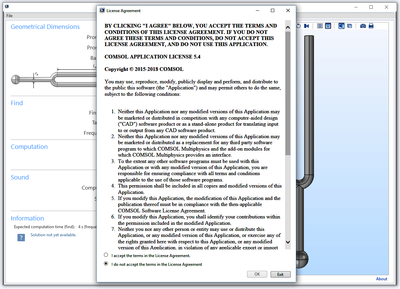
This example of a simulation application shows how to add a user-defined license agreement, which you can use to protect applications that you publish and distribute. Read More
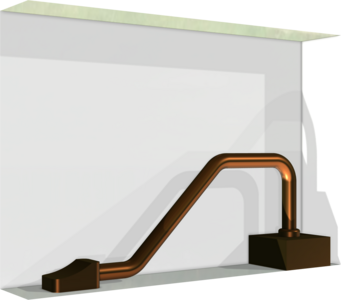
This model analyzes Joule heating and thermal expansion in a bond wire in an LED. Its purpose is to estimate the temperature increase and the resulting mechanical stresses in the bond wire due to thermal expansion. The magnitude of these stresses can be used to assess the risk of fatigue ... Read More

This example shows how to create a time-limited and hardware-locked application. It is associated with the section "Time-Limited and Hardware-Locked Applications" in the Application Programming Guide Read More
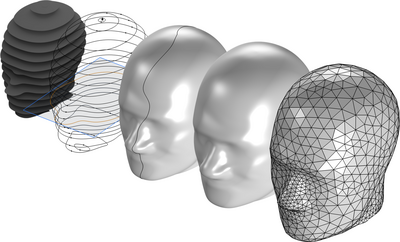
One of the possible formats when working with scanned data is images for the slices of an MRI or CT scan. This is an example with images from the cross sections of the different levels of a human head. In short, the procedure includes creating curve objects of each of the images using ... Read More
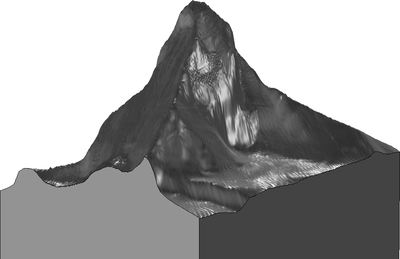
This file shows how to create a surface of an irregular shape based on text, image, or elevation data. This approach is best suited for data where the height (or elevation) is a function of x- and y-coordinates. The data is of the Matterhorn, a European mountain located in the Alps. In ... Read More
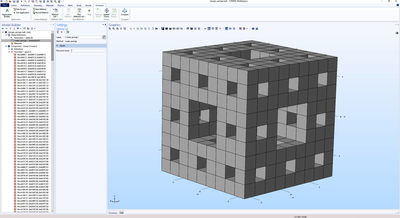
You can use the Method Editor in the Application Builder for creating methods that perform almost any type of modeling tasks, including geometry modeling. It is easy to miss the fact that methods can support recursion by having a method calling itself in a recursive loop. Here, we will ... Read More
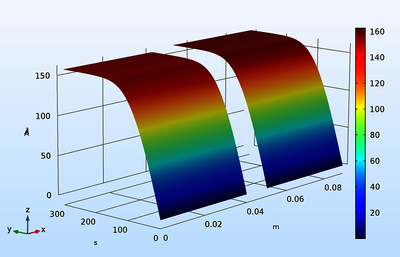
Surface chemistry is often an overlooked aspect of reacting flow modeling. This tutorial model shows how surface reactions and species can be added to study processes like chemical vapor deposition (CVD). The tutorial then models silicon growth on a wafer. Initially, the example uses a ... Read More
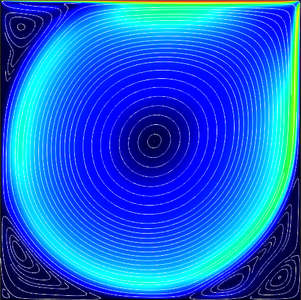
This example demonstrates how to define the lid-driven cavity benchmark in the field of computational fluid dynamics. In the model setup, a 2D square cavity has a tangentially moving wall that induces a large vortex in the center of the cavity, and small vortices in the corners. The ... Read More

A catalyst particle with a hypothetical microstructure is described in detail. The heterogeneous description is approximated in a second model with a homogeneous particle and the results from the two approaches are compared. See: https://www.comsol.se/blogs/modeling-approaches-in ... Read More
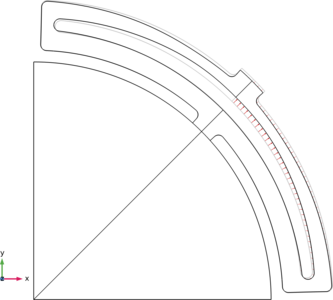
This model demonstrates how to tune the lowest natural frequency of the diaphragm of a MEMS microphone using Shape Optimization. The Stationary then Eigenfrequency study modifies the shape of the suspension springs that support the diaphragm. Although the model is in 3D, shape change is ... Read More


