
The Application Gallery features COMSOL Multiphysics® tutorial and demo app files pertinent to the electrical, structural, acoustics, fluid, heat, and chemical disciplines. You can use these examples as a starting point for your own simulation work by downloading the tutorial model or demo app file and its accompanying instructions.
Search for tutorials and apps relevant to your area of expertise via the Quick Search feature. Note that many of the examples featured here can also be accessed via the Application Libraries that are built into the COMSOL Multiphysics® software and available from the File menu.
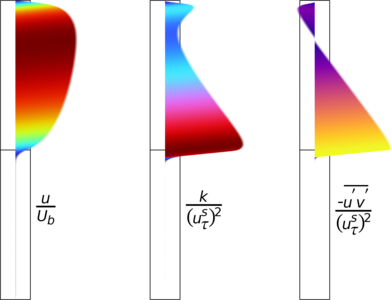
This setup demonstrates how the characteristics of turbulent flow in a channel are modified by the presence of an adjacent porous region. Asymmetric velocity profiles, higher turbulence levels, and higher friction coefficients both at the solid wall and the fluid-porous interface are ... Read More
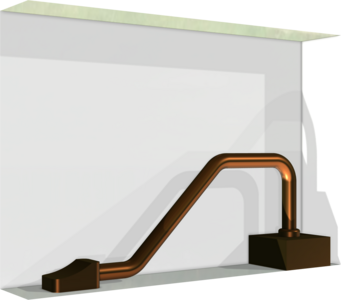
This model analyzes Joule heating and thermal expansion in a bond wire in an LED. Its purpose is to estimate the temperature increase and the resulting mechanical stresses in the bond wire due to thermal expansion. The magnitude of these stresses can be used to assess the risk of fatigue ... Read More
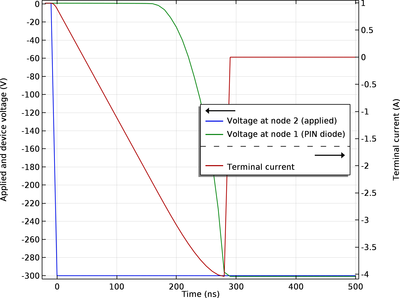
This tutorial simulates the turn-off transient (reverse recovery) of a simple PIN diode with an inductive load, loosely based on the book "Fundamentals of Power Semiconductor Devices" by B. J. Baliga (p. 256, 2008 edition). Unlike the book, which assumes an initial constant current ramp ... Read More
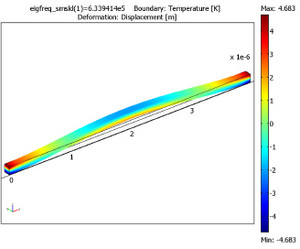
Thermoelastic damping, which arises when you subject a material to cyclic stress, is an important factor when designing MEMS resonators. The stress brings about deformation, where materials heat under compressive stress and cool under tensile stress. Thus, due to the resulting heat flux, ... Read More
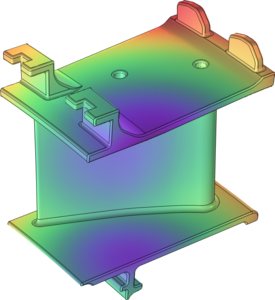
This example shows how to compute thermally induced stresses in a turbine stator blade using the Thermal Stress, Solid interface. The conditions within gas turbines are extreme. The pressure can be as high as 40 bar, and the temperature more than 1000 K. Any new component must therefore ... Read More
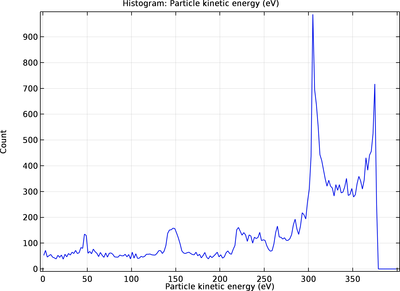
This model computes the ion energy distribution function (IEDF) for a commercial capacitively coupled plasma reactor. The results show good agreement with experimental data. Read More
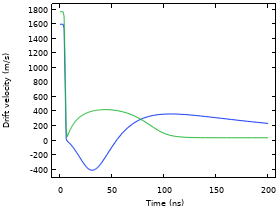
This tutorial model presents a study showing the transient negative mobility and the negative differential conductivity effects in xenon. The stationary and time dependent Boltzmann equation in the two-term approximation is used to compute the electron energy distribution function. ... Read More
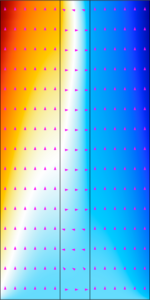
This tutorial demonstrates how to modify a concentration-independent (also known as a secondary current distribution) liquid alkaline water electrolyzer with concentrated electrolyte theory to explicitly resolve local electrolyte and solvent concentrations (thereby creating a tertiary ... Read More
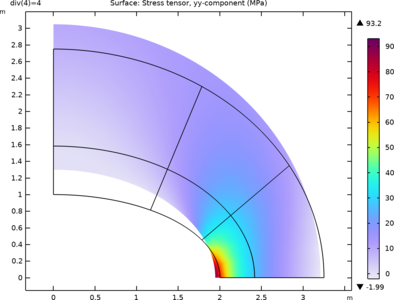
This is a benchmark model for a plane stress problem. The accuracy of the computed stress concentration is evaluated, and a mesh convergence study is performed for different element types. Read More
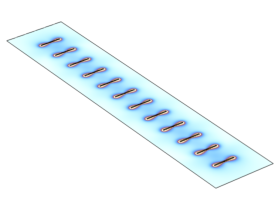
This example of a dipole antenna array demonstrates a cost-effective analysis using the Boundary Element Method (BEM). When dealing with a large array made of metallic radiators, the Finite Element Method (FEM) would necessitate greater computational resources. The simulation results ... Read More


