
The Application Gallery features COMSOL Multiphysics® tutorial and demo app files pertinent to the electrical, structural, acoustics, fluid, heat, and chemical disciplines. You can use these examples as a starting point for your own simulation work by downloading the tutorial model or demo app file and its accompanying instructions.
Search for tutorials and apps relevant to your area of expertise via the Quick Search feature. Note that many of the examples featured here can also be accessed via the Application Libraries that are built into the COMSOL Multiphysics® software and available from the File menu.

These examples demonstrate using the Electrostatics, Boundary Elements interface, introduced in version 5.3 of the COMSOL Multiphysics® software. In the blog post associated with these files, "How to Create Electrostatics Models with Wires, Surfaces, and Solids", we demonstrate the pros ... Read More
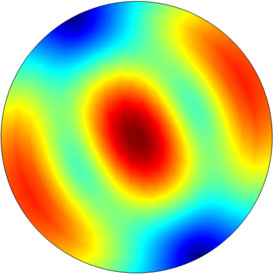
In mode analysis it is usually the primary goal to find a propagation constant. This quantity is often, but not always, real valued; if the analysis involves some lossy part, such as a nonzero conductivity or an open boundary, the eigenvalue is complex. In such situations, the real and ... Read More
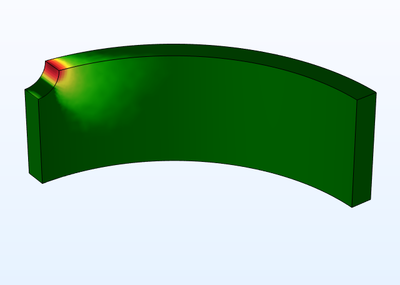
A load carrying component of a structure is subjected to multi-axial cyclic loading during which localized yielding of the material occurs. In this model you perform a low cycle fatigue analysis of the part based on the Smith-Watson-Topper (SWT) model. Due to localized yielding, you ... Read More
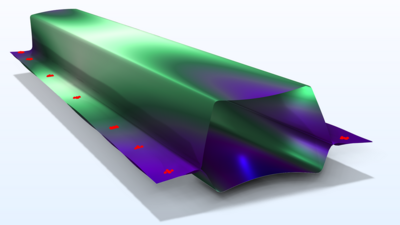
In this example, the natural frequencies of a double hat beam are studied. The beam is made of two thin steel plates, joined together by spot welds along the flanges. The Spot Welds feature sets up multiple mesh-independent connections between the shells. Read More
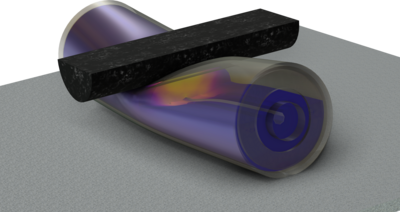
Indentation tests are commonly used to evaluate the safety of battery cells by assessing the risk of internal short circuits under external mechanical loads. This example demonstrates how to set up such a test, in which an indenter is pressed onto a battery cell, causing large ... Read More
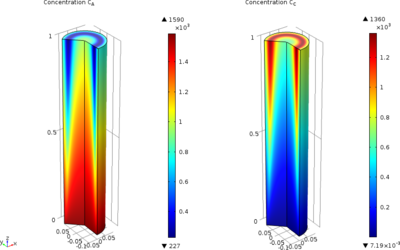
This application uses the Chemical Reaction Engineering Module to study an elementary, exothermic, irreversible reaction in a tubular reactor (liquid phase, laminar flow regime). To keep its temperature down, the reactor uses a cooling jacket with a constant coolant temperature. The ... Read More
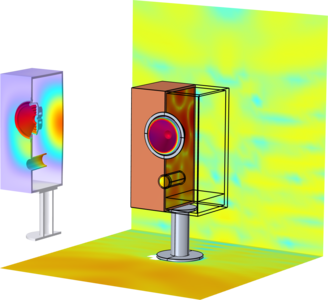
This model shows a full vibroacoustic analysis of a loudspeaker including driver, cabinet, and stand. It lets you apply a nominal driving voltage and extract the resulting sound pressure level in the cabinet and in the outside room, as well as the deformation of the cabinet and driver, ... Read More
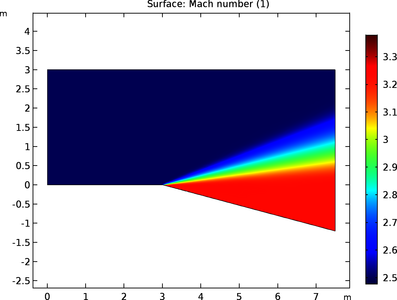
An important and interesting phenomenon with supersonic flows are expansion fans, which take place when the flow encounters a convex or expansion corner. The direction of the flow changes smoothly across the fan, while the Mach number increases. This 2D example models an expansion fan ... Read More


