
The Application Gallery features COMSOL Multiphysics® tutorial and demo app files pertinent to the electrical, structural, acoustics, fluid, heat, and chemical disciplines. You can use these examples as a starting point for your own simulation work by downloading the tutorial model or demo app file and its accompanying instructions.
Search for tutorials and apps relevant to your area of expertise via the Quick Search feature. Note that many of the examples featured here can also be accessed via the Application Libraries that are built into the COMSOL Multiphysics® software and available from the File menu.
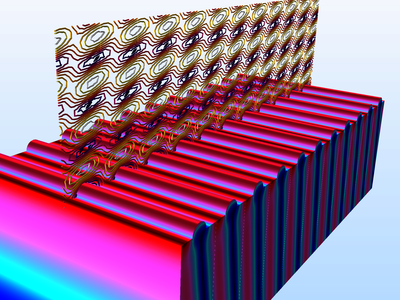
Surface plasmon-based circuits are being used in applications such as plasmonic chips, light generation, and nanolithography. The Plasmonic Wire Grating Analyzer application computes the coefficients of refraction, specular reflection, and first-order diffraction as functions of the ... Read More
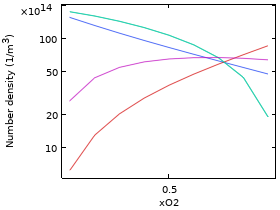
This tutorial model solves for an inductively coupled plasma reactor in a mixture of argon/oxygen. The model computes the fluid flow and gas heating. Important aspects and strategies for modeling electronegative discharges are discussed. Read More
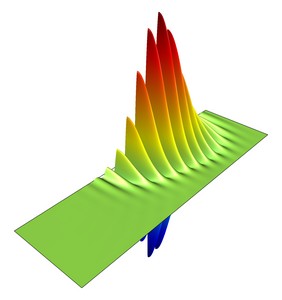
It is possible to generate harmonics that are multiples of the frequency of laser light by using nonlinear optical materials. This model demonstrates second harmonic generation using transient wave simulation and nonlinear material properties. A YAG (lambda=1.06 micron) laser beam is ... Read More
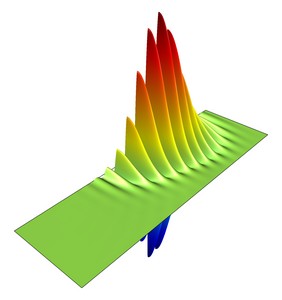
Laser systems are an important application area in modern electronics. With nonlinear materials it is possible to generate harmonics that are a multiple of the frequency of the laser light. This model shows how a second harmonic generation can be set up as a transient wave simulation, ... Read More
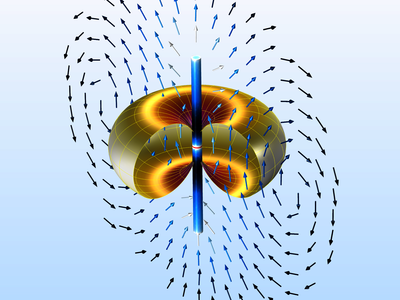
The dipole antenna is one of the most straightforward antenna configurations. It can be realized with two thin metallic rods that have a sinusoidal voltage difference applied between them. The length of the rods is chosen such that they are quarter wavelength elements at the operating ... Read More
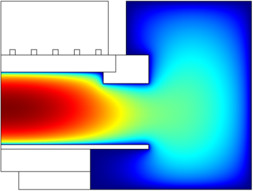
The GEC cell was introduced by NIST in order to provide a standardized platform for experimental and modeling studies of discharges in different laboratories. The plasma is sustained via inductive heating. The Reference Cell operates as an inductively-coupled plasma in this model. This ... Read More
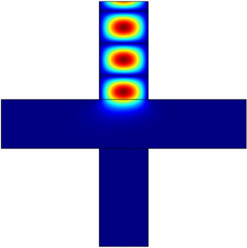
Wave heated discharges may be very simple, where a plane wave is guided into a reactor using a waveguide, or very complicated as in the case with ECR (electron cyclotron resonance) reactors. In this example, a wave is launched into reactor and an Argon plasma is created. The wave is ... Read More
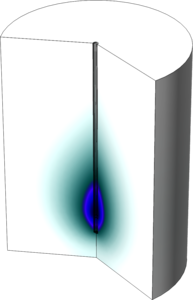
Electromagnetic heating is ideally suited for modeling in COMSOL Multiphysics. This model shows the area of hyperthermic oncology but the modeling issues and techniques are generally applicable to any problem involving electromagnetic heating. The purpose of this model is to compute the ... Read More
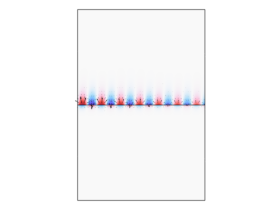
Electromagnetic waves that are confined to propagate along a surface, such as surface plasmon polaritons (SPPs), are of great research interest due to their potential applications in nanoscale manipulation of light. This model demonstrates how to set up a simulation of the propagation ... Read More
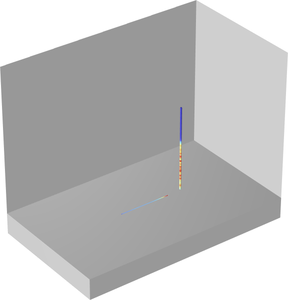
This model computes the lightning-induced voltage on an overhead line positioned above a lossy ground. It includes parameters like the inclination angle of lightning channels and soil conductivity, enabling straightforward analysis of their impacts. The calculated induced voltage aligns ... Read More


