
The Application Gallery features COMSOL Multiphysics® tutorial and demo app files pertinent to the electrical, structural, acoustics, fluid, heat, and chemical disciplines. You can use these examples as a starting point for your own simulation work by downloading the tutorial model or demo app file and its accompanying instructions.
Search for tutorials and apps relevant to your area of expertise via the Quick Search feature. Note that many of the examples featured here can also be accessed via the Application Libraries that are built into the COMSOL Multiphysics® software and available from the File menu.
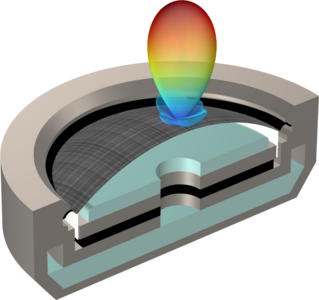
Loudspeaker design is a challenging task, where the design objective is to achieve better sound quality without violating manufacturing and operational constraints. The quality of sound depends on many parameters; one of them is the ability to control, damp, and shift the diaphragm ... Read More
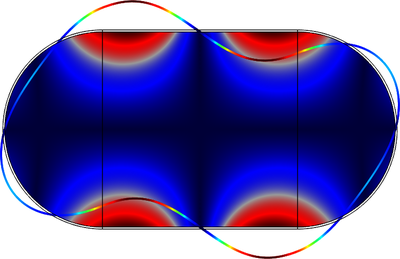
This example consists of a 2D analysis of propagation modes in the chamber of a muffler. In this case, the muffler walls are considered to be made of a linear elastic material and account for their influence on the modes propagating through the cross section of the chamber. This analysis ... Read More
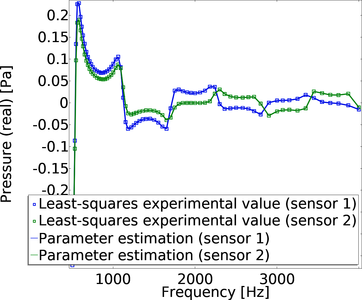
Impedance tubes are used for estimating the surface impedance of various samples, for example, a layer of porous material used for sound insulation. This model shows how the five material parameters of the Johnson-Champoux-Allard model can be estimated from the pressure at two ... Read More
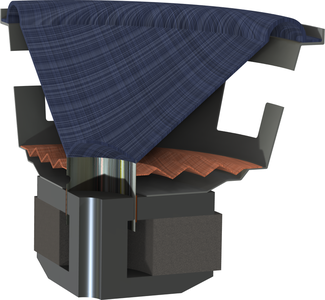
This tutorial shows how to best solve full 3D vibro-electroacoustic multiphysics models of loudspeakers. The model is based on a 3D representation of the existing 2D axisymmetric Application Library model loudspeaker_driver found in the software. The setup of the physics is essentially ... Read More
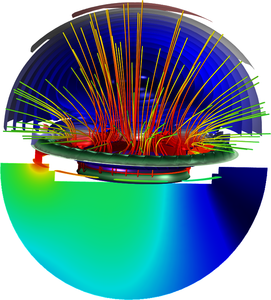
This model analyzes the electromagnetic, mechanical, and acoustical characteristics of the OWS-1943T-8CP (discontinued) speaker. Beside certain details, the geometry, material properties, and measurements are copyright by Ole Wolff. Starting from the geometry of the speaker, an ... Read More
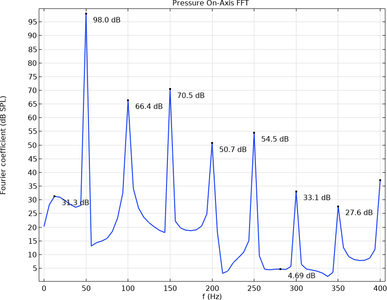
This model shows how to include the nonlinear (large signal) behavior of certain lumped components in a simplified loudspeaker analysis. The mechanical and electrical system is modeled using an equivalent electrical circuit. The large signal compliance CMS(x) and force factor BL(x) are ... Read More
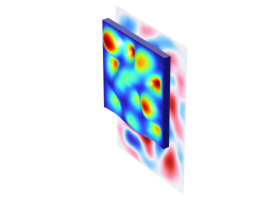
This model presents a practical and efficient method to compute the sound transmission loss (STL) through a building component, specifically this example treats the case of a concrete wall. The method used here is valid as long as the component has little influence on the acoustic field ... Read More
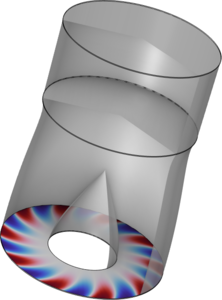
The acoustic field in a model of an axially symmetric lined aero-engine duct, based on modal sound transmission, is analyzed. The source is generated by a single mode excitation at a boundary. Sources and nonreflecting conditions are applied using port boundary conditions. The model ... Read More
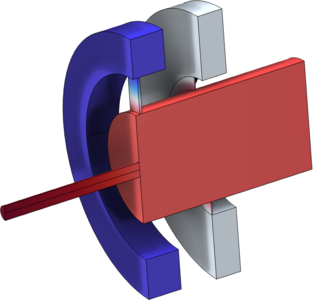
This model computes the input impedance/admittance to an acoustic system in the frequency domain. The system here represents a typical measurement setup used for testing hearing aids and includes domains with thermoviscous boundary layer losses. The input admittance, computed in the ... Read More
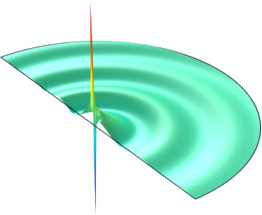
We have all noticed the Doppler effect when an ambulance passes by with its sirens blaring. The siren’s pitch suddenly drops the moment the ambulance starts moving away from you. Another effect you can notice is how the siren’s sound is very loud when nearby, but as soon as the ... Read More


