
The Application Gallery features COMSOL Multiphysics® tutorial and demo app files pertinent to the electrical, structural, acoustics, fluid, heat, and chemical disciplines. You can use these examples as a starting point for your own simulation work by downloading the tutorial model or demo app file and its accompanying instructions.
Search for tutorials and apps relevant to your area of expertise via the Quick Search feature. Note that many of the examples featured here can also be accessed via the Application Libraries that are built into the COMSOL Multiphysics® software and available from the File menu.
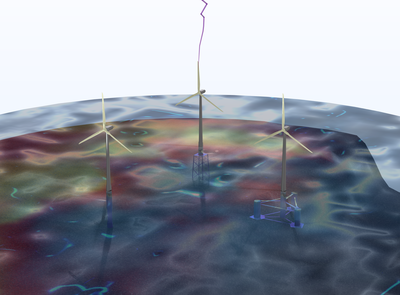
This model analyzes lightning surges in an offshore wind farm. When a lightning strike with a current of 20 kA hit one wind turbine, the induced electric fields in adjacent wind turbines were computed. Read More
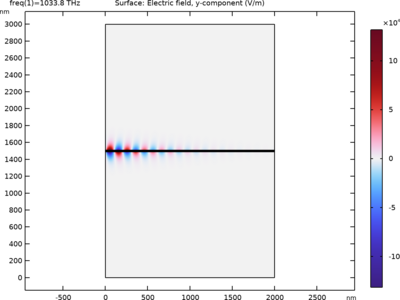
This model demonstrates how to simulate surface plasmon polaritons in a thin metal layer embedded in dielectric layers. It calculates the dispersion and propagation length of surface plasmon polaritons as a function of photon energy. Read More
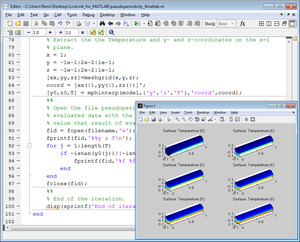
This model simulates convective heat transfer in a channel filled with water. To reduce memory requirements, the model is solved repeatedly on a pseudo-periodic section of the channel. Each solution corresponds to a different section, and before each solution step the temperature at the ... Read More
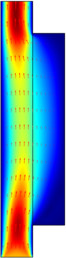
This is a tutorial model of the coupling between flow of a fluid in an open channel and a porous block attached to one of the channel walls. The flow is described by the Navier-Stokes equation in the free region and a Forchheimer-corrected version of the Brinkman equations in the porous ... Read More
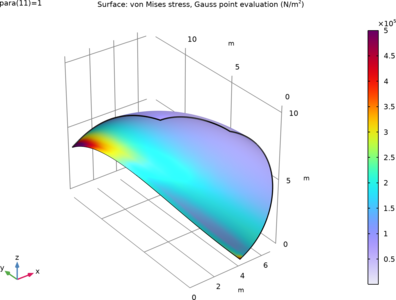
This example studies the deformation of a hemispherical shell, where the loads cause significant geometric nonlinearity. The maximum deflections are more than two magnitudes larger than the thickness of the shell. The problem is a standard benchmark, used for testing shell formulations ... Read More
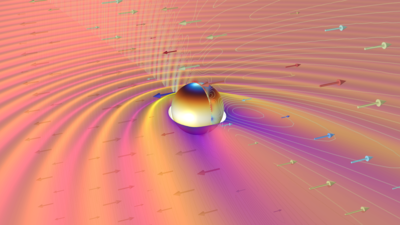
This verification model uses the Electromagnetic Waves, Boundary Elements interface to simulate the RCS of perfectly conducting sphere. The simulated result is compared to analytical calculation to verify the accuracy. Read More
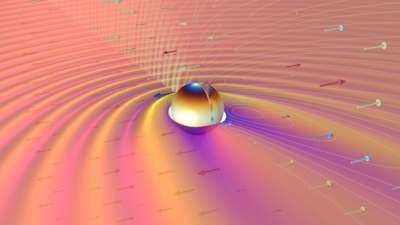
This model illustrates the process of evaluating the radar cross section (RCS) of a metallic sphere through the utilization of the boundary element method (BEM). By taking advantage of a vertical symmetry plane that is parallel to the polarization of an incident background field, the ... Read More
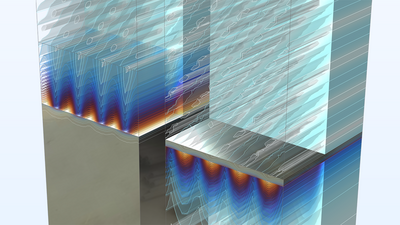
This example demonstrates a simulation setup for exciting surface plasmon polaritons using Otto and Kretschmann configurations. The underlying mechanism is enabled by the interplay between total internal reflection and evanescent-wave coupling phenomena. It also calculates the ... Read More
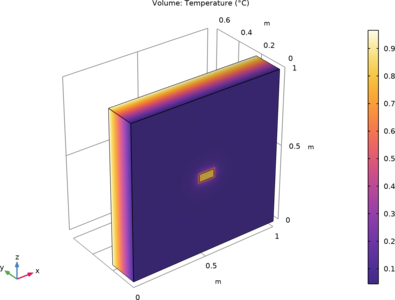
This model studies the heat conduction in a thermal bridge made up of an iron bar and an insulation layer that separates a hot internal side from a cold external side. The heat flux between internal and external side and the maximum temperature on the external wall are compared them with ... Read More
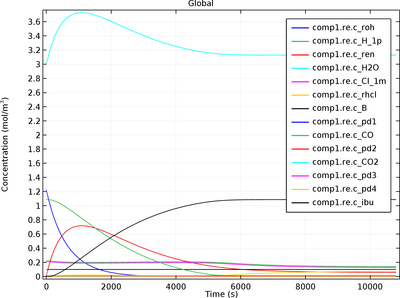
Kinetic analysis of catalytic reactions is essential for understanding rate behavior as well as the reaction mechanism. Developing knowledge of intrinsic reaction kinetics and of rate equations is central to reaction engineering studies aimed at improving reactor design. This model ... Read More


