
The Application Gallery features COMSOL Multiphysics® tutorial and demo app files pertinent to the electrical, structural, acoustics, fluid, heat, and chemical disciplines. You can use these examples as a starting point for your own simulation work by downloading the tutorial model or demo app file and its accompanying instructions.
Search for tutorials and apps relevant to your area of expertise via the Quick Search feature. Note that many of the examples featured here can also be accessed via the Application Libraries that are built into the COMSOL Multiphysics® software and available from the File menu.
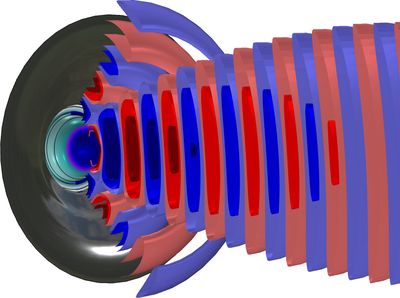
A tweeter is a high frequency driver used in loudspeaker systems. An ideal tweeter will produce a constant sound pressure level at a given distance in front of the driver independently of frequency, that is, a flat response. Ideally the tweeter will also, to a certain degree, maintain ... Read More
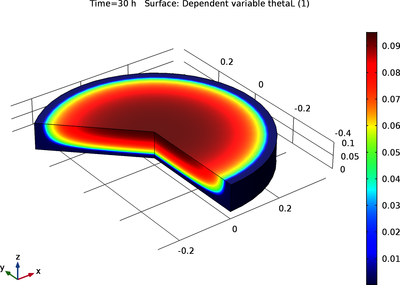
Vacuum drying is a chemical process frequently used in the pharmaceutical and food industries to remove water or an organic solvent from a wet powder. When designing a vacuum drying system, engineers aim to minimize the drying time while maintaining high quality in the product. This ... Read More
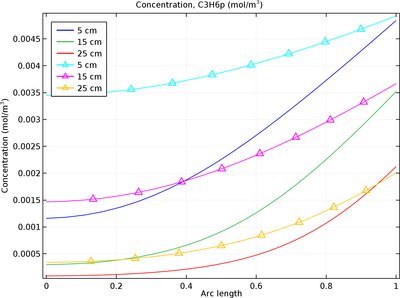
One of the most common reactors in the chemical industry, for use in heterogeneous catalytic processes, is the packed bed reactor. This type of reactor is used both in synthesis as well as in effluent treatment and catalytic combustion. The reactor consists in essence of a container ... Read More
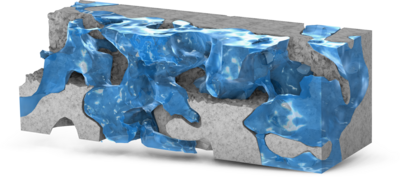
Digital Rock technology utilizes high-resolution imaging techniques, such as SEM and X-ray CT, to characterize the pore structures of rock cores. This approach enables pore-scale modeling of reservoir rocks, offering valuable insights into pore morphology, connectivity, and fluid ... Read More
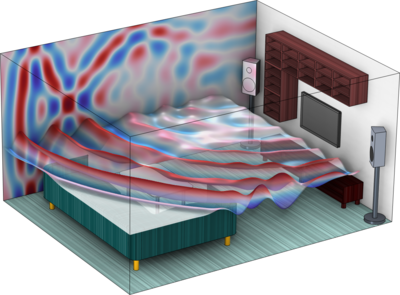
The use of wave-based techniques for room acoustic simulations has spread in the last years due to the increase in computational performance as well as the development of new numerical methods. The challenge of including realistic impedance conditions at walls is traditionally solved in ... Read More
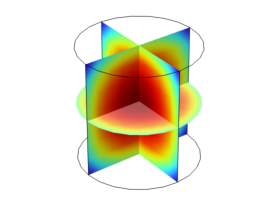
These models use the Discrete Ordinates method (DOM) and P1 approximation to solve a 3D radiative transfer problem in an emitting, absorbing, and linear-anisotropic scattering finite cylindrical medium. Using the S6 quadrature of DOM leads to accurate results, which are needed in ... Read More
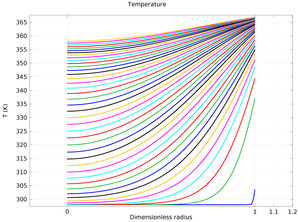
This model approximates 3D spherical transport using a 1D model. Many models of industrial-transport problems allow the assumption that the problem is spherically symmetric. This assumption is of great importance because it eliminates two space coordinates to result in a 1D problem that ... Read More
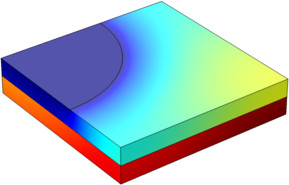
In modeling of transport by diffusion or conduction in thin layers, we often encounter large differences in dimensions of the different domains in a model. If the modeled structure is a so-called sandwich structure, we can replace the thinnest geometrical layers with a thin layer ... Read More

This model shows how to set up a simulation of flow through a fractured reservoir. The reservoir includes a discrete fracture network (DFN), where the fractures have a randomized distribution of position, size, orientation and aperture. The model uses the Discrete Fracture Network Add ... Read More
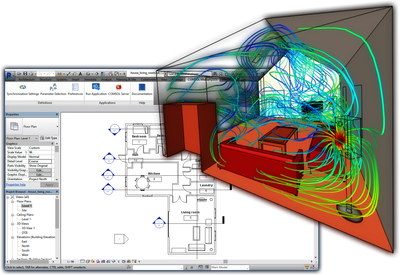
Prevent shaking windows and enhance the sound experience by careful positioning of the loudspeakers in your room. This tutorial analyzes the low frequency response of a living room to the woofer units of two loudspeakers, and solves for the eigenfrequencies of the room. The room geometry ... Read More


