
The Application Gallery features COMSOL Multiphysics® tutorial and demo app files pertinent to the electrical, structural, acoustics, fluid, heat, and chemical disciplines. You can use these examples as a starting point for your own simulation work by downloading the tutorial model or demo app file and its accompanying instructions.
Search for tutorials and apps relevant to your area of expertise via the Quick Search feature. Note that many of the examples featured here can also be accessed via the Application Libraries that are built into the COMSOL Multiphysics® software and available from the File menu.
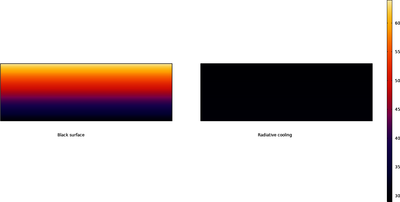
Because the atmosphere is nearly transparent to wavelengths in the range 8 to 13 µm (atmospheric window) for a clear sky, it is possible to cool down a surface even during a sunny day. This model compares the temperature distribution on a concrete block exposed to ambient and solar ... Read More
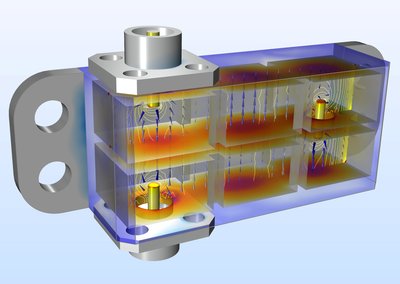
This example investigates the electrical performance of a cascaded cavity filter operating in the millimeter-wave 5G band with temperature changes. The thermal variations result in structural deformations of the structure. Thus, the resonant frequencies of the filter elements (cavities) ... Read More
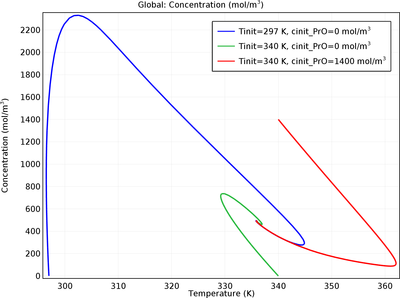
The hydrolysis of propylene oxide into propylene glycol is an important chemical process with 400,000 metric tons produced worldwide each year. Propylene glycol finds wide application as a moisturizer in foods, pharmaceuticals, and cosmetics. In this example, the startup phase of a ... Read More
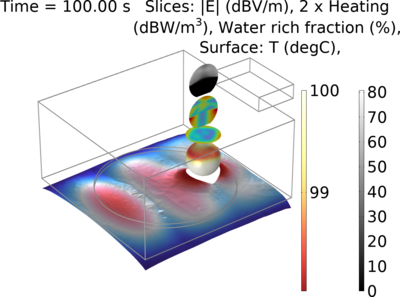
A spherical water-rich load (potato) is placed on the rotating glass tray of a microwave oven some distance from the center of rotation. 1 kW of 2.45 GHz microwave power is applied via a waveguide feed. The plate rotates at 9 degrees per second. The heat transfer model involves the ... Read More
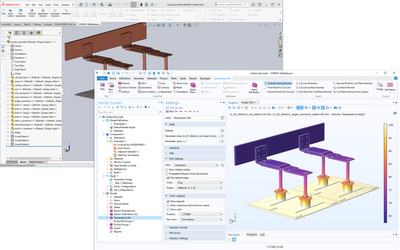
This tutorial model of the Joule heating effect in a busbar demonstrates how to synchronize an assembly between the SOLIDWORKS® software and the COMSOL Multiphysics® software, how to modify the geometry from COMSOL Multiphysics®, and how to run a geometric ... Read More
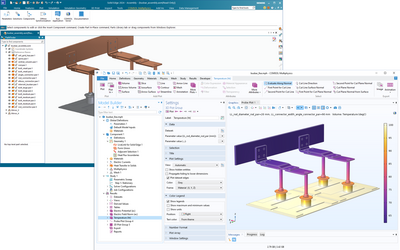
This tutorial model of the Joule heating effect in a busbar demonstrates how to synchronize an assembly between the Solid Edge® software and the COMSOL Multiphysics® software, how to modify the geometry from COMSOL Multiphysics®, and how to run a geometric ... Read More
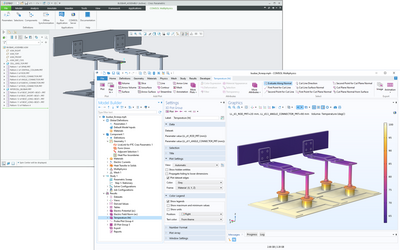
This tutorial model of the Joule heating effect in a busbar demonstrates how to synchronize an assembly between the PTC Creo Parametric™ software and the COMSOL Multiphysics® software, how to modify the geometry from COMSOL Multiphysics®, and how to run a ... Read More
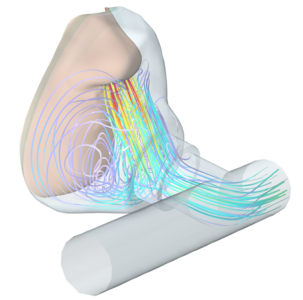
When designing oxygen masks for delivering respiratory support to patients via BiPAP and CPAP, multiphysics modeling helps visualize the flow pattern inside the mask for a given design. From there, it is possible to estimate oxygen consumption, carbon dioxide accumulation, and ... Read More
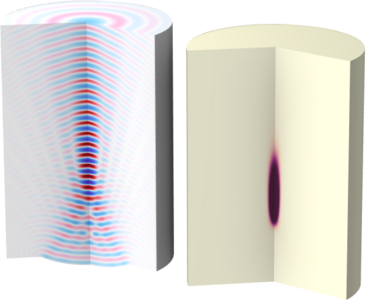
This tutorial studies tissue heating induced by high-intensity focused ultrasound (HIFU). The nonlinear propagation of the HIFU signal is modeled using the Nonlinear Pressure Acoustics, Time Explicit physics interface. In this example, the source amplitude is sufficient to generate ... Read More
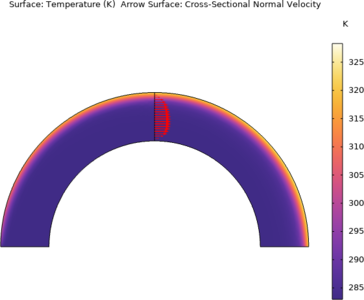
This tutorial illustrates how to use built-in variables and operators, for the evaluation of the bulk temperature along a geometry like a channel, a pipe or a chimney, in a nonisothermal flow in 2D and 3D. The bulk temperature may be needed to compute the heat transfer coefficient for an ... Read More


