
The Application Gallery features COMSOL Multiphysics® tutorial and demo app files pertinent to the electrical, structural, acoustics, fluid, heat, and chemical disciplines. You can use these examples as a starting point for your own simulation work by downloading the tutorial model or demo app file and its accompanying instructions.
Search for tutorials and apps relevant to your area of expertise via the Quick Search feature. Note that many of the examples featured here can also be accessed via the Application Libraries that are built into the COMSOL Multiphysics® software and available from the File menu.
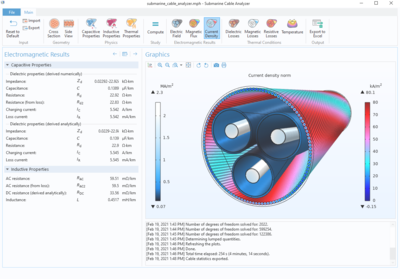
This application demonstrates how the Application Builder in the COMSOL Multiphysics® software can be used to make advanced cable modeling available to a general audience. At its core is a multiphysics model based on the technology introduced in the Cable Tutorial Series. The ... Read More
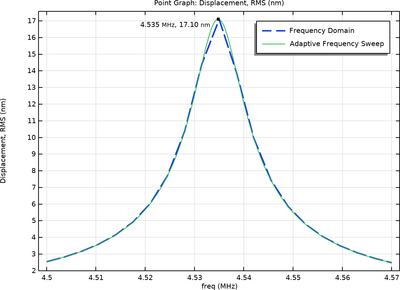
This tutorial shows how to model a miniaturized magnetostrictive antenna developed for use inside living cells. The stress in the antenna, the magnetic flux density, the current density, and the displacement of the tip of the device are investigated at the resonance frequency. Read More
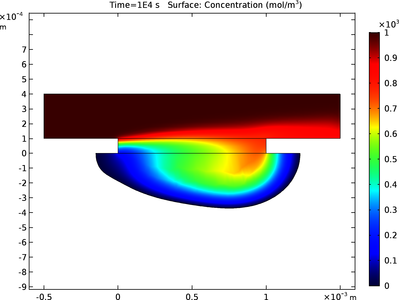
This example illustrates the principle of wet chemical etching for 2D geometry under laminar flow. The purpose of this tutorial is to examine how the copper substrate material is depleted and how the cavity shape evolves during the wet etching process. Wet chemical etching is ... Read More
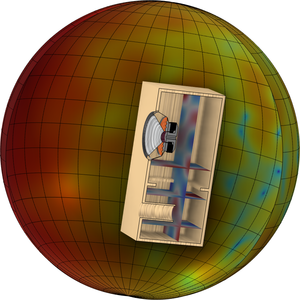
This tutorial models the acoustic behavior of a loudspeaker driver mounted in a bass reflex enclosure. The enclosure, sometimes called the cabinet, alters substantially the sensitivity and radiation characteristics of the loudspeaker and it is why it is usually considered part of the ... Read More

Prismatic lithium cells are widely used in electric vehicles and battery energy storage systems. This example demonstrates the use of the Lithium-Ion Battery interface for a full 3D prismatic battery equipped with two jelly rolls. The model defines a full so-called Newman model but ... Read More
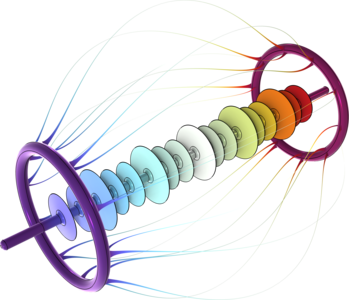
This example demonstrates how to use the Electrostatic interface to calculate the surface electric field of a typical high-voltage insulator. It is shown that the inhomogeneity and the maximum of the surface electric field are greatly reduced with the installation of the grading rings. ... Read More
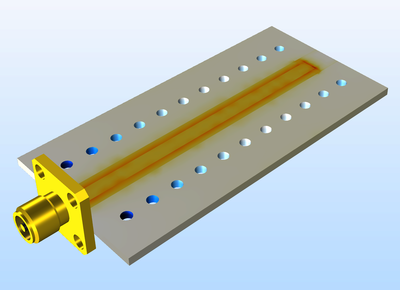
SMA connectors are popularly used on printed circuit boards (PCB) for testing. This model shows how to excite an SMA connector on a microwave substrate and how to terminate a grounded coplanar waveguide (GCPW) with 50 ohm using a lumped port and an air-bridge. Read More

This example exemplifies how to optimize the design of a capacitor through optimization. A more detailed description of the phenomenon and the modeling process can be seen in the blog post "Changing the Dimensions of a Model Using Shape Optimization". Read More
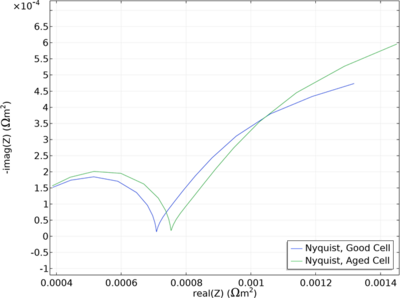
The model used is the P2D model also called the Newman model. Parameter estimation is run using experimental data of driving cycles from healthy cells. The parameter values are determined for a confidence of 0.95 for each parameter. Parameter estimation is then run using data from ... Read More
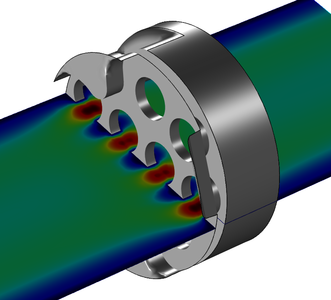
In this tutorial, the acoustic properties of a wax guard are analyzed. A wax guard is a small perforated mesh used to protect the receiver (the miniature loudspeaker in a hearing aid) used for receiver-in-the-ear (RITE) or receiver-in-canal (RIC) hearing aids. Because of the very small ... Read More


