
The Application Gallery features COMSOL Multiphysics® tutorial and demo app files pertinent to the electrical, structural, acoustics, fluid, heat, and chemical disciplines. You can use these examples as a starting point for your own simulation work by downloading the tutorial model or demo app file and its accompanying instructions.
Search for tutorials and apps relevant to your area of expertise via the Quick Search feature. Note that many of the examples featured here can also be accessed via the Application Libraries that are built into the COMSOL Multiphysics® software and available from the File menu.
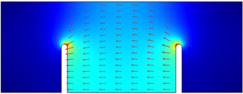
This example treats the modeling of electroosmotic flow in porous media. The system consists of a compartment of sintered porous material and two electrodes that generate an electric field. The cell combines pressure and electroosmotic driven flow. The equations that are solved are the ... Read More
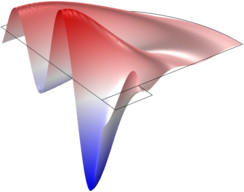
A piezoelectric transducer can be used either to transform an electric current to an acoustic pressure field or, the opposite, to produce an electric current from an acoustic field. These devices are generally useful for applications that require the generation of sound in air and ... Read More
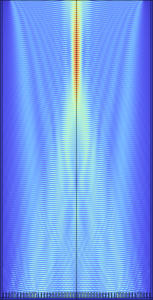
This is a simple yet powerful simulation app for designing a two-dimensional reflective metalens. This metalens consists of a array of glass nanopillars on a metal substrate. Initially, the app determines the optimal grating parameters for a specific wavelength and calculates the ... Read More
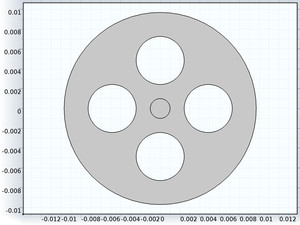
A quadrupole mass filter (QMF) is a key component of a modern mass spectrometer. A QMF uses direct current (DC) and alternating current (AC) electric fields to analyze positive or negative ions by mass to charge ratio. A QMF consists of 4 parallel rods spaced equidistantly, the ratio of ... Read More
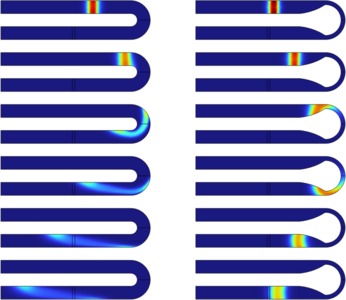
As an analyte band flows through a curved channel in an electroosmotically driven flow, dispersion of the band occurs due to gradients in the fluid velocity across the channel. These velocity gradients result from differences in the electric field acting at the walls within the curved ... Read More
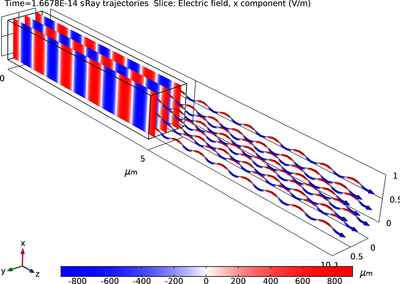
This tutorial shows how to set up a ray release based on the incident electric field at a boundary. First the Electomagnetic Waves, Frequency Domain interface is used to solve for the electric field of a plane wave. Then rays are released with initial intensity and polarization matching ... Read More

This model simulates the initiation of streamers from suspended metal particles, their propagation under a high electric field, and their subsequent merging. The discharge current flows into the metal particles, which are maintained at equal potential. These suspended particles enhance ... Read More
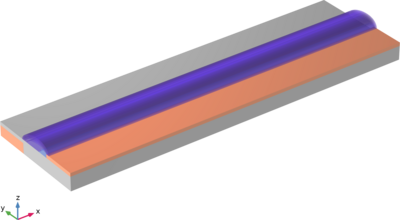
This model demonstrates the simulation of surface dielectric barrier discharges (DBDs) using the Electric Discharge interface. The formulation incorporates a comprehensive set of physical processes, including charge transport, impact ionization, electron attachment, recombination, and ... Read More
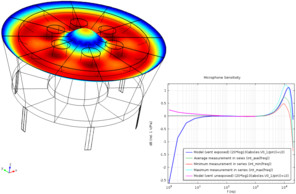
This is a model of the Brüel and Kjær 4134 (BK 4134) condenser microphone. The geometry and material parameters are those of the actual microphone. The modeled sensitivity level is compared to measurements performed on an actual microphone and shows good agreement. The membrane ... Read More
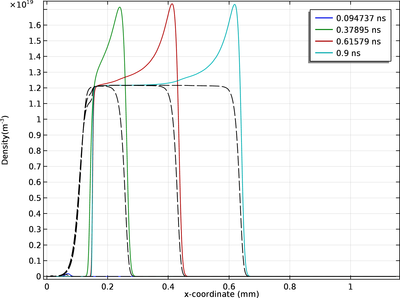
Streamers are transient filamentary electric discharges that can develop in a nonconducting background in the presence of an intense electric field. These discharges can attain high electron number density and consequently a high concentration of chemical active species that are relevant ... Read More


