
The Application Gallery features COMSOL Multiphysics® tutorial and demo app files pertinent to the electrical, structural, acoustics, fluid, heat, and chemical disciplines. You can use these examples as a starting point for your own simulation work by downloading the tutorial model or demo app file and its accompanying instructions.
Search for tutorials and apps relevant to your area of expertise via the Quick Search feature. Note that many of the examples featured here can also be accessed via the Application Libraries that are built into the COMSOL Multiphysics® software and available from the File menu.
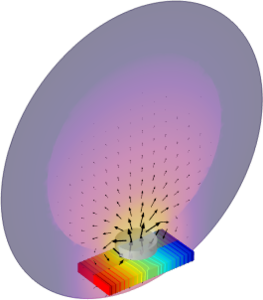
A Hall effect sensor is a semiconductive material with an anisotropic conductivity that is a function of the magnetic field. A magnet, mounted on a wheel, is rotated around nearby the sensor and the variation in the electric potential across the sensor is modeled. For complete ... Read More
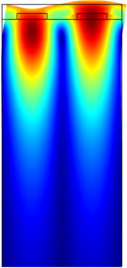
A surface acoustic wave (SAW) is an acoustic wave propagating along the surface of a solid material. Its amplitude decays rapidly, often exponentially, through the depth of the material. SAWs are utilized in many kinds of electronic components, including filters, oscillators, and ... Read More
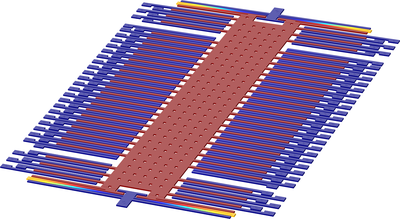
This model shows how to simulate a capacitively actuated surface micromachined accelerometer, using the Electromechanics Interface. It is based on a case study from the book Microsystem Design by Stephen D. Senturia (Kluwer Academic Publishers, 5th Edition, 2003, pages 513-525). Read More
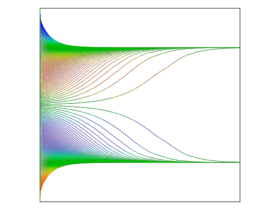
For more than 50 years, it has been known that neutrally buoyant particles in a flow channel tend to converge to specific locations in the channel cross section. For a cylindrical pipe, or two parallel planes carrying a Poiseuille flow, the equilibrium position is about 0.6 times the ... Read More
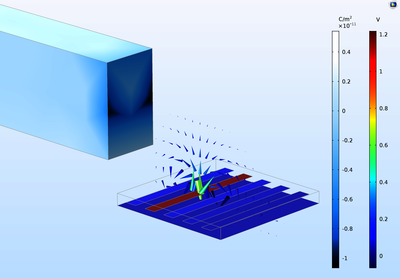
This tutorial model explains how to extract lumped matrices by means of the Stationary Source Sweep study. The capacitance matrix of a five-terminal system is used to infer the position of a metallic object rather like real-world capacitive position sensors. The example illustrates the ... Read More
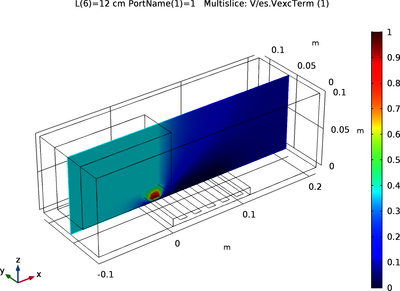
This tutorial model explains how to extract lumped matrices by means of the Stationary Source Sweep study. The capacitance matrix of a five-terminal system is used to infer the position of a metallic object similar to real-world capacitive position sensors. The example illustrates the ... Read More

This model is a benchmark for three-phase flow commonly used in food processing, pharmaceutical industry, and chemical processing. The results are validated against data reported in the literature. A gas bubble rises through two layers of liquid, a lighter liquid resting on top of a ... Read More
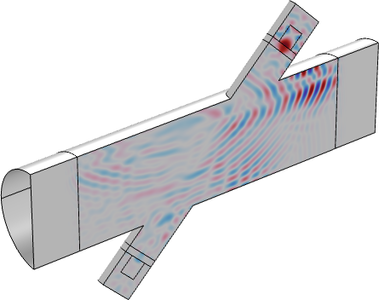
Ultrasonic flowmeters determine the velocity of a fluid flowing through a pipe by sending an ultrasonic signal across the flow at a skew angle. When there is no flow, the transmitting time between the transmitter and the receiver is the same for the signals sent in the upstream and ... Read More
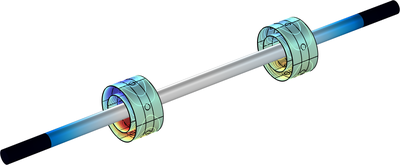
In this model, a turbocharger supported on two floating ring bearings is studied. The film forces on the ring cause it to rotate within the bearing. In steady state, the ring rotates at a constant angular speed and the torque on the ring due to the inner and outer films are balanced. ... Read More
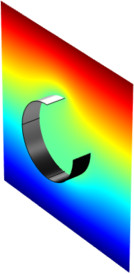
Many applications involve simulating the electromagnetic behavior of relatively thin material in voluminous domains. To save computer memory and processing time, the thin materials can be treated differently by resolving them with 3D meshes. Here, the modeling domain is a box filled ... Read More


