
The Application Gallery features COMSOL Multiphysics® tutorial and demo app files pertinent to the electrical, structural, acoustics, fluid, heat, and chemical disciplines. You can use these examples as a starting point for your own simulation work by downloading the tutorial model or demo app file and its accompanying instructions.
Search for tutorials and apps relevant to your area of expertise via the Quick Search feature. Note that many of the examples featured here can also be accessed via the Application Libraries that are built into the COMSOL Multiphysics® software and available from the File menu.
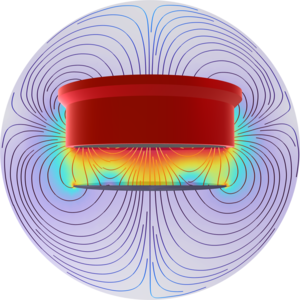
One-sided magnets are magnets designed to have both magnetic poles emerging from the same side of the magnet. This results in the magnetic flux being concentrated on one side of the magnet. These kinds of magnets are found in many applications from the common fridge magnet to particle ... Read More

The model includes a compilation of benchmark examples included in the text book: Shape Memory Alloys: Modeling and Engineering Applications. D. Lagoudas Ed. Springer 2008. The model uses the Souza–Auricchio model and shows the thermomechanical properties of a NiTi alloy sample ... Read More
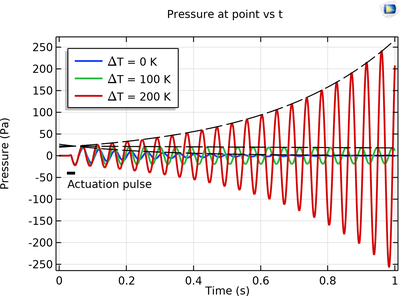
This is a model of a simple thermoacoustic engine that includes a thermal stack to convert thermal energy to acoustic energy. The model is set up using two approaches: 1) Using a linear perturbation (acoustic) approaches solving the fluid motion with the Thermoviscous Acoustics, ... Read More
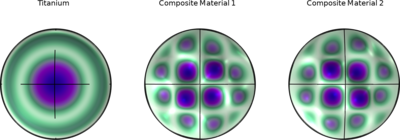
Analyzing resonances is essential when designing loudspeakers. Resonances can come from various sources in a loudspeaker, with the diaphragm being a significant one. There are numerous traditional approaches to address diaphragm resonances, each with its own benefits and drawbacks. A ... Read More
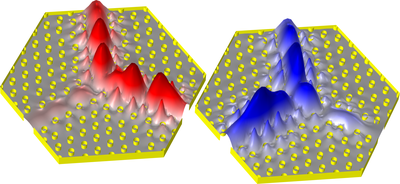
This model simulates the propagation of two frequency bands in a photonic crystal with three ports. The crystal is initially symmetric, so that the two frequency bands are directly equally to either output port. The model optimizes the position of the pillars in order to make the two ... Read More
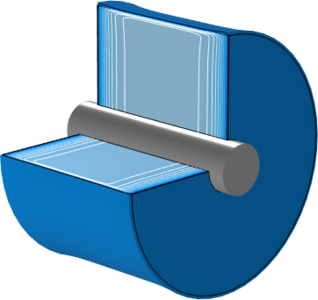
This example demonstrates how to model moisture transfer and induced swelling in a paperboard roll subject to varying ambient conditions. The material properties of the paperboard are anisotropic. Read More
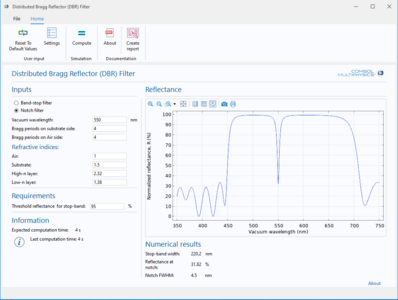
A distributed Bragg reflector (DBR) is a periodic structure formed from alternating dielectric layers that can be used to achieve nearly total reflection within a range of frequencies. The main advantage of DBRs over ordinary metallic mirrors is that DBRs can be engineered to have custom ... Read More
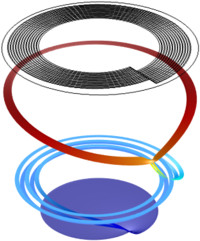
Due to the large differences in length scales in a lithium-ion battery, with the thickness of the different layers typically being several orders of magnitude smaller than the extension in the sheet direction, a lithium-ion battery is often well represented by a one-dimensional model. ... Read More
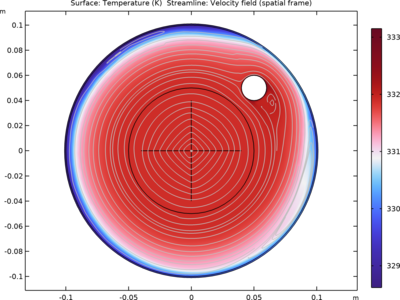
This model illustrates the modeling of temperature distribution in a simplified mixer. Read More
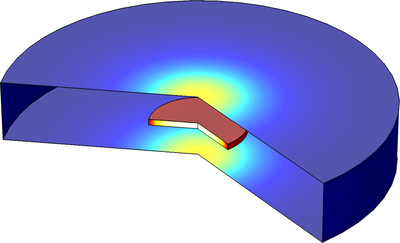
The flash method is widely used for measuring the thermal conductivity of a thin sample material that is about the size of a coin. The sample material is submitted to a laser pulse on one of its faces. In turn, the opposite face is heated up by around 1 K. As the pulse is uniform and ... Read More


