
The Application Gallery features COMSOL Multiphysics® tutorial and demo app files pertinent to the electrical, structural, acoustics, fluid, heat, and chemical disciplines. You can use these examples as a starting point for your own simulation work by downloading the tutorial model or demo app file and its accompanying instructions.
Search for tutorials and apps relevant to your area of expertise via the Quick Search feature. Note that many of the examples featured here can also be accessed via the Application Libraries that are built into the COMSOL Multiphysics® software and available from the File menu.
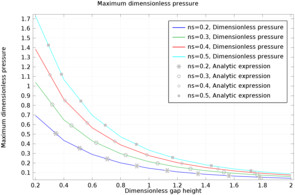
This benchmark model computes the load-carrying capacity of a one dimensional hydrodynamic step bearing. The results are compared with analytic expressions obtained by solving the Reynolds equations directly in this simple case. Read More
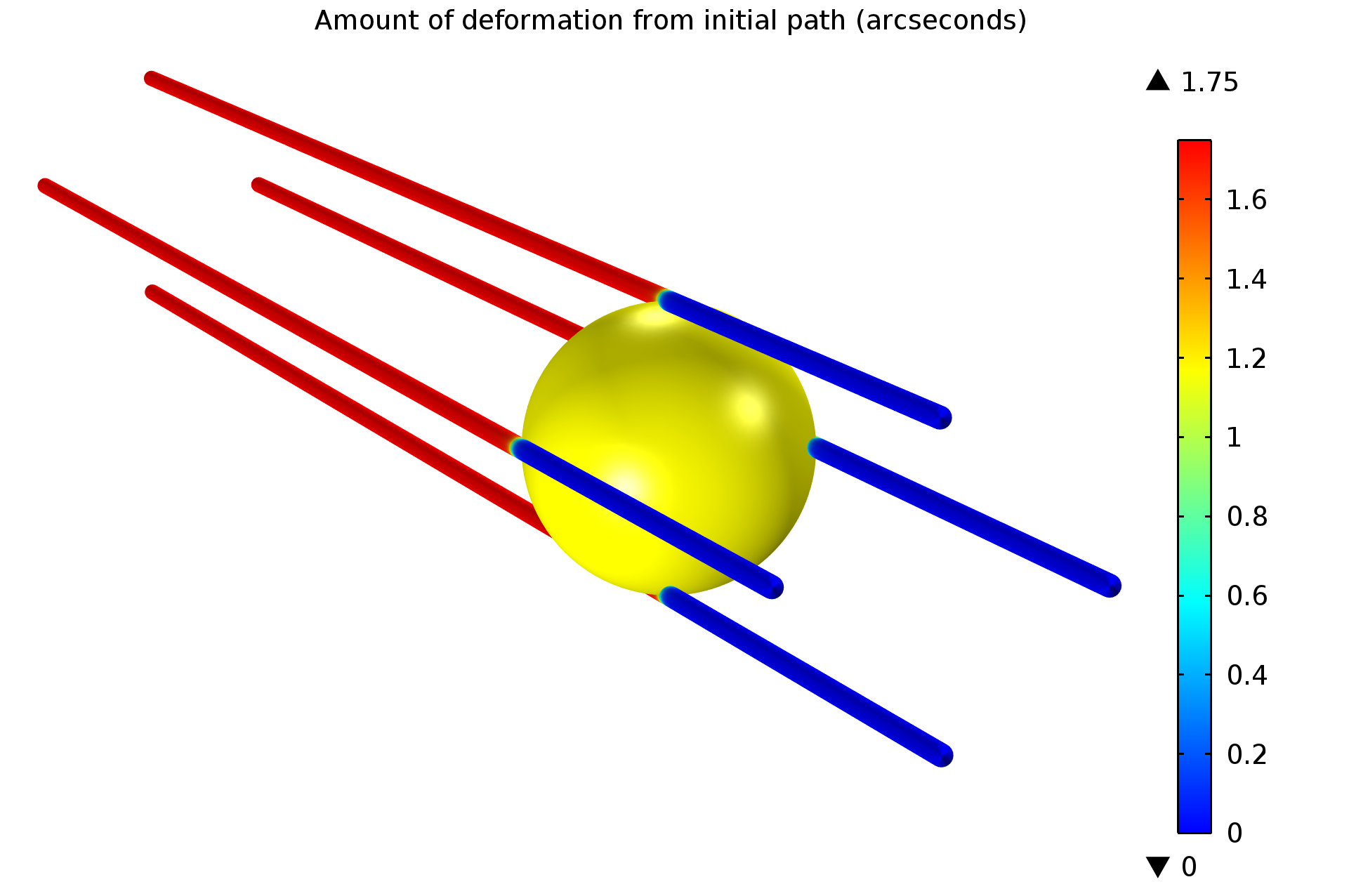
This model demonstrates how the sun causes 1.75 arcseconds of deflection for rays grazing the sun's surface as observed from the earth. Einstein predicted this value after refining his theory of relativity during World War I. Read More
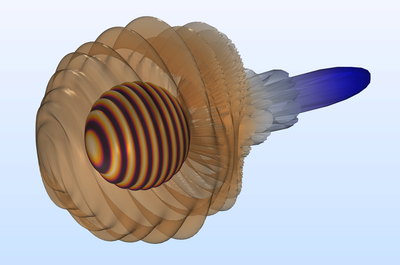
This example uses asymptotic techniques to study the radar cross-section (RCS) response of a conductive sphere. The selected physics interface transforms the incident plane-wave field on the boundaries to the far-field using the Stratton–Chu formula. The computed results are compared to ... Read More

This example illustrates the principle of electrochemical polishing. The simplified 2D model geometry consists of two electrodes and an intermediate electrolyte domain The positive electrode has a protrusion, representing a surface defect. The purpose of the model is to examine how this ... Read More
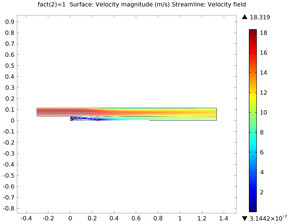
The backward facing step is an interesting case for studying the performance and solution strategy of a turbulence model. In this case, the flow is subjected to a sudden increase of cross-sectional area, resulting in a separation of flow starting at the point of expansion. Spatial ... Read More

This example illustrates a linear buckling analysis conducted for a corrugated conical shell, utilizing a single sector of the geometry along with cyclic symmetry periodicity edge conditions. The results are compared to those using the full shell geometry. Read More
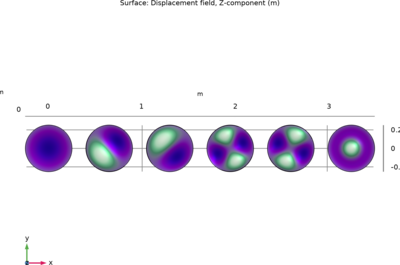
This example studies the natural frequencies of a pretensioned membrane exhibiting stress stiffening. The model results are compared with the analytical solution. Two different techniques for generating the prestress are explored. Read More
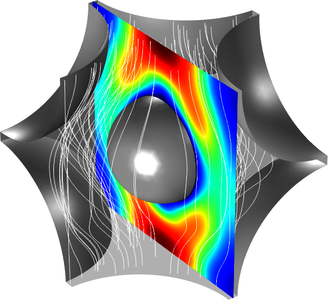
This example shows how to estimate the permeability of a porous material by creating a detailed fluid flow model in a small unit cell. The result of the model is a lumped permeability of the material, which can be used in homogenized models using Darcy's law or the Brinkman equations. ... Read More
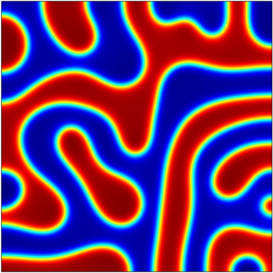
Phase separation occurs when a binary system is quenched from its stable, homogeneous one-phase state into the two-phase region of its phase diagram. The spontaneous separation of two immiscible fluids is sometimes referred to as spinodal decomposition. Each phase tends to separate into ... Read More
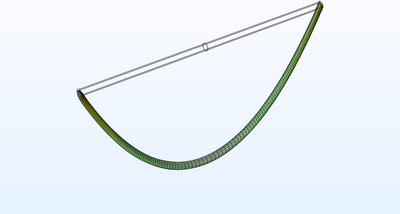
The catenary is the geometrical shape that corresponds to the curve followed by an idealized chain or cable supported at both ends and hanging under its own weight. The viscous catenary problem describes the motion of a cylinder of highly viscous fluid, supported at its ends as it flows ... Read More


