
The Application Gallery features COMSOL Multiphysics® tutorial and demo app files pertinent to the electrical, structural, acoustics, fluid, heat, and chemical disciplines. You can use these examples as a starting point for your own simulation work by downloading the tutorial model or demo app file and its accompanying instructions.
Search for tutorials and apps relevant to your area of expertise via the Quick Search feature. Note that many of the examples featured here can also be accessed via the Application Libraries that are built into the COMSOL Multiphysics® software and available from the File menu.
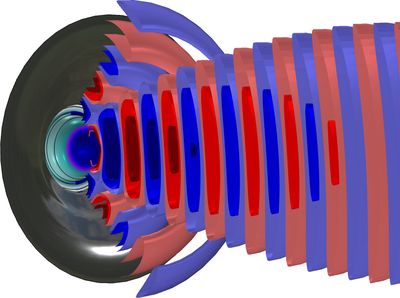
A tweeter is a high frequency driver used in loudspeaker systems. An ideal tweeter will produce a constant sound pressure level at a given distance in front of the driver independently of frequency, that is, a flat response. Ideally the tweeter will also, to a certain degree, maintain ... Read More
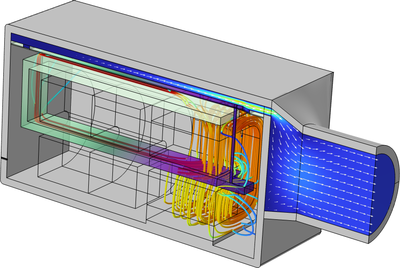
This is a full vibro-electroacoustic simulation of a balanced armature transducer (BAT or also known as a receiver in some industries) which is a high-performance miniature loudspeaker often used in hearing aids and other in-ear audio products such as earbuds. The model is set up and ... Read More
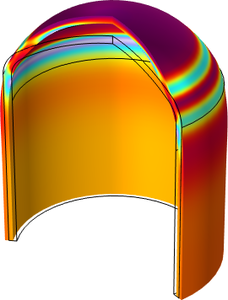
A thin-walled container made of rolled steel is subjected to an internal overpressure. As an effect of the manufacturing method, the out-of- plane direction has a higher yield stress than the other two directions. Hill’s orthotropic plasticity is used to model the difference in yield ... Read More
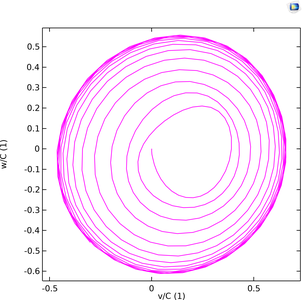
The Whirling of a Uniform Shaft tutorial model shows you how to perform a transient analysis of a uniform shaft under gravity. The shaft is supported by two hydrodynamic bearings at its ends. The gyroscopic effect causes the rotor to whirl about its initial axis and the rotor eventually ... Read More
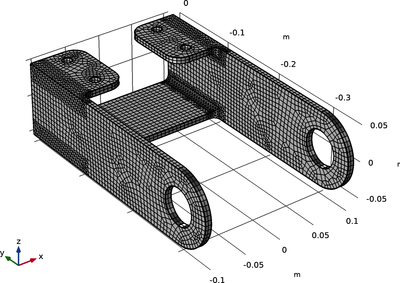
This tutorial demonstrates how to partition a 3D part to create a swept mesh. The example explores different strategies for partitioning the geometry, and demonstrates how to combine hexahedral and tetrahedral meshes. Read More
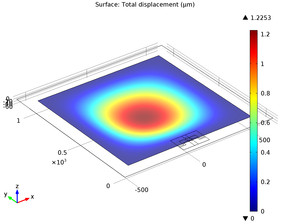
Piezoresistive pressure sensors were some of the first MEMS devices to be commercialized. Compared to capacitive pressure sensors, they are simpler to integrate with electronics, their response is more linear and they are inherently shielded from RF noise. They do, however, usually ... Read More
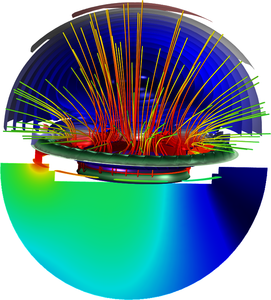
This model analyzes the electromagnetic, mechanical, and acoustical characteristics of the OWS-1943T-8CP (discontinued) speaker. Beside certain details, the geometry, material properties, and measurements are copyright by Ole Wolff. Starting from the geometry of the speaker, an ... Read More
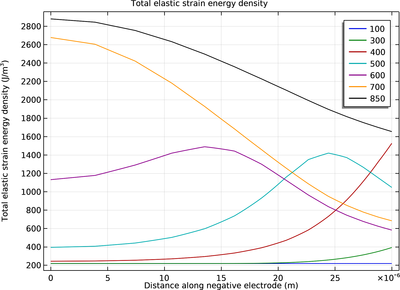
Diffusion-induced stress in lithium-ion battery electrode materials can occur as a result of compositional inhomogeneities during lithium intercalation in the host material particles. These stresses are important since the electrode host material can undergo significant volume changes ... Read More
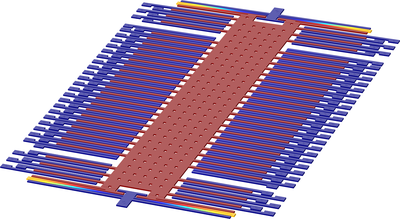
This model shows how to simulate a capacitively actuated surface micromachined accelerometer, using the Electromechanics Interface. It is based on a case study from the book Microsystem Design by Stephen D. Senturia (Kluwer Academic Publishers, 5th Edition, 2003, pages 513-525). Read More
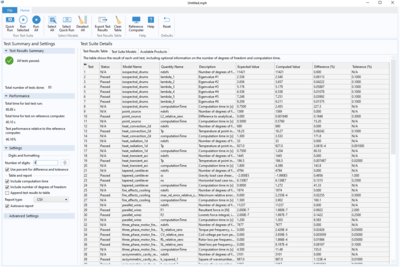
The installation verification application can be used to help verify that your COMSOL Multiphysics® or COMSOL Server™ installation works as expected on your hardware platforms and operating systems. The app automatically loads and runs a suite of test models and compares the results with ... Read More


