
The Application Gallery features COMSOL Multiphysics® tutorial and demo app files pertinent to the electrical, structural, acoustics, fluid, heat, and chemical disciplines. You can use these examples as a starting point for your own simulation work by downloading the tutorial model or demo app file and its accompanying instructions.
Search for tutorials and apps relevant to your area of expertise via the Quick Search feature. Note that many of the examples featured here can also be accessed via the Application Libraries that are built into the COMSOL Multiphysics® software and available from the File menu.
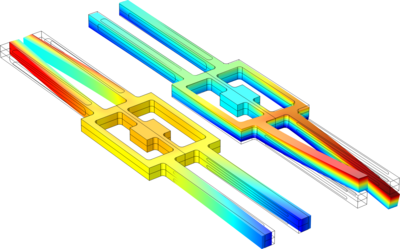
This model shows how to analyze a tuning fork based piezoelectric rate gyroscope. The reverse piezoelectric effect is used to drive an in-plane tuning fork mode. This mode is coupled to an out of plane mode by the Coriolis force and the resulting out of plane motion is sensed by the ... Read More
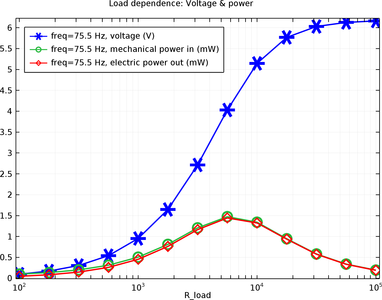
This model shows how to analyze a simple, cantilever based, piezoelectric energy harvester. A sinusoidal acceleration is applied to the energy harvester and the output power is evaluated as a function of frequency, load impedance and acceleration magnitude. Read More
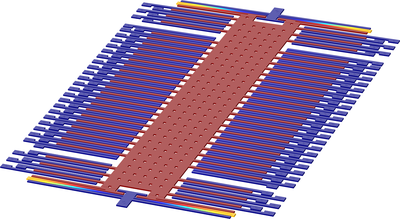
This model shows how to simulate a capacitively actuated surface micromachined accelerometer using the Electromechanics, Solid interface. It is based on a case study from the book Microsystem Design by Stephen D. Senturia (Kluwer Academic Publishers, 5th Edition, 2003, pages 513–525). Read More
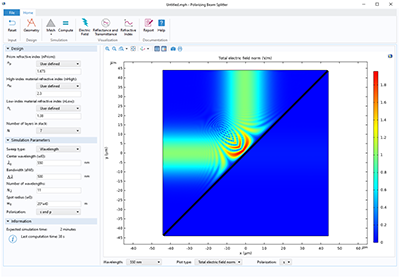
A Gaussian beam is incident on a 45-degree thin-film stack embedded in glass material prisms. The thin-film stack is designed from alternating high and low refractive index materials. The wave will be refracted at the Brewster angle at each internal interface. Thus, mainly p-polarized ... Read More

The models here showcase several use cases of the Circuit Extractor add-in, which is able to generate electric circuits from solved physics. A more detailed description of this tutorial model can be found in the blog post "Extracting Electrical Circuits from Electromagnetics ... Read More
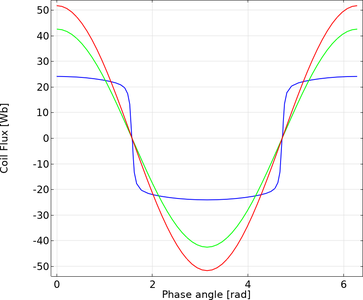
A model comparing the magnetization material models in time-dependent and frequency domain studies. Effective B-H curves are used for frequency domain. A linear relative permeability is included as reference. Read More
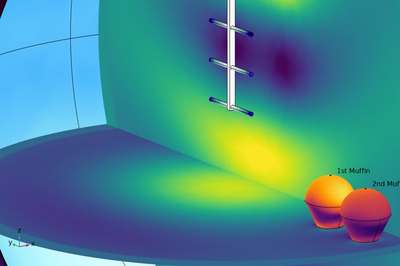
In food industries, microwave heating is gaining attention over a conventional heating treatment because of several advantages such as precise process control, speed of heating, fast turn-on and turn-off time, etc. In this model, a high directional Yagi-Uda antenna is used to heat up ... Read More
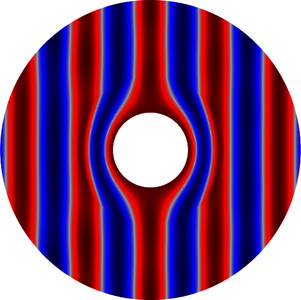
This example demonstrates how to use a background field in a sound scattering problem. The application is an acoustic invisibility cloak made of a metamaterial. Two different types of metamaterials are used, one using an anisotropic acoustic material with varying properties and one using ... Read More
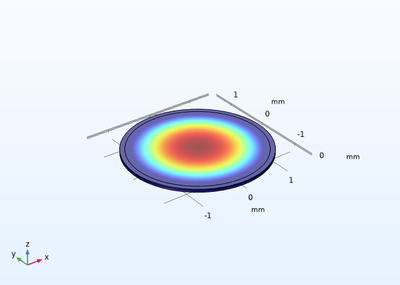
This 2D axisymmetric model demonstrates the operation of a pyroelectric detector found in instruments for measuring laser energy. A disk of lithium niobate (LiNbO3) is sandwiched between two electrodes and connected to an external circuit. The disk is mounted on a ring-shaped ... Read More
The elastic cantilever beam is one of the elementary structures used in MEMS designs. This model shows the bending of a cantilever beam under an applied electrostatic load. The model solves the deformation of the beam under an applied voltage. Read More


