
The Application Gallery features COMSOL Multiphysics® tutorial and demo app files pertinent to the electrical, structural, acoustics, fluid, heat, and chemical disciplines. You can use these examples as a starting point for your own simulation work by downloading the tutorial model or demo app file and its accompanying instructions.
Search for tutorials and apps relevant to your area of expertise via the Quick Search feature. Note that many of the examples featured here can also be accessed via the Application Libraries that are built into the COMSOL Multiphysics® software and available from the File menu.
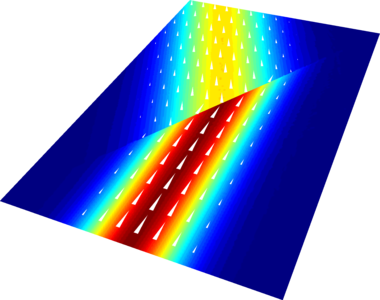
This model demonstrates the polarization properties for a Gaussian beam incident at an interface between two media at the Brewster angle. The model shows how to use the Electromagnetic Waves, Beam Envelopes physics interface with a User defined phase specification. Matched Boundary ... Read More
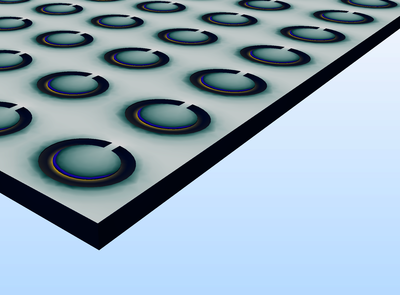
Frequency-selective surfaces (FSS) are periodic structures with a bandpass or a bandstop frequency response. This model shows that only signals around the center frequency can pass through the periodic complementary split ring resonator layer. Read More
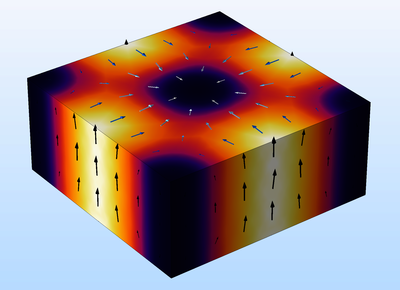
A classic benchmark example in computational electromagnetics is to find the resonant frequency and Q-factor of a cavity with lossy walls. Here, models of rectangular, cylindrical, and spherical cavities are shown to be in agreement with analytic solutions. Read More
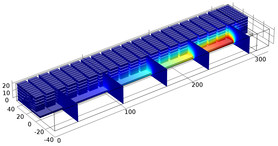
The elastic cantilever beam is one of the elementary structures used in MEMS designs. This model shows the bending of a cantilever beam under an applied electrostatic load. The model solves the deformation of the beam under an applied voltage. Read More
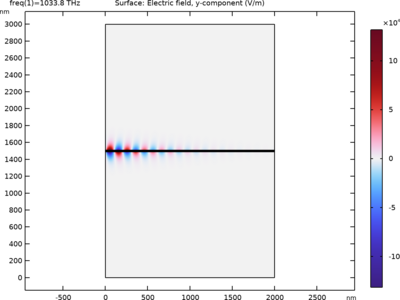
This model demonstrates how to simulate surface plasmon polaritons in a thin metal layer embedded in dielectric layers. It calculates the dispersion and propagation length of surface plasmon polaritons as a function of photon energy. Read More
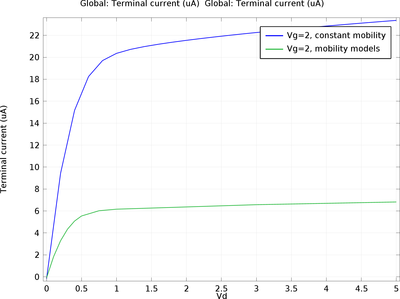
This model shows how to add several linked mobility models to the simple MOSFET example. Read More
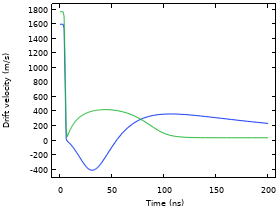
This tutorial model presents a study showing the transient negative mobility and the negative differential conductivity effects in xenon. The stationary and time dependent Boltzmann equation in the two-term approximation is used to compute the electron energy distribution function. ... Read More
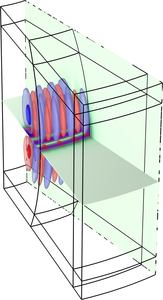
Dielectric microspheres can support whispering gallery modes with high optical quality factors. This model illustrates how to compute the different eigenmodes and resonance frequencies. The resonance frequencies are either filtered by their spatial localization in the resonator or by ... Read More
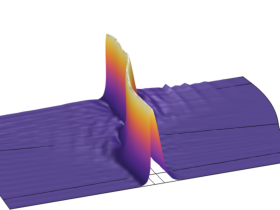
This model demonstrates how to simulate the propagation of guided waves in a dielectric S-bent optical waveguide. The model demonstrates that the phase approximation, required by the Electromagnetic Waves, Beam Envelopes interface, can be numerically calculated by solving an additional ... Read More
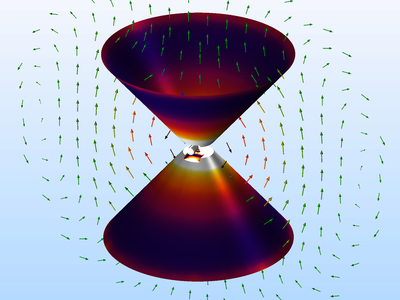
A Biconical antenna is a type of wideband antenna with omni-directional radiation pattern in the H-plane similar to a dipole antenna. A coaxial feed is connected to the radiators using two 90 degree bent arms. The model shows that the biconical antenna works well in applications ... Read More


