
The Application Gallery features COMSOL Multiphysics® tutorial and demo app files pertinent to the electrical, structural, acoustics, fluid, heat, and chemical disciplines. You can use these examples as a starting point for your own simulation work by downloading the tutorial model or demo app file and its accompanying instructions.
Search for tutorials and apps relevant to your area of expertise via the Quick Search feature. Note that many of the examples featured here can also be accessed via the Application Libraries that are built into the COMSOL Multiphysics® software and available from the File menu.
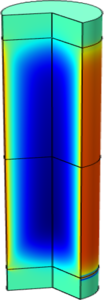
A gate-all-around MOSFET consists of a nanowire with a gate electrode wrapped around the circumference. Since the entire nanowire forms the channel, this configuration provides the best possible electrostatic control of the channel and offers a good candidate for the miniaturization of ... Read More
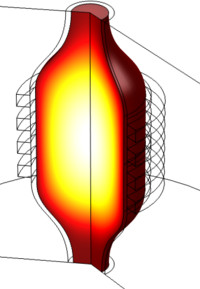
This model simulates a plasma at medium pressure (2 torr) where the plasma is still not in local thermodynamic equilibrium. At low pressures the two temperatures are decoupled but as the pressure increases the temperatures tend towards the same limit. Read More
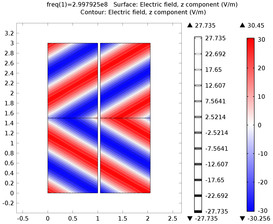
It is possible to engineer the structure of materials such that both the permittivity and permeability are negative. Such materials are realized by engineering a periodic structure with features comparable in scale to the wavelength. It is possible to model both the individual unit cells ... Read More
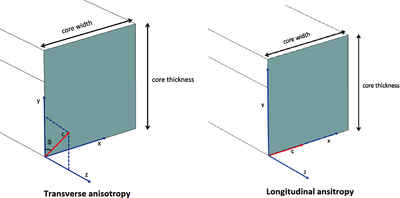
In this model, a modal analysis is performed while parametrically sweeping the length of a waveguide from 0.5 um to 4 um to derive the dispersion curve for the anisotropic core. Both transverse and longitudinal anisotropy are considered in two different models. These models are ... Read More
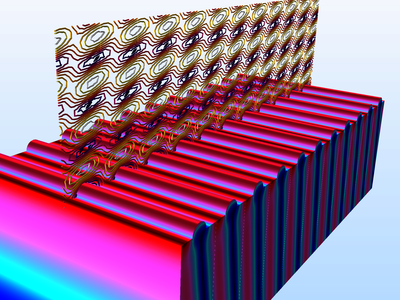
Surface plasmon-based circuits are being used in applications such as plasmonic chips, light generation, and nanolithography. The Plasmonic Wire Grating Analyzer application computes the coefficients of refraction, specular reflection, and first-order diffraction as functions of the ... Read More
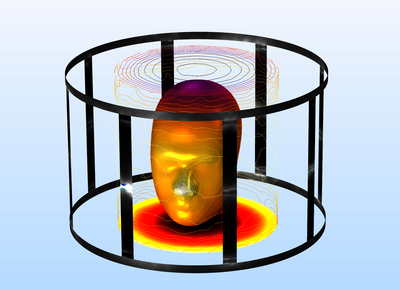
Magnetic resonance imaging (MRI) systems generate a magnetic flux density (B-field) to create images. Providing a homogeneous field distribution within a birdcage coil is a key factor for improving the quality of the scanned data. A homogeneous magnetic field can be found through ... Read More
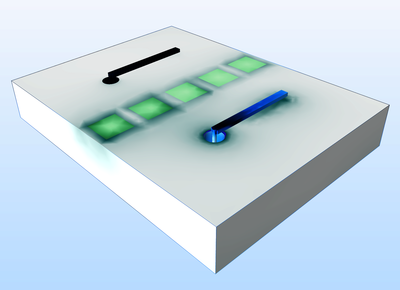
An Electromagnetic Band Gap (EBG) structure can be used to increase the isolation between antennas close to each other. The decoupling effect is not only a function of frequency but also polarization and coupling-plane configuration. When designing an EBG structure, one needs to make ... Read More
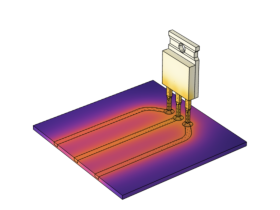
In every system where there is conduction of electric current, and where the conductivity of the material is finite, there will be electric heating. Electric heating, also referred to as Joule heating, is in many cases an undesired by-product of current conduction. This model simulates a ... Read More
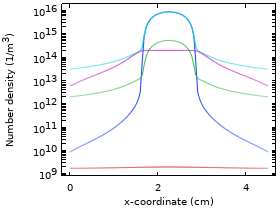
This tutorial model solves for a one-dimensional capacitively coupled plasma reactor in a mixture of argon/oxygen. Important aspects and strategies for modeling electronegative discharges are discussed. Read More
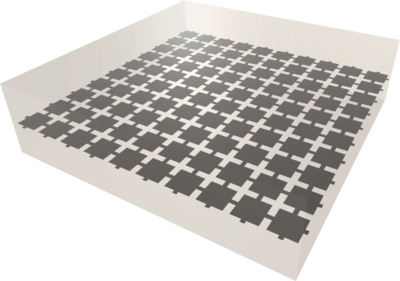
Graphene, carbon atoms arranged in a two-dimensional hexagonal lattice has sparked tremendous research and application interests since its experimental discovery about two decades ago. Besides being ultrathin, this material exhibits a plethora of interesting properties, including high ... Read More


