
The Application Gallery features COMSOL Multiphysics® tutorial and demo app files pertinent to the electrical, structural, acoustics, fluid, heat, and chemical disciplines. You can use these examples as a starting point for your own simulation work by downloading the tutorial model or demo app file and its accompanying instructions.
Search for tutorials and apps relevant to your area of expertise via the Quick Search feature. Note that many of the examples featured here can also be accessed via the Application Libraries that are built into the COMSOL Multiphysics® software and available from the File menu.

The engine block of a car includes a cooling jacket to remove excess heat from combustion. The cooling jacket consists of open spaces in the cylinder block and the cylinder head. When the engine is running, a coolant fluid is pumped through the jacket to keep the engine from overheating. ... Read More
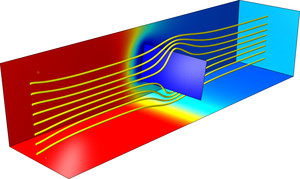
Chemical vapor deposition (CVD) allows a thin film to be grown on a substrate through molecules and molecular fragments adsorbing and reacting on a surface. This example illustrates the modeling of such a CVD reactor where triethyl-gallium first decomposes, and the reaction products ... Read More
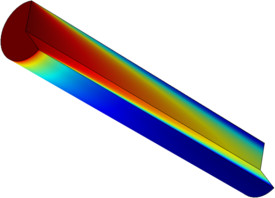
Chemical engineering students can model a nonideal tubular reactor, including radial and axial variations in temperature and composition, and investigate the impact of different operating conditions with this easy-to-use app. The process described by the Tubular Reactor with ... Read More
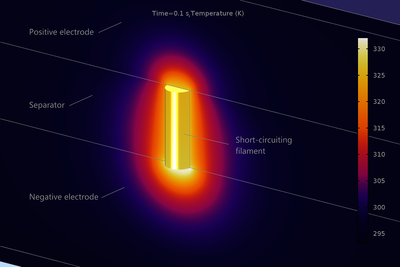
During an internal short circuit of a battery, the two electrode materials are internally and electronically interconnected, giving rise to high local current densities. Internal short circuits may occur in a lithium-ion battery due to, for instance, lithium dendrite formation or a ... Read More
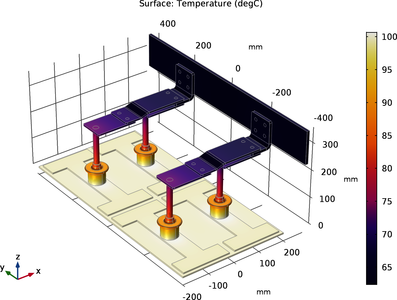
This tutorial analyzes the resistive heating (Joule heating) of a busbar assembly designed to conduct a direct current from a current source to the anode in an electrolysis process. Read More
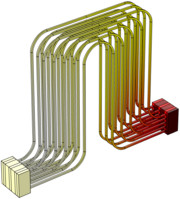
This model simulates a temperature profile in a number of cells and cooling fins in a liquid-cooled battery pack. The model solves in 3D and for an operational point during a load cycle. A full 1D electrochemical model for the lithium battery calculates the average heat source. Read More
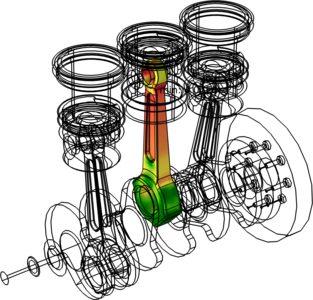
In a reciprocating piston engine, the connecting rods are subjected to high cyclic stresses that increase with engine speed. Because failure of a critical component can lead to failure of the engine, fatigue life is an important consideration in the design of these components. In this ... Read More
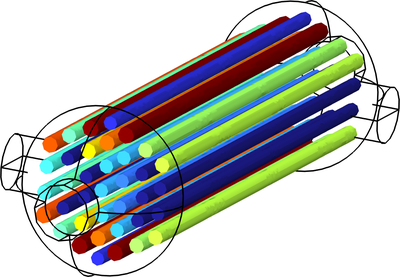
Commercial heat exchangers often feature a complex design. It is significantly easier to build a design with new CAD parameters than to build designs with novel topologies. This model demonstrate how to optimize the size and position of the tubes in a tube and shell heat exchanger. It is ... Read More
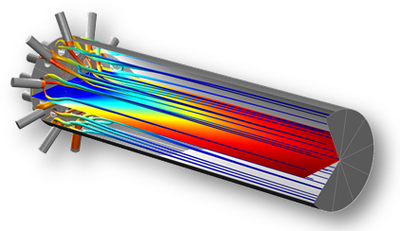
In a polymerization reactor for polyester manufacturing, the mixing in the reactor is achieved by impinging turbulent jets of reactants onto each other. The turbulence affects the reaction kinetics and quality of the polymer linkage. Turbulent flows involving rapid reaction kinetics are ... Read More
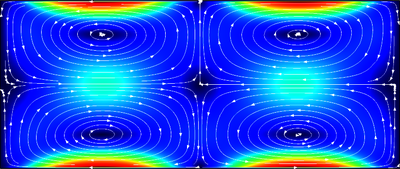
Recent advances in the fabrication of microfluidic systems require handling of live cells and other micro particles as well as mixing. All this can, for example, be achieved using acoustic radiation forces and the viscous drag from the streaming flow. Streaming: Due to the nonlinear ... Read More


