
The Application Gallery features COMSOL Multiphysics® tutorial and demo app files pertinent to the electrical, structural, acoustics, fluid, heat, and chemical disciplines. You can use these examples as a starting point for your own simulation work by downloading the tutorial model or demo app file and its accompanying instructions.
Search for tutorials and apps relevant to your area of expertise via the Quick Search feature. Note that many of the examples featured here can also be accessed via the Application Libraries that are built into the COMSOL Multiphysics® software and available from the File menu.
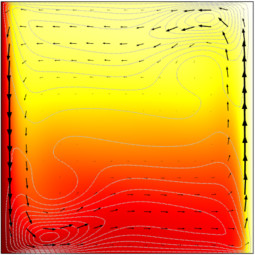
This model couples the Navier Stokes equations and the heat transfer equations to examine density driven flow of free fluids. Here the fluid is in a square cavity with a heated wall. The buoyancy force is a Boussinesq term added to the Navier-Stokes equations. The equation is ... Read More
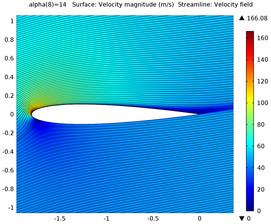
This model simulates the flow around an inclined NACA 0012 airfoil at different angles of attack using the SST turbulence model. The results show good agreement with the experimental lift data of Ladson and the pressure data of Gregory and O’Reilly. Read More
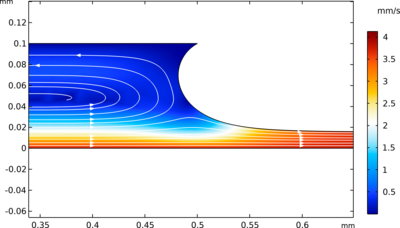
Free-surface calculations in the predefined flow interfaces are currently limited to time-dependent studies when using the built-in boundary conditions. Here, a stationary formulation following Romero et al. [1] is implemented using equation contributions. The attached slides describe ... Read More
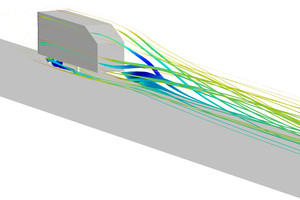
The Ahmed body represents a simplified, ground vehicle geometry of a bluff body type. Its shape is simple enough to allow for accurate flow simulation but retains some important practical features relevant to automobile bodies. This model describes how to calculate the turbulent flow ... Read More
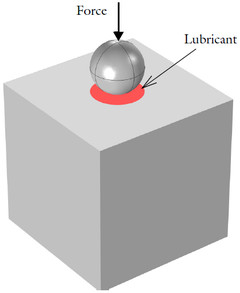
This benchmark model computes the transient pressure distribution and film height in a squeeze film bearing for lubrication in a nonconformal conjunction of a solid sphere and an elastic wall separated by a lubricant film. This model solves the benchmark case of hydrodynamic interaction ... Read More

The Turbulent flow, Elliptic Blending R-ε interface is used to analyze fully developed turbulent flow in a spanwise rotating channel. Due to the influence of the Coriolis force on turbulence, profiles of the flow variables are skewed at moderate rotation rates. An asymmetry between the ... Read More

Wastewater treatment is a several-step process for removing contaminants. Firstly, large, solid particles are removed through sedimentation, flotation, and filtration. And then in a second step, biological treatment causes the smaller particles to aggregate, forming so called flocs. ... Read More
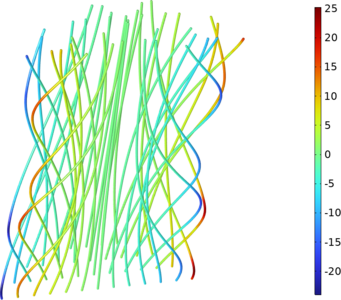
Turbulent flow, SSG-LRR interface is employed to investigate turbulent flow in a straight semicircular duct. The resulting flow pattern is characterized by slow secondary motions in the plane normal to the duct axis. The order of magnitude of velocity of those motions is 1% of the ... Read More
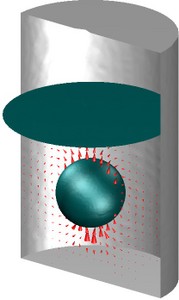
The level set method is well suited for problems with moving boundaries in which the geometry’s topology changes with time. A bubble of oil that travels up through water and finally merges with oil at the top causes this kind of topology change. For problems where the topology is ... Read More
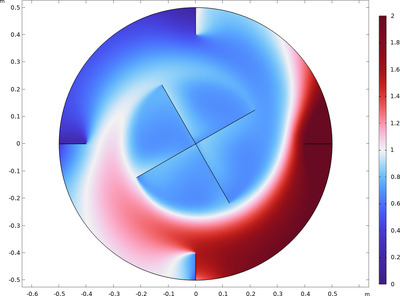
This example shows how the mixing capability of a stirred vessel can be evaluated. To efficiently reach the steady operational conditions the turbulent flow is solved for using a frozen rotor analysis, and a following time dependent simulation. When a quasi-steady flow field has ... Read More


