
The Application Gallery features COMSOL Multiphysics® tutorial and demo app files pertinent to the electrical, structural, acoustics, fluid, heat, and chemical disciplines. You can use these examples as a starting point for your own simulation work by downloading the tutorial model or demo app file and its accompanying instructions.
Search for tutorials and apps relevant to your area of expertise via the Quick Search feature. Note that many of the examples featured here can also be accessed via the Application Libraries that are built into the COMSOL Multiphysics® software and available from the File menu.
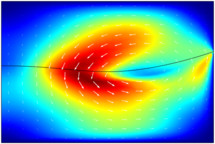
The contact angle of a two-fluid interface with a solid surface is determined by the balance of the forces at the contact point. In electrowetting the balance of forces at the contact point is modified by the application of a voltage between a conducting fluid and the solid surface. In ... Read More
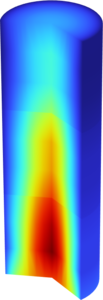
This model simulates a cylindrical furnace with isotropic scattering. It validates the use of the Discrete Ordinates Method for 2D axisymmetric cases, comparing the results with the highly accurate Monte Carlo method. The setup and reference Monte Carlo values are given in: R .P. Gupta, ... Read More
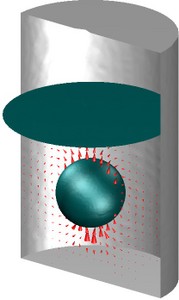
The level set method is well suited for problems with moving boundaries in which the geometry’s topology changes with time. A bubble of oil that travels up through water and finally merges with oil at the top causes this kind of topology change. For problems where the topology is ... Read More
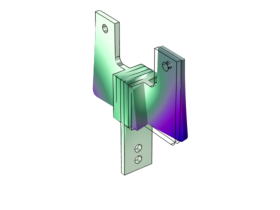
In this example, the eigenmodes of a structural damper are computed. In the damper, most of the deformation is controlled by the viscoelastic domains, which have strongly frequency-dependent stiffness and damping properties. This leads to a nonlinear eigenfrequency problem, which can be ... Read More
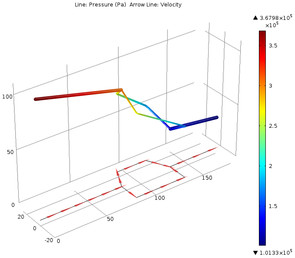
The Pipe Flow interface allows you to simulate non-Newtonian fluids flowing in pipes. This example models a coal slurry being transported in a pipe system where the pipe diameter changes in different sections. The slurry behaves as a non-Newtonian fluid described by the power law model. ... Read More

This model studies a part of a shell-and-tube heat exchanger where hot water enters from above. The cooling medium flows through the tubes that, in this model, impose a constant temperature at the walls. Furthermore, the tubes are assumed to be made of stainless steel and the heat flux ... Read More
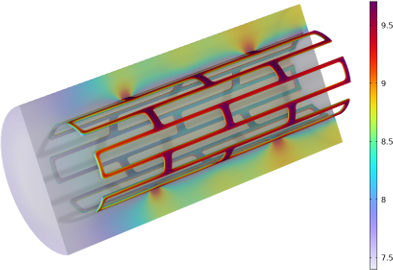
Biodegradable metallic biomaterials such as Magnesium (Mg) are gathering attention for biomedical applications due to their favorable properties. The present model simulates dissolution of a Mg stent in a blood vessel. Due to the circumferential symmetry, only one-twelfth of the actual ... Read More
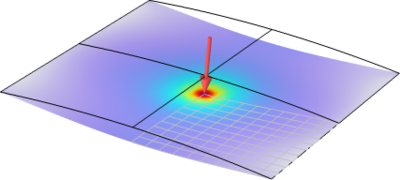
For slender structures, buckling is a catastrophic instability if the service load is above the critical limit. For such structures, it can be important to study the behavior of the structure beyond the critical buckling load, which is known as postbuckling analysis. Tracing the ... Read More
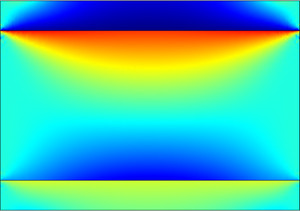
The thermal stress in a layered plate is studied in this example. A plate consisting of two layers, a coating and a substrate layer, is stress and strain free at 800 degrees C. The temperature of the plate is reduced to 150 degrees C and thermal stresses are induced due to the difference ... Read More

Interference fit is a technique used to join or fit one part over or around another part. The internal part is cooled, so that it shrinks, and is then fitted. Once the part heats up again and expands, a contact pressure builds up at the interface between the two parts. This type of ... Read More


