
The Application Gallery features COMSOL Multiphysics® tutorial and demo app files pertinent to the electrical, structural, acoustics, fluid, heat, and chemical disciplines. You can use these examples as a starting point for your own simulation work by downloading the tutorial model or demo app file and its accompanying instructions.
Search for tutorials and apps relevant to your area of expertise via the Quick Search feature. Note that many of the examples featured here can also be accessed via the Application Libraries that are built into the COMSOL Multiphysics® software and available from the File menu.
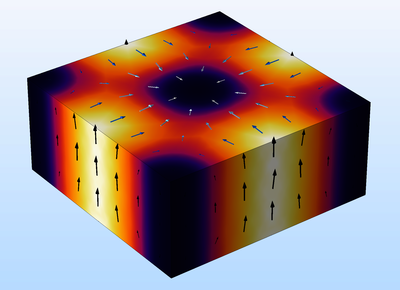
A classic benchmark example in computational electromagnetics is to find the resonant frequency and Q-factor of a cavity with lossy walls. Here, models of rectangular, cylindrical, and spherical cavities are shown to be in agreement with analytic solutions. Read More
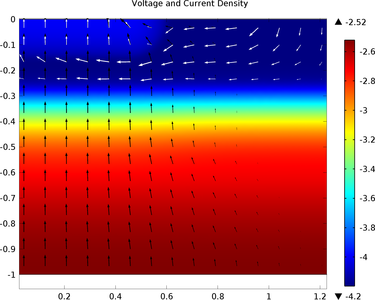
This model shows how to set up a simple Bipolar Transistor model. The output current-voltage characteristics in the common-emitter configuration are computed and the common-emitter current gain is determined. Read More
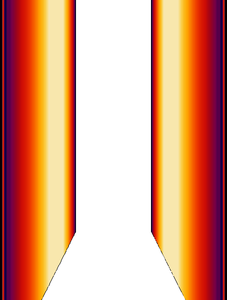
This tutorial shows how to use the Surface-to-Surface Radiation interface to simulate radiative heat transfer with radiation between diffuse emitters and diffuse-and-specular reflectors. This model is separated in two parts. The first part focuses on a validation test for the radiative ... Read More
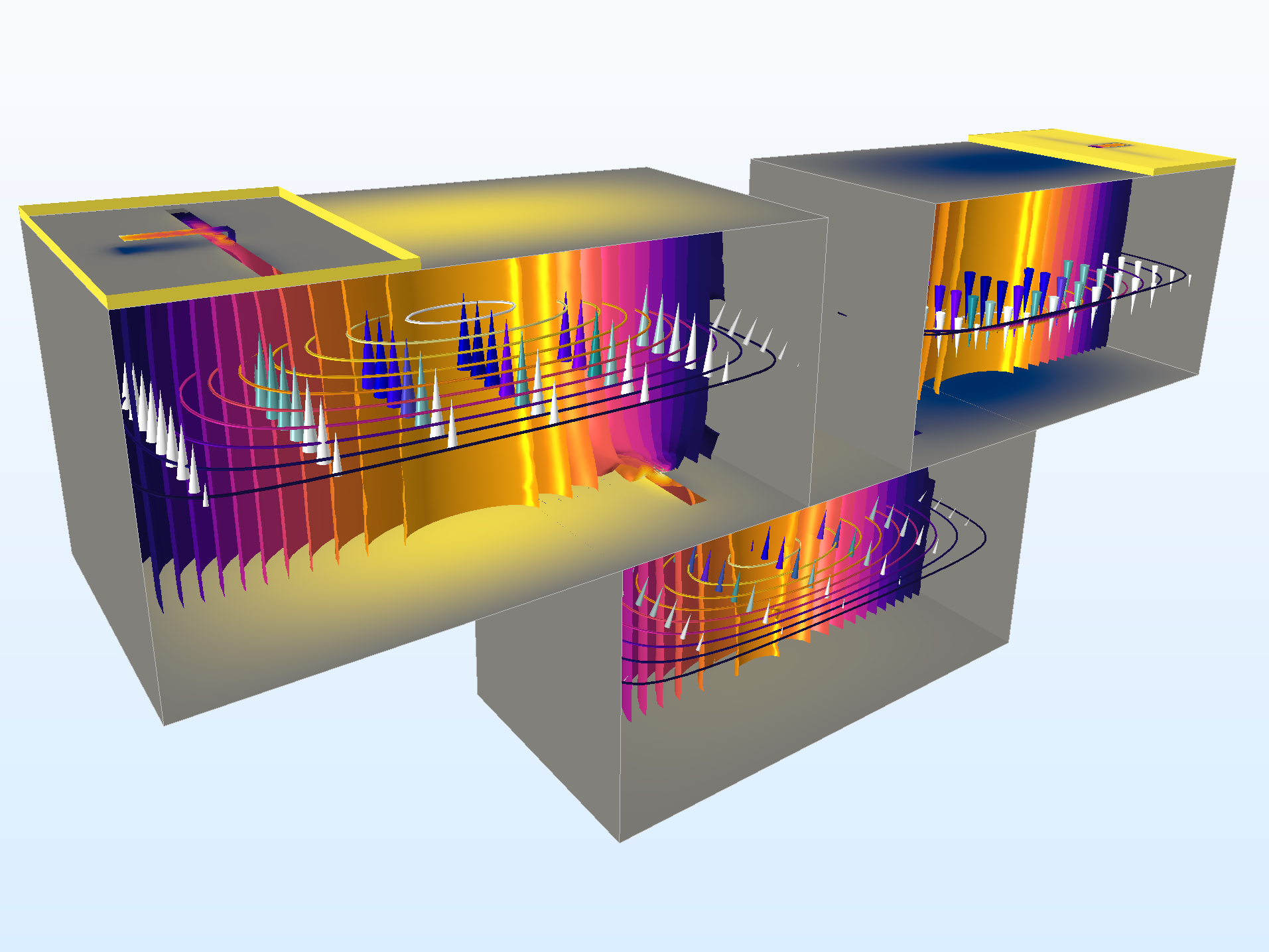
A cascaded cavity filter provides much better bandpass filter performance compared to a single cavity. Out-of-band rejection improves dramatically using a cascaded design. This model uses three rectangular cavity filters coupled via slots. The calculated S-parameters show excellent out ... Read More
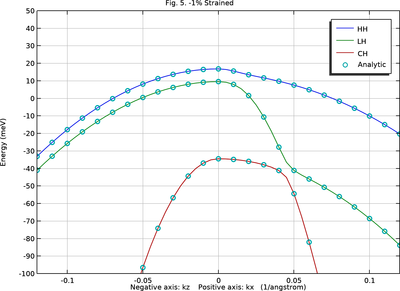
This benchmark model computes the valence band structure of an unstrained and a strained bulk GaN wurtzite crystal, as a tutorial for users who wish to set up multiple wave function components with the Schrödinger Equation interface. The model follows the formulation given in the ... Read More
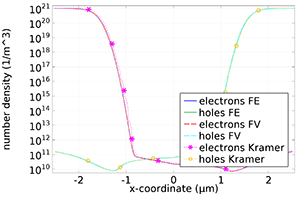
This simple benchmark model computes the potential and carrier concentrations for a one-dimensional p-n junction using both the finite element and finite volume methods. The results are compared with an equivalent device from the book, "Semiconductor Devices: A Simulation Approach," by ... Read More
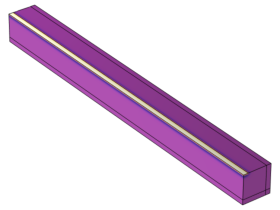
The model demonstrates the basics of the 3-omega method. The coupled electromagnetic heating problem is solved in a solid sample which is heated by a thin copper strip, deposited on the surface of a sample. Analyzing the frequency dependence of the voltage oscillation amplitude, we ... Read More
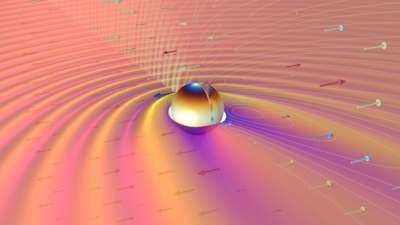
This model illustrates the process of evaluating the radar cross section (RCS) of a metallic sphere through the utilization of the boundary element method (BEM). By taking advantage of a vertical symmetry plane that is parallel to the polarization of an incident background field, the ... Read More
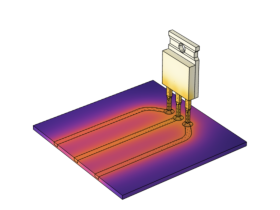
In every system where there is conduction of electric current, and where the conductivity of the material is finite, there will be electric heating. Electric heating, also referred to as Joule heating, is in many cases an undesired by-product of current conduction. This model simulates a ... Read More
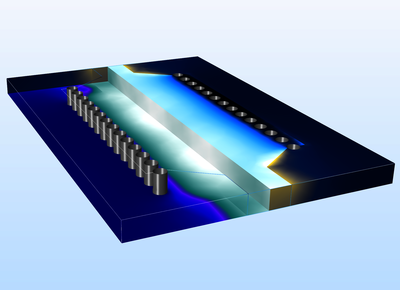
A waveguide-type structure can be fabricated on a substrate by adding vias between the microstrip line and the ground plane. Such a device will behave as a high-pass filter and is attractive because it is easy to fabricate. A model is set up that shows the S-parameters as a function of ... Read More


