
The Application Gallery features COMSOL Multiphysics® tutorial and demo app files pertinent to the electrical, structural, acoustics, fluid, heat, and chemical disciplines. You can use these examples as a starting point for your own simulation work by downloading the tutorial model or demo app file and its accompanying instructions.
Search for tutorials and apps relevant to your area of expertise via the Quick Search feature. Note that many of the examples featured here can also be accessed via the Application Libraries that are built into the COMSOL Multiphysics® software and available from the File menu.
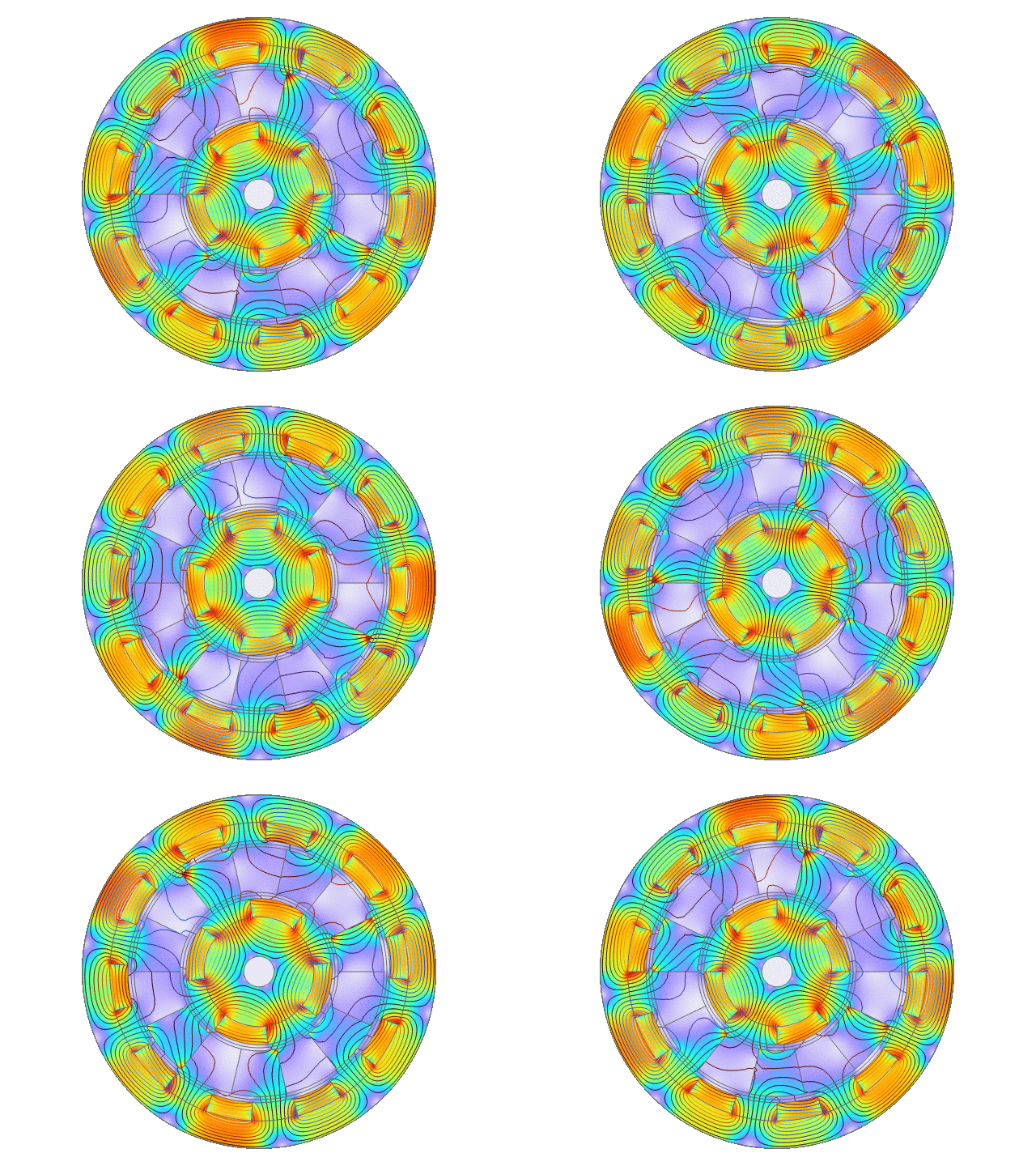
This model presents the transient modeling of a coaxial magnetic bearing using permanent magnets. The coaxial magnetic bearing is advantageous over the conventional mechanical gear mainly because of minimum noise, maintenance free operation, overload protection and physical isolation ... Read More
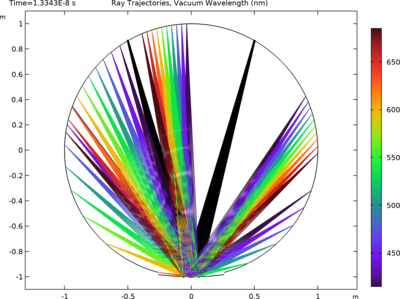
The Rowland circle is a circle of radius R that lies tangent to a concave curved diffraction grating of radius 2R. If the entrance slit of incoming light is positioned on this circle, then rays reflected by the grating will be focused at various points along the same circle based on ... Read More
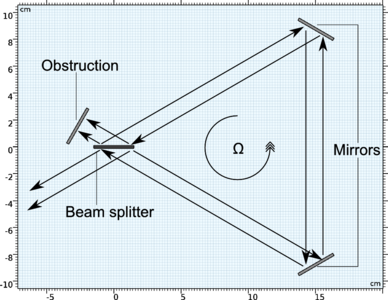
This is a model of a simple Sagnac interferometer consisting of two mirrors and a beam splitter arranged in a triangle. The entire modeling domain rotates; as a result, the rays propagating in opposite directions in the triangle have different optical path lengths due to the Sagnac ... Read More
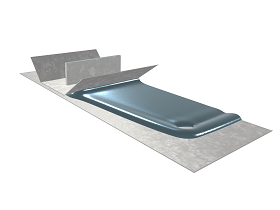
This is a tutorial of a slot die coating process in 3D where the channel is obstructed. The example uses a two-phase flow phase-field method with a non-Newtonian power-law fluid. The effects on the film thickness of the channel obstruction can clearly be seen. Read More

This example demonstrates how to couple the Lithium-ion Battery interface to the Phase Field interface for modeling electrode deformations. The example is based on the Lithium Plating with Deformation model, available in the Battery Design Module Application Library. As current is ... Read More

Surface plasmon polariton (SPP) as well as other types of surface electromagnetic waves is of great interest due to unique physical properties and application potentials. The models here demonstrate how to simulate SPP propagation and its frequency-momentum dispersion relation. The ... Read More
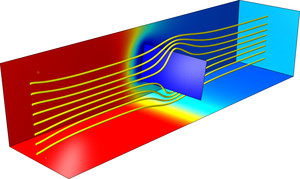
Chemical vapor deposition (CVD) allows a thin film to be grown on a substrate through molecules and molecular fragments adsorbing and reacting on a surface. This example illustrates the modeling of such a CVD reactor where triethyl-gallium first decomposes, and the reaction products ... Read More
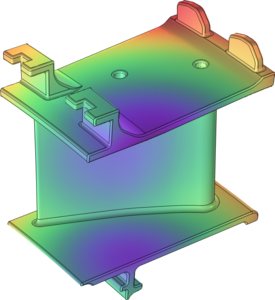
This example shows how to compute thermally induced stresses in a turbine stator blade using the Thermal Stress, Solid interface. The conditions within gas turbines are extreme. The pressure can be as high as 40 bar, and the temperature more than 1000 K. Any new component must therefore ... Read More
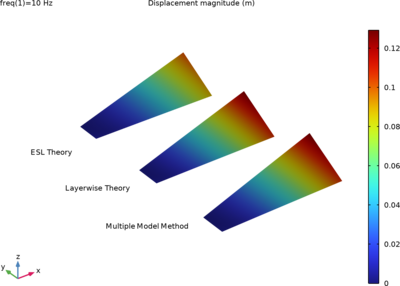
This example demonstrates the modeling of a sandwiched composite blade made of carbon–epoxy, glass–vinylester, and PVC foam materials. Three different methods are used to model the sandwich composite structure: Layerwise theory, Equivalent Single Layer (ESL) theory, and a multiple model ... Read More
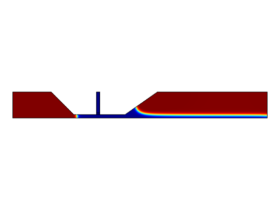
This tutorial shows how to model a slot die coating process with a power-law non-Newtonian fluid in one of the two phases. The model uses a two-phase flow phase-field method. Read More


