
The Application Gallery features COMSOL Multiphysics® tutorial and demo app files pertinent to the electrical, structural, acoustics, fluid, heat, and chemical disciplines. You can use these examples as a starting point for your own simulation work by downloading the tutorial model or demo app file and its accompanying instructions.
Search for tutorials and apps relevant to your area of expertise via the Quick Search feature. Note that many of the examples featured here can also be accessed via the Application Libraries that are built into the COMSOL Multiphysics® software and available from the File menu.
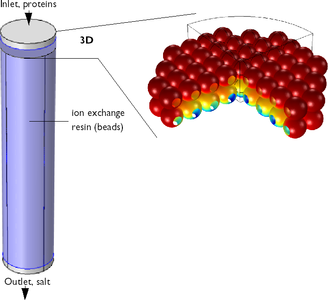
Ion-exchange is a powerful method to separate proteins from solutions and is today readily used in biotechnological and pharmaceutical industry. This model simulates an ion-exchange column for protein adsorption. The fluid phase contains four components: two proteins, solvent, and one ... Read More
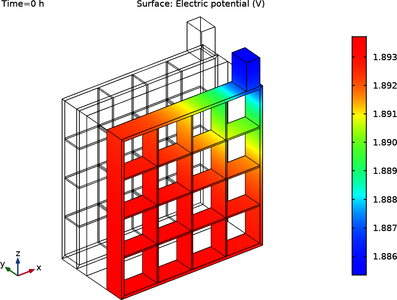
This 3D model example demonstrates the use of the Lead-Acid Battery interface for modeling current distribution in full cell employing a lead-acid battery chemistry. The lead acid battery chemistry uses PbO2 as the positive porous electrode and Pb as the negative porous electrode and ... Read More
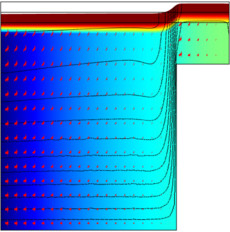
The Poroelasticity interface couples Darcy's law and solid mechanics to assess deformation of porous media that results from fluid withdrawals. The model builds on top of the Terzaghi Compaction example. Results from Terzaghi compaction and Biot poroelasticity analyses are compared to ... Read More
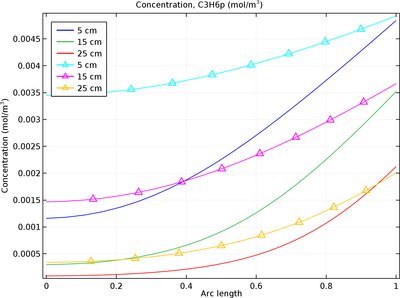
One of the most common reactors in the chemical industry, for use in heterogeneous catalytic processes, is the packed bed reactor. This type of reactor is used both in synthesis as well as in effluent treatment and catalytic combustion. The reactor consists in essence of a container ... Read More
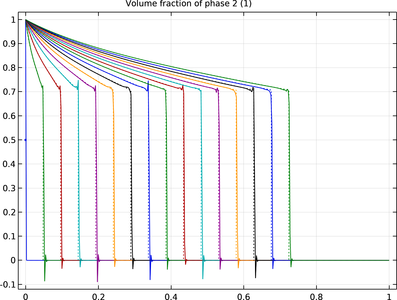
This benchmark models two-phase flow in a porous medium in 1D, where the flow can be analytically described by the Buckley-Leverett equation. Read More
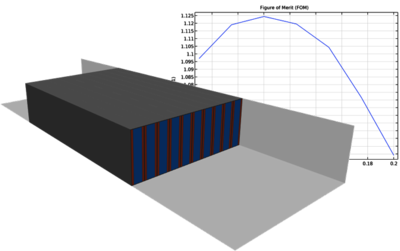
This example computes the effectiveness of a porous microchannel heat sink over a conventional microchannel heat sink. The model is fully parameterized. A parameter study on the thickness of the porous substrate is used to determine the optimal configuration. Read More
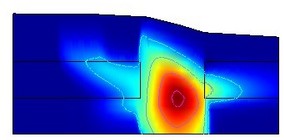
This model demonstrates the application of COMSOL Multiphysics to a benchmark case of steady-state subsurface fluid flow and transient solute transport along a vertical cross section in an unconfined aquifer. Because of profound geologic heterogeneity, the model must estimate solute ... Read More
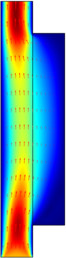
This is a tutorial model of the coupling between flow of a fluid in an open channel and a porous block attached to one of the channel walls. The flow is described by the Navier-Stokes equation in the free region and a Forchheimer-corrected version of the Brinkman equations in the porous ... Read More
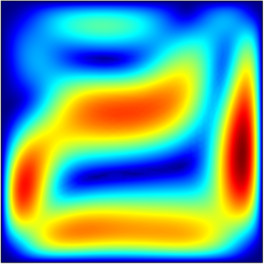
This example treats the modeling of sub-surface flow where free convection in porous media is analyzed. The results are compared with published literature in the field. The model couples the momentum balance to an energy balance through an equation, dependent on temperature, being ... Read More

Drying of porous media is an important process in the food and paper industry among others. Many physical effects must be considered: fluid flow, heat transfer with phase change, and transport of participating liquids and gases. All of these effects are strongly coupled, and predefined ... Read More


