Knowledge-Embedded Neural Network for Multiphysics-Coupled Frequency Shifts in MPCVD Reactors
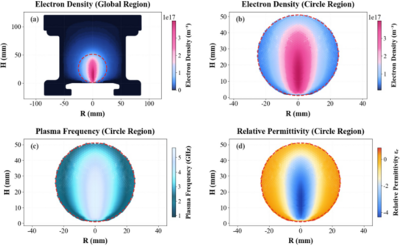
In microwave plasma chemical vapor deposition (MPCVD) reactors the microwave, plasma, flow and thermal fields are coupled in a strongly nonlinear way. The plasma reshapes the electromagnetic field in the chamber and thereby shifts the cavity resonance — by as much as 200 MHz in the case studied here — so that a cavity designed from purely electromagnetic considerations no longer operates at its intended frequency. Although full multiphysics simulation captures this shift, it is far too slow to support design: a single coupled COMSOL Multiphysics run takes about 6 h, which makes exhaustive exploration of the parameter space impractical. To overcome this bottleneck, we propose a knowledge-embedded neural network (KENN) framework, also referred to as a generation–modification neural network. A Generation Network, implemented as a multilayer perceptron, maps the 24 geometric parameters of the cavity to the poles and residues of a pole–residue transfer function describing the intrinsic, plasma-free electromagnetic response. A Modification Network then takes plasma parameters — volume-averaged electron density, microwave power, plasma temperature and pressure — and outputs corrections to those poles and residues, so that the plasma-induced frequency shift and the change in damping are captured explicitly. Adding the two outputs reconstructs S11 under coupled conditions. Because the pole–residue model and the constraint that the real parts of the poles be negative are embedded in the output layer as physical prior knowledge, the predictions remain physically consistent and interpretable. The two networks are trained sequentially with the Adam optimizer: the Generation Network is trained first on CST data, after which the Modification Network is trained with the Generation Network frozen. COMSOL Multiphysics provided the coupled multiphysics data on which this framework is built. In the Plasma Module, the microwave electromagnetic field was coupled with the fluid kinetics of a hydrogen plasma at 800 W, 13 kPa and 2.45 GHz, accounting for electron–hydrogen excitation, dissociation and ionization, to give the spatial distributions of electron density and temperature. Volume-averaged values over the highly ionized core region (ne > 7.8×10^16 m^-3) were then mapped onto a Drude-dispersion complex permittivity to build an equivalent plasma medium model, which supplied the plasma-loaded training labels for 1500 cavity configurations. The trained framework reproduces the simulated S11 curves both with and without plasma. Because plasma loading shifts the resonance, KENN was combined with a genetic algorithm, and a new dimensional solution was found within 45 s that returns the resonant frequency to 2.45 GHz ± 3 MHz, while the maximum electric field above the sample holder rises by 22% and the electron density in that region increases by nearly an order of magnitude. At the same time, the evaluation of a single parameter combination drops from several hours to under 1 s. Embedding physical priors in a modular generation–modification architecture therefore compensates multiphysics-coupled frequency shifts effectively and makes fast, accurate MPCVD reactor design feasible, and the same strategy should transfer to other strongly coupled multiphysics systems.