Multiphysics Simulation of Needle-Based Drug Delivery: Subcutaneous and Intravitreal Injection
Subcutaneous (SC) and intravitreal (IVT) injections are critical routes of administration for targeted drug therapy, each presenting distinct engineering challenges for combination products such as prefilled syringes and autoinjectors. Successful SC injection requires optimization of dose volume, flow rate, needle gauge, and tissue mechanics to ensure patient comfort and effective drug uptake, while IVT injection demands precise control of injectate volume, injection rate, and intraocular pressure (IOP) to protect delicate retinal tissues and achieve accurate drug delivery to specific intraocular targets. We apply multiphysics computational fluid dynamics (CFD) simulations in COMSOL Multiphysics® to model and optimize key performance metrics for both routes of administration.
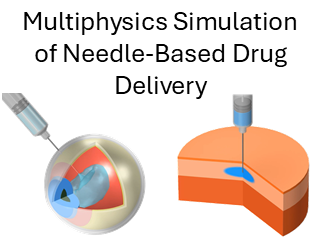
For SC injection (Figure 1, top), we coupled the Porous Media Flow, Solid Mechanics, and Transport of Diluted Species interfaces to model the interplay between interstitial fluid flow, mechanical tissue deformation, and three-dimensional drug dispersion. Injected fluid induces local tissue swelling that alters porosity and permeability, collectively governing drug bolus shape, spread, and uptake. Inputs include needle gauge, injection flow rate, injectate volume and viscosity, and tissue mechanical properties. Key model outputs include injection force, delivery time, bolus geometry, and skin surface deformation (“bleb” formation), which directly inform combination product design and injection protocol optimization.
For IVT injection (Figure 1, bottom), we used the Laminar Flow and Transport of Diluted Species interfaces to model needle-based injection into the vitreous humor, represented as a viscous liquid analog. Simulations predict injection force, delivery time, IOP changes, and drug bolus evolution within the vitreous. The momentum of the injected fluid interacts with the viscous vitreous to produce characteristic bolus shapes sensitive to injection rate and needle gauge. Because the liquid analog does not fully capture the viscoelastic nature of native vitreous, experimental validation is important to ensure predictive accuracy.
For SC injection, simulations predict ellipsoidal drug bolus shapes (Figure 1) and quantify bleb height vs. time (Figure 2) for a flow rate of 0.1 mL/s and injected volume of 2 mL. At high flow rates (>10 mL/min), delivery forces may exceed tens of Newtons. At large volumes (>10 mL), delivery times can extend to minutes. For IVT injection, at 2 mL/min, the injected drug produces a characteristic mushroom-shaped bolus in the vitreous (Figure 3); at higher flow rates, the jet penetrates deeper, increasing the risk of transient pressure elevations near retinal tissues. Both models support parametric studies of needle gauge, flow rate, and formulation viscosity to guide device and protocol optimization for a given drug formulation while maximizing efficacy and patient comfort.
These multiphysics simulations reduce experimental lead times and provide physical insight into how device and formulation parameters affect injection performance, key quality attributes, and patient safety. Virtual parametric evaluation—varying needle gauge, injection rate, or formulation viscosity—enables rapid design iteration without costly physical testing, supporting risk assessment across both modalities. Validation with experimental data remains essential to confirm simulation accuracy, particularly for IVT injection where native vitreous viscoelasticity and for SC injection where patient-to-patient tissue variability can affect predicted outcomes.