Numerical Analysis of Swirl Formation and Turbulence Modelling in Local Dry Welding Chamber
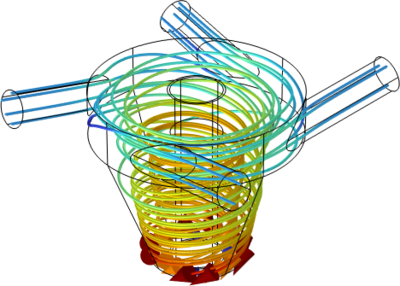
Underwater local dry welding is a prominent method for performing marine joints and repairs, whereas local dry-welding chambers require a stable flow of drainage gas to prevent water ingress and hydrogen diffusion, thereby ensuring weld quality. However, unstable flow, recirculation, and insufficient gas coverage can degrade weld quality and allow water ingress into the chamber. The underwater local dry welding chamber is a device having cylindrical and conical bodies with tangential inlets and one exit, which is underflow for drainage gas exit with a hole inside for the welding torch, as shown in the Figure 1. In this study, a stationary computational fluid dynamics (CFD) investigation was conducted to analyze the flow behavior within a novel conical local dry-welding chamber with an angled inlet configuration. To evaluate the influence of velocity and inlet geometry on swirl formation, turbulence development, pressure distribution, and flow stabilization. Air was used as the working fluid, with an inlet velocity of 45 m/s, a constant outlet pressure of 0 Pa, an inlet radius of 8 mm, and an outlet radius of 20 mm. A physics-dependent mesh has been applied to the chamber at a fine level to assess the flow regime and numerical accuracy. A Three-dimensional (3D) model was developed in COMSOL Multiphysics® version 6.3, using the CFD module and the Shear Stress Transport (SST) turbulence model, coupled with the Reynolds Average Navier Stokes (RANS) model under stationary conditions. The study included evaluations of velocity magnitude, pressure contours, streamline behavior, cutline velocity profiles, and the swirl number(S), which were extracted using COMSOL's post-processing and derived-value tools as shown in Figure 2 and Figure 3. Moreover, the swirl number significantly decreased from 7.6601 at the inlet to 1.1664 at the outlet, with an average value of 4.4903 as shown in Figure 4. The results showed that it generated a stronger vortex flow field, with a large pressure drop across the outlet due to the velocity's influence. Higher inlet velocities increased turbulence intensity, pressure drop, and the size of recirculation zones within the chamber. The analysis revealed that the vortex structure evolved rapidly during the initial stage and gradually reached a quasi-steady condition. Vorticity contours and streamline plots confirmed the formation of coherent recirculation zones in the angled inlet chamber configuration. This work shows the usefulness of COMSOL Multiphysics® for the CFD analysis and optimization of underwater welding systems. The methodology can be extended to other shielding gas chambers, jet-driven devices, and vortex-based industrial flow applications.