
Rub-Induced Ignition in Oxygen-Rich Turbomachinery
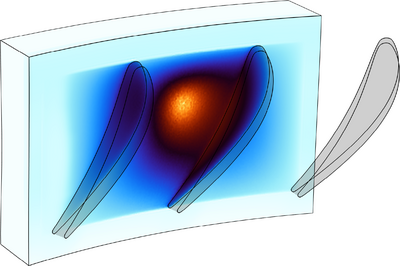
Blade-tip clearance and turbine inlet temperature are critical efficiency parameters in turbomachinery design. Smaller clearances reduce leakage losses, but increase the risk of rubs between blades and the casing. Higher operating temperatures improve efficiency, but reduce the finite-lifetime of structural materials. In conventional turbomachinery, rubs typically result in wear, vibration, uneven bearing loads, or frictional heating. These risks are exacerbated in high-pressure oxygen environments, such as oxygen-rich turbopumps, where high-speed rubs remove protective oxides, heat the underlying metal, and accelerate oxidative heating. This ultimately results in frictional ignition and melting, creating a path to catastrophic engine failure. In this work, we develop a COMSOL workflow for assessing the risk of frictional ignition in a turbine section under transient rub conditions at high oxygen pressures. This methodology evaluates two conservative rub scenarios: a continuous blade rub, in which a single blade remains in contact with the casing, and periodic blade strikes, in which a localized region of the casing is repeatedly struck by successive blades. Together, these limiting scenarios represent bounding conditions for either sustained or repeated transient heating at the rubbing interface. Prior rub models commonly rely on one-dimensional heat-partition theory or steady thermal analyses, which do not fully represent strongly transient rub events with spatially varying thermal boundary conditions. This work extends those approaches by coupling transient frictional heating, spatially varying gas conditions, and oxidative heating to assess frictional ignition in turbine components and identify rub conditions that result in stability, material damage, or ignition. An operating-point snapshot from a previously developed fully-coupled CFD simulation of an oxygen-rich turbopump supplies the initial and boundary conditions, including casing wall temperature and local gas pressure, temperature, and heat-transfer coefficient. COMSOL’s Heat Transfer in Solids interface computes transient heat transfer, frictional heat generation, convection, and oxidative heating. Boundary ODE/DAE equations compute temporally and spatially varying heat partitioning, while Moving Mesh and Solid with Translational Motion features advance the rub geometry. Event logic maintains the periodic strike sequence after each rub completes. By varying the initial conditions, material properties, rub duration, and frictional heat input, we develop ignition maps that define safe operating conditions and identify material properties and design parameters that improve ignition resistance. A contact model may then relate ignition limits to blade-casing interference and contact pressure at each operating point. The resulting framework provides engineering guidelines for designing more efficient, ignition-resistant turbomachinery components.
Download
- french_comsol_slides_compressed.pptx - 27.54MB


