
Vaporization and vapour transport as a thermocouple drift mechanism
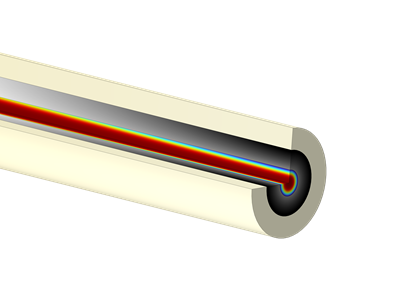
This axisymmetric model describes mass loss and resultant thermoelectric drift in a platinum-rhodium thermocouple wire, in air, operating inside a narrow aluminium oxide (alumina) bore with one end at high temperature and the other end at 0 °C. The key physical mechanism considered is oxide-mediated vaporization of Pt and Rh, with subsequent transport and capture within the bore. The model is deliberately formulated as a kinematic, non-equilibrium model, avoiding assumptions of local gas-surface equilibrium that are not valid in this confined geometry. At elevated temperatures, Pt and Rh in the alloy form volatile oxides (primarily PtO2 and RhO2) in the presence of oxygen. Vaporization is treated as a supply-limited process, controlled by oxide formation on the wire surface rather than by gas-phase equilibrium. Accordingly, the vaporization flux, J_HK, of each species is modelled using a Hertz-Knudsen expression, proportional to the difference between the saturation vapour pressure of the oxide at the local wire temperature and the local species pressure. The solid composition evolves solely through this vaporization flux, with mass change tracked explicitly via a coupled solid-phase balance. The axisymmetric model comprises Pt-Rh wire in air, inside an outer alumina protective tube. The model includes non-isothermal flow (vapour in air), heat transfer in solids and fluids (all domains), transport in solids (wire), transport of diluted species (air). The vaporized oxides are transported within the narrow bore by diffusion. Convection is neglected due to the small dimensions and low flow velocities. The gas-phase concentration fields are solved using a standard transport equation with source terms from wire vaporization and sink terms at the bore wall. The inner surface of the alumina bore acts as a sink for PtO2 and RhO2 vapours. This is modelled using the same Hertz-Knudsen expression to ensure that any species vapour pressure in excess of the saturation vapour pressure results in rejection of the surplus species onto the alumina wall. Thermoelectric drift arises from net preferential loss of Pt and Rh from the wire, particularly in the hot region, leading to a slow change in alloy composition along the temperature gradient. Even small composition changes produce measurable electromotive force (EMF, or voltage) drift due to the strong sensitivity of the Seebeck coefficient to Rh content. The model captures observed experimental trends without the introduction of any arbitrary adjustments, and without invoking equilibrium gas saturation or redeposition mechanisms, relying instead on evaporation kinetics and irreversible wall capture.
Download
- 17661_final_poster.pdf - 1.78MB


