COMSOL Conference 2026 Proceedings
Collection of Papers, Posters, and Slideshows Accepted by the Program Committee
At the COMSOL Conference 2026, engineers, researchers, and scientists from around the globe showcased their use of modeling and simulation across all major industries and in academia. Use the Quick Search tool to find a specific presentation or filter by topic or event location.ISBN: 978-1-7364524-5-5
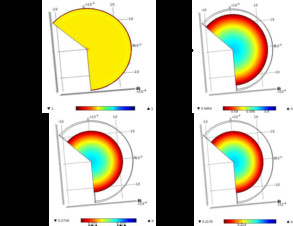
Drying of biomaterials such as foodstuffs involves mass, momentum and energy transport along with large shrinkage of the porous material, which have significant effects on their final quality. Foodstuffs exhibit non-linearity when undergoing large deformations that affect the transport ... Read More
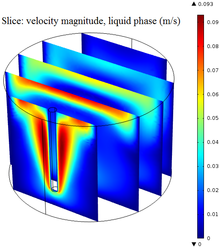
Computational fluid dynamics (CFD) modeling is a useful tool to gain an insight into various high temperature metallurgical processes such as the magnesium refining and the magnesium solid oxide membrane (SOM) electrolysis. In both processes, argon gas was used to stir the molten salt ... Read More

This work presents the results of a 3D numerical magneto-hydrodynamic (MHD) simulation of an electromagnetic DC pump for liquid metal using a rectangular metal flow channel subjected to an externally imposed transversal inhomogeneous magnetic field. In this study. 3D numerical simulation ... Read More
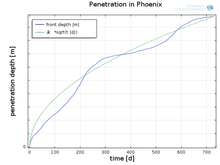
Photovoltaic systems can degrade with moisture. The addition of an edge-seal containing a desiccant can reduce the amount of water reaching the interior. This report discusses the modeling of the water transport into the system to determine the amount of edge seal and desiccant ... Read More
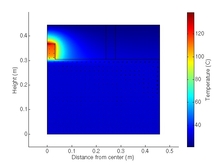
COMSOL Multiphysics is used to simulate natural convection and its impact on peak operating temperatures of solid-sate lighting in thermally adverse conditions. PDE modes in the general form are used in conjunction with a thin-surface conduction formulation in the weak form. COMSOL is ... Read More

Two finite element models have been developed to investigate the acoustic radiation from a Pratt truss train bridge. The first model was a time dependent structural model that determined the vibration response of the structure due to two wheels, representing a single axle, moving across ... Read More

Quenching from high temperature by fluid flow has been analyzed; when no phase transformation occurs heat transfer is a function of conduction and convection. Flow conditions may lead to turbulent flow that affects the heat dissipation over the surface. Analysis of heat transfer with ... Read More

The resonance conditions for surface plasmons are influenced by the type and amount of material on a surface. Full insight into surface plasmon resonance requires quantum mechanics considerations. However, it can be also described in terms of classical electromagnetic theory by ... Read More