Explore the innovative ways multiphysics simulation is being used worldwide to advance research
Multiphysics modeling and simulation drives innovation across industries and academia — as is evidenced by the many uses showcased in the technical papers and posters presented by engineers, researchers, and scientists at the COMSOL Conference each year.
Draw inspiration from the recent proceedings collected below, or, to find a specific presentation or filter by application area or conference year/location, use the Quick Search tool.
View the COMSOL Conference 2026 Collection

This paper utilizes COMSOL Multiphysics® software and the Application Builder to simulate neurological responses in nerve axons due to external electrical stimuli. The AC/DC Module of the COMSOL® software is first used to solve the Maxwell's equations. Then the results from the Maxwell's ... Read More

Permanent magnets are ubiquitous in our world today, from refrigerator magnets to industrial sensor applications. Often, the magnitude of the field at a specific distance from an arbitrarily shaped magnet of variable strength is a necessary parameter for end-use systems. We used the the ... Read More

Recent studies report problems related to premature aging and degradation of high-voltage polymeric insulators. Corona activity, which is induced in areas of high electric field levels, is considered one of the leading causes of these problems. The insulator operation under adverse ... Read More
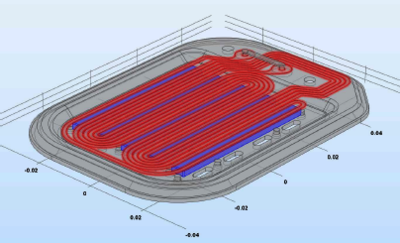
A simulation of an electrodynamic planar loudspeaker (EDPL) has been developed in this study with the COMSOL Multiphysics® software. Using the simulated model, effect of different parts has been studied to improve the performance. The locations of the coil and magnets have been obtained ... Read More

Introduction: Medical devices undergo a series of evaluations in order to determine their performance and level of safety in a magnetic resonance (MR) environment. The standard of focus for this work is ASTM F2052-15 which measures the induced displacement of a device due to the ... Read More

The finite element method was used for simulating the dielectric response of polymer matrix dielectric composites with randomly and evenly distributed fillers. The dielectric simulation of the composite materials was conducted using a time harmonic-electric current solver in the AC/DC ... Read More
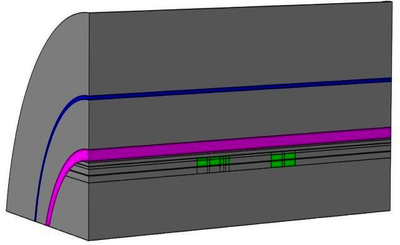
Two different Finite Element Method (FEM) models of the CANDU® nuclear fuel channels were compared against experimental data to determine if the curvature of the fuel channels is necessary to consider for measurements of the pressure tube to calandria tube gap. The different models were ... Read More

The brain is a heterogeneous porous medium with regions of anisotropy. Measurements of tortuosity (λ) showed that diffusion in gray matter (e.g. striatum) is isotropic (λ = 1.65), whereas it is anisotropic in white matter (e.g. corpus callosum) (λparallel = 1.38, λperpendicular = 1.80) ... Read More