
Explore the innovative ways multiphysics simulation is being used worldwide to advance research
Multiphysics modeling and simulation drives innovation across industries and academia — as is evidenced by the many uses showcased in the technical papers and posters presented by engineers, researchers, and scientists at the COMSOL Conference each year.
Draw inspiration from the recent proceedings collected below, or, to find a specific presentation or filter by application area or conference year/location, use the Quick Search tool.
View the COMSOL Conference 2025 Collection

The Japan Atomic Energy Agency (JAEA) is carrying out an URL (Underground Research Laboratory) project in Mizunami city, central Japan. The project is a purpose-built generic URL project that is planned for a scientific study of the deep geological environment in fractured crystalline ... Read More

Crust which develops at the surface of meat leads to reactions which affect food color, flavor and safety. Whole pieces of meat are only contaminated by microorganisms at their surface. Thus intense thermal treatment can inactivate pathogenic bacteria; however the associated high ... Read More

At the forefront of a new generation of sensors graphene and graphene composite materials are intensively studied for medical and biosensing applications. The outstanding electrical, mechanical and quantum properties of graphene make them a promising material solution to overlap the ... Read More

Integration or retrofitting of photocatalytic air purifying units into HVAC (Heating, Ventilation and Air Conditioning) equipment is an interesting approach for abating indoor air pollution and removal of volatile organic compounds. An attractive possibility is the use of glass fiber ... Read More
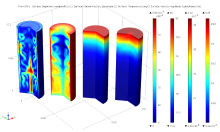
We investigate a prototype concept of a back-up electricity device where we use liquid formic acid (FA) to produce a mixture of carbon dioxide (CO2) and hydrogen (H2) which is used in a PEM fuel cell, Fig. 1. In the fluidized bed reactor the liquid FA is decomposed to a gaseous mixture ... Read More

A micro steam methane reformer is a complex product consisting of multiple units. For the virtual functional product development it is necessary to validate these sub models separately. Therefore a reactor was designed to analyse kinetics of chemical reactions. The reactor design is ... Read More

Radionuclide sorption is often simulated using a lumped approach where retention processes are represented by the distribution coefficient (Kd), which relates the radionuclide mass retained in the solid phase to its aqueous concentration. Classical Kd-based simulations rely on two strong ... Read More

Possible drawbacks of microreactors are inefficient reactant mixing due to the predominance of laminar flow and clogging (when solid-forming reactions are performed or solid catalyst suspensions are used). Ultrasound has been successfully implemented not only to prevent these problems ... Read More

The Fischer-Tropsch Synthesis (FTS) is a highly exothermic condensation polymerization reaction of syngas (CO+H2) in the presence of Fe/Co/Ru-based catalysts to produce a wide range of paraffins, olefins and oxygenates, the latter of which is often called syncrude. Multi-Tubular Fixed ... Read More
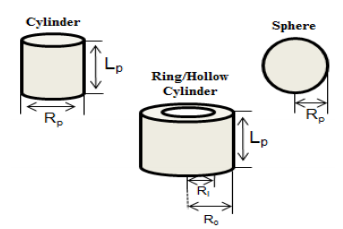
In the early 1920’s, Gas-To-Liquids (GTL) and Coal-To-Liquids (CTL) technologies were developed to account for the depleting crude oil resources [1]. During this period, Franz Fischer and Hans Tropsch developed a process to convert synthesis gas (syn gas), derived from coal ... Read More


