
Explore the innovative ways multiphysics simulation is being used worldwide to advance research
Multiphysics modeling and simulation drives innovation across industries and academia — as is evidenced by the many uses showcased in the technical papers and posters presented by engineers, researchers, and scientists at the COMSOL Conference each year.
Draw inspiration from the recent proceedings collected below, or, to find a specific presentation or filter by application area or conference year/location, use the Quick Search tool.
View the COMSOL Conference 2025 Collection
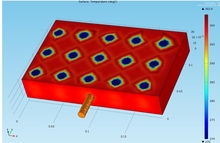
Hydrogen storage can be considered as a key factor in the development of hydrogen economy. Hydrogen storage in a magnesium hydride MgH2 is a very promising technique for numerous of reasons. Magnesium is abundant, relatively cheap, life – friendly , weight storage capacity of 7.6% ... Read More
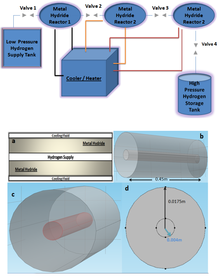
Hydrogen, the most abundant element in the universe, has great potential as an energy source, and can be generated from renewable energy sources. We used COMSOL for the solution of the energy, mass and momentum balance equations that describe the hydrogen absorption and desorption ... Read More

The Swedish Organization for Radioactive Waste (SKB) is considering disposal High Level Wastes in a deep underground repository. Bentonite clay is planned to be used in the near-field of the waste packages as buffer material. The buffer is expected to provide a favorable environment with ... Read More
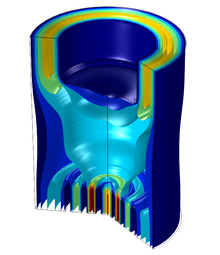
Gallium nitride (GaN) and its related nitride alloys with special physical properties are in technical areas of high interest. The growing of gallium nitride boules on non-native sapphire or silicon carbide requires complicated mechanisms of defect reduction in the lattice structure. ... Read More

This paper describes the modeling of a blood glucose sensor using COMSOL Multiphysics. Chemical species interaction and diffusion, coupled with electrochemical oxidation of multiple blood species produced a powerful working model used in developing and refining a range of blood glucose ... Read More
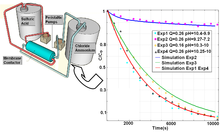
Ammonia separation from water by membrane contactor was simulated on transient state and compared with experimental data. Aqueous low concentrated solution of ammonium with high pH has been pumped inside the hydrophobic hollow fibers, acid solution in the outside part. The system is in ... Read More

Oxygen-free methane aromatization has been attracting growing attention due to a potential means for producing high valuable products such as aromatics and hydrogen. Many studies have been focused on catalysts screening and characterization, and elementary thermodynamic steps of the ... Read More
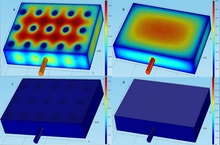
Hydrogen storage in a metal hydride bed, uses an intermetallic alloy that can absorb efficiently high amounts of hydrogen by chemical bonding resulting to metal hydrides. This alloy is capable of absorbing and desorbing hydrogen while maintaining its own structure. The heat, mass and ... Read More


