
Explore the innovative ways multiphysics simulation is being used worldwide to advance research
Multiphysics modeling and simulation drives innovation across industries and academia — as is evidenced by the many uses showcased in the technical papers and posters presented by engineers, researchers, and scientists at the COMSOL Conference each year.
Draw inspiration from the recent proceedings collected below, or, to find a specific presentation or filter by application area or conference year/location, use the Quick Search tool.
View the COMSOL Conference 2025 Collection

In this paper, we use the PDE interface of COMSOL Multiphysics® software to implement the 2.5D frequency wave-number domain method to investigate the wave propagation in a deviated borehole penetrating a transversely isotropic formation. A convolutional perfectly matched layer is ... Read More
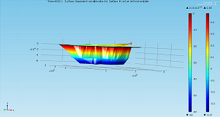
Lake Victoria is the largest tropical lake in the world and is very important for environment and economy in East Africa. The hydrodynamic processes in the shallow (40-80 m deep) water system are unique due to its location at the equator which makes Coriolis effects noticeable also for ... Read More

The Marine Controlled Source ElectroMagnetic (marine CSEM) is a geophysical method used by the oil industry to investigate resistive targets in the sediments under the ocean floor. In this work we simulate marine CSEM data including 1D, 2.5D and 3D modeling. The results obtained with ... Read More

The subsurface thermal structure in presence of groundwater recharge/discharge has been obtained by applying the Robin type boundary condition at the earth’s surface. The Robin type boundary condition involves the effect air temperatures at the surface which are taken as exponentially ... Read More

COMSOL Multiphysics® software has been used in computational geodynamics for years. Because very high pressure in the mantle even significantly compressed the mantle up to ~40%, it is crucial to consider the mantle compressibility in computational geodynamics. COMSOL Multiphysics allows ... Read More

Introduction Computer simulations are widely used for the interpretation and inversion of electromagnetic measurements in well logging. Until recently, simulated logs have been computed with approximate 1D or 2D models. By using the COMSOL® RF Module installed on a cluster, we show that ... Read More
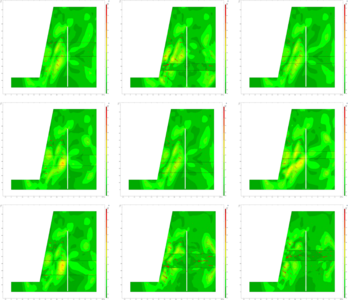
互层岩体台阶爆破中力学差异性较大的岩层影响了炸药能量的均匀分布,为了快速确定影响爆破效果的主控岩层的位置及台阶整体炸药单耗,采用数值分析的方式探讨了主控岩层对炸药能量分布特征的影响规律,实验结果表明:采用连续装药结构时力学差异性较大的夹层处质点运动速度更为集中,而间隔装药可改善台阶内速度场的分布均匀程度;由最小抵抗线原理分析发现主控岩层的厚度和力学性质是影响炸药能量传递方向的主要因素;在此基础上结合波阻抗原理,构建了考虑台阶岩体整体力学特性及各岩层局部工程特征的能耗分级体系,通过现场测试取得了良好的应用效果,验证了该方法的可行性 ... Read More
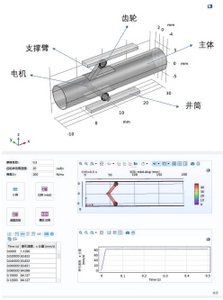
井下牵引机器人是一种安装在测井、射孔或修井工具串前端的自驱动装置,其核心作用是解决传统电缆或钻杆输送方式的局限性。其工作环境极端,给设计与可靠性评估带来了巨大挑战。传统的经验设计和单场分析方法难以准确预测其在实际井筒中的结构特性与牵引性能。本研究基于COMSOL Multiphysics多物理场仿真平台,对一款电动轮式牵引机器人进行了全流程的建模仿真与性能预测,建立了牵引机器人的几何模型,并系统性地研究了其核心物理过程。牵引机器人在运动过程中,伸缩臂可根据井筒尺寸自适应调节角度。将模型简化为二维结构,可以更直观地观察伸缩臂角度自适应调节的过程。在水平井 ... Read More
页岩储层水力压裂中的裂缝扩展行为直接影响裂缝网络形态与油气产能提升。本文基于 COMSOL Multiphysics 建立三维流固耦合压裂数值模型,模拟并分析了五类典型压裂情形:单一裂缝扩展、两簇裂缝扩展及互相干扰、三簇对称压裂、三簇完全压裂以及水平主裂缝与垂向天然裂缝相交的情形。本文首先介绍了耦合力学与孔隙流体动力学控制方程、材料与边界条件,然后引入室内实体实验参数作为模型校核(包括页岩破裂韧性、抗拉强度、弹性模量与渗透率等特性)。在 COMSOL 中采用损伤参数化的线弹性-弹塑性破裂捕捉策略,并结合能量释放率与临界应力强度因子判据来判定裂缝的起裂与扩展。数值结果显示 ... Read More
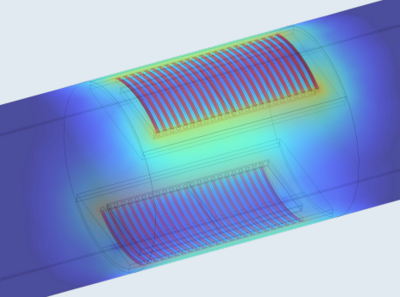
This study focuses on the design and optimization of a logging while drilling (LWD) tool with look-ahead detection capabilities, which is widely used in measuring formation resistivity and detecting formation boundaries ahead of the drill bit during oil and gas drilling operations. The ... Read More


