
See How Modeling and Simulation Is Used Across Industries
Multiphysics modeling and simulation drives innovation across industries and academia — as is evidenced by the many uses showcased in the technical papers and posters presented by engineers, researchers, and scientists at the COMSOL Conference each year.
Draw inspiration from the recent proceedings collected below, or, to find a specific presentation or filter by application area or conference year/location, use the Quick Search tool.
View the COMSOL Conference 2025 Collection

Problem Description Sorption heat storage systems are attracting growing interest due to their high energy density and loss-free heat storage capability, making them a promising solution for storing surplus solar energy in summer for use in winter in residential buildings. However, these ... Read More

Hunting Lodge St. Hubertus is one of the most prominent Dutch buildings from the early twentieth century. An extensive study of wind and wind-driven rain (WDR) was conducted to provide insight into the moisture load of the building facade, using measurements and CFD simulations. COMSOL ... Read More

A model built with COMSOL Multiphysics® to exploit meteorological forecasts and instant outdoor meteorological data (temperature, solar radiation, moisture, wind speed and direcition, etc.) together with indoor ambient data (air temperature, radiant temperature of enclosures, etc), ... Read More
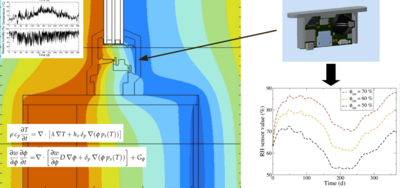
The material wood is frequently used in construction industry for several elements such as window frames. However, as a hygrothermal material, wood is sensitive to moisture induced damage. In this context, the moisture uptake of wood based windows logged with an integrated relative ... Read More
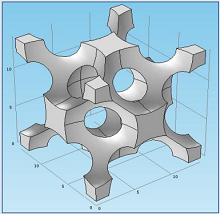
The problem of storage, and release of thermal energy is an important challenge in various industrial fields. Several systems for thermal energy storage exist like phase change materials (PCM) and thermochemical storage [1]. The first system usually addresses short term storage (day ... Read More
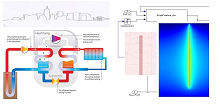
Pioneering Computational Models for the Built Environment Energy performance is becoming more important in the build environment. With better insulated buildings, the possibility of moisture problems and thermal bridges increases. There for, it is not only important to determine the ... Read More
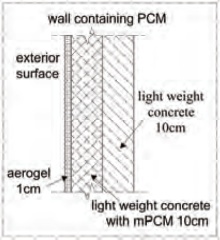
Simulation tools for building physics problems play an important role in design and understanding the behavior of energy efficient buildings. There are different tools available for simulation of these problems, but each simulation tool has its own advantages and limitations. In this ... Read More
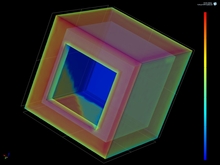
In order to predict, improve and meet a certain set of performance requirements related to the indoor climate of buildings and the associated energy demand, building energy simulation (BES) tools are indispensable. Due to the rapid development of FEM software and the Multiphysics ... Read More
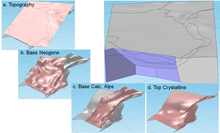
Temperature measurements of the subsurface are available due to hydrocarbon exploration in the project area, where the average drilling depth is about 2-4 km and the deepest well reaches about 8.5 km. Since the data is heavily uneven distributed, standard interpolation techniques did not ... Read More

This study examines the effect of air flow between the building integrated PV-panel and the wall. To formulate the heat exchange process for the air flowing between the PV panel and the wall, time-dependent, heat transfer partial differential equations (PDEs) are solved with COMSOL ... Read More


