
Explore the innovative ways multiphysics simulation is being used worldwide to advance research
Multiphysics modeling and simulation drives innovation across industries and academia — as is evidenced by the many uses showcased in the technical papers and posters presented by engineers, researchers, and scientists at the COMSOL Conference each year.
Draw inspiration from the recent proceedings collected below, or, to find a specific presentation or filter by application area or conference year/location, use the Quick Search tool.
View the COMSOL Conference 2025 Collection

This paper presents an Analog to Digital Microfluidic Converter (ADMC) using passive valves and enabling the conversion of a continuous liquid flow into droplets for Electro-Wetting On Dielectric (EWOD) actuation. Valves calibration, geometry characteristics and losses reduction have ... Read More
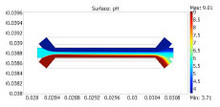
A portable device that can identify protein and peptides real time in complex biological systems such as human bodily fluids reliably and accurately is in high demand to properly diagnose and treat medical conditions. Lynntech has developed an innovative Polydimethylsiloxane (PDMS) based ... Read More

Dielectrophoresis (DEP) is a method for cell manipulation without physical contact in lab-on-chip devices, since it exploits the dielectric properties of cells suspended in a microfluidic sample, under the action of locally generated high-gradient electric fields. The DEP platform that ... Read More
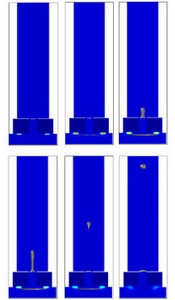
The present study investigates simulation model and droplet ejection performance of a thermal-bubble microejector. This model simulates the bubble nucleation and the bubble growth, to predict the droplet ejection process. Specificity, it is achieved by coupling an electric-thermal model ... Read More
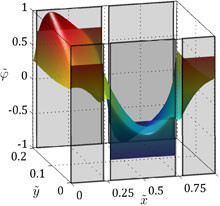
In this paper we present results of the mathematical modeling of AC electroosmotic micropumps. Unlike others we use the full dynamic description, instead of the linearized model. Skewed hybrid discretization meshes are employed in order to accurately capture the main features of the ... Read More
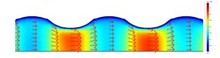
A finite element model is employed to describe the electric potential distribution and electroosmotic flow field inside a wavy cylindrical channel. The model uses coupled Laplace and Poisson-Boltzmann to evaluate the electric potential distribution inside the channel. It also contains ... Read More
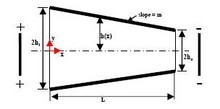
A fundamental understanding of the transport phenomena in microfluidic channels is critical for systematic design and precise control of such miniaturized devices towards the integration and automation of Lab-on- a-chip devices. Electroosmotic flow is widely used to transport and mix ... Read More

It is possible to control the motion of magnetic beads using a combination of hydrodynamic and electromagnetic forces. In this work, we investigate the possibility to manipulate the motion of beads with different magnetic moments in a special microfluidic structure so as to separate ... Read More

The mixing characteristics and residence time distributions (RTDs) of a staggered herringbone microchannel have been investigated numerically by COMSOL Multiphysics and by particle tracking algorithms that incorporate diffusion via a random walk. All simulations were validated with ... Read More
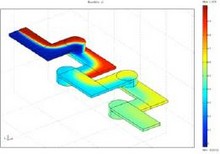
The mixing of liquids was characterized in thirteen different microfluidic devices. The goal was to characterize, in a uniform manner, the flow and mixing that occurred in slow, laminar flow and to present the results that allow quick designs. The mixing of a dilute chemical in another ... Read More


