Explore the innovative ways multiphysics simulation is being used worldwide to advance research
Multiphysics modeling and simulation drives innovation across industries and academia — as is evidenced by the many uses showcased in the technical papers and posters presented by engineers, researchers, and scientists at the COMSOL Conference each year.
Draw inspiration from the recent proceedings collected below, or, to find a specific presentation or filter by application area or conference year/location, use the Quick Search tool.
View the COMSOL Conference 2026 Collection
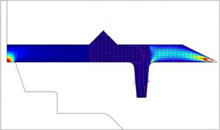
In this work we tackle a more theoretical aspect of micro-injection molding, to better understand physics during the process, through numerical simulations of cavity filling. We developed a two phase flow approach by the use of COMSOL Multiphysics®. In a first step, a Level Set model is ... Read More

There is a requirement for an RF (Radiofrequency) industrial dryer that will be capable of dehydrating foodstuff to the correct level after the product has been fried. RF drying should actively target moisture, due to waters high dielectric properties. An industrial dryer can be ... Read More

The understanding of quench, or the sudden transition to the normal state of a high-current Superconductor (SC), is fundamental for the design of a SC magnet, and it is widely discussed in the literature. This paper presents some simple COMSOL models, which are compared with well-known ... Read More
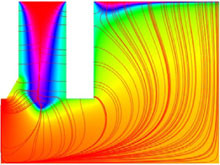
In this paper, we present the numerical modelling of a free-burning arc and its application to the understanding of optical mirage effect which could occur in a TIG (Tungsten Inert Gas) device used in welding applications. Read More
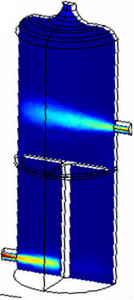
Non-thermal plasma, generated in atmospheric pressure discharges, has been investigated in our laboratory in order to treat highly diluted (300 ppm to 1000 ppm) volatile pollutant. The collision of electrons created in the discharge with atmospheric air, leads to the formation of ... Read More
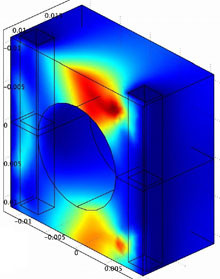
The development of powerful negative ion sources requires precise and versatile simulation tools to predict the emittance of the extracted ion beams and the heat load on the electrodes. A first tool is a determination of the plasma beam interface which is accomplished by a set of macro ... Read More

The aim of the proposed device is to overcome the typical drawbacks of MHD generators, such as the needed of a very high external magnetic field, the strong dependency of the efficiency by the temperature of the fluid, and the deterioration of the electrodes that are in contact with the ... Read More
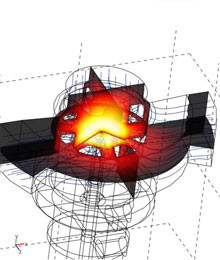
After previous microwave simulations done with very hard assumptions, we improve the model by using Funer model to improve prediction of plasma effects on the microwave coupling. Some parameters are still not well known and are used as adaptation parameters. An experience plan technique ... Read More